
Parma Day Trip from Milan: Food, Frescoes and Correggio by Train
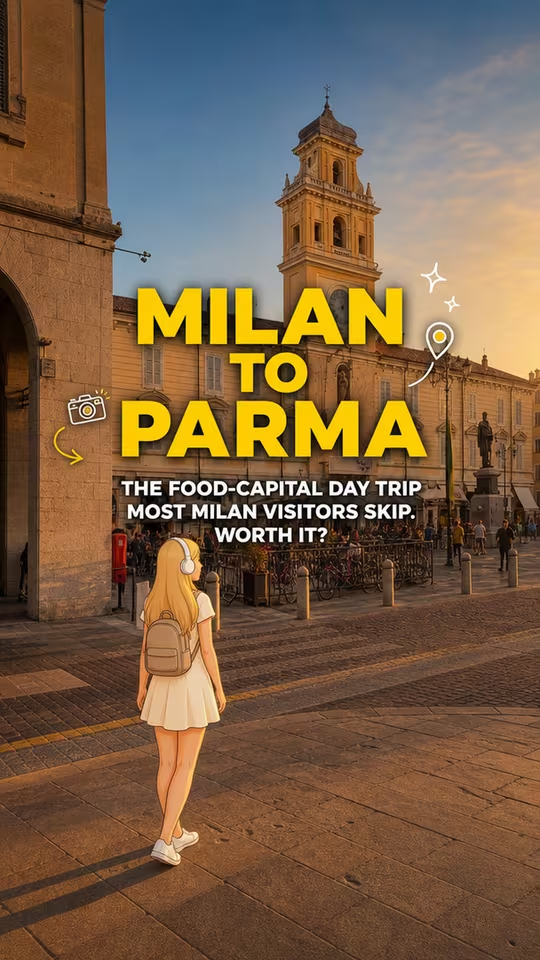
A Frecciarossa lifts you out of Milano Centrale and drops you 51 minutes later in the capital of the Food Valley. Step off, walk fifteen minutes into the centre, and let our free self-guided tour thread the cathedral, the Baptistery, the Pilotta and Correggio's two great frescoed ceilings into one clean loop.
The Quick Answer: Milan to Parma
A Parma day trip from Milan is one of the most satisfying short hops you can take out of this city, and the easiest to plan. A direct Frecciarossa leaves Milano Centrale roughly every hour, takes 51 minutes, and puts you at Parma station from about €8 one-way if you book ahead. The regional train takes 1h20 to 1h38, costs from around €8 too, and never needs advance booking. From the station it is a flat fifteen-minute walk south into the historic centre, and once you are there almost nothing worth seeing sits more than a fifteen-minute walk from anything else. You do not need a car, you do not need to plan a route, and the two things you came for, the food and Correggio's frescoes, are both right there.
| Question | Short answer |
|---|---|
| How far is Parma from Milan? | 126 km southeast. 51 min by Frecciarossa, 1h20 to 1h38 by regional train. |
| Cheapest way there? | Regional train (Regionale Veloce), from around €8 one-way. Fixed price, no advance booking needed. |
| Where do trains leave from? | Milano Centrale, direct, no changes. Frecciarossa roughly hourly. |
| How do I reach the centre? | Walk 15 min south from Parma station to Piazza del Duomo / Piazza Garibaldi. Flat the whole way. |
| How long do I need? | One full day is ideal. The headline loop takes 4 to 5 hours; food and the Pilotta easily fill the rest. |
| Is it worth it? | Yes. The food capital of Italy, two world-class Correggio ceilings and almost no crowds. |
Is the Milan to Parma Day Trip Worth It?
Parma earns its train ticket more cleanly than almost any other Milan day trip, and it does so for one specific reason: this is the home of Parmigiano Reggiano and Prosciutto di Parma, a UNESCO City of Gastronomy since 2015, and a place where almost everything that matters fits inside a fifteen-minute walk. The centre is flat, compact and almost empty of tourists compared with Milan, Bologna or Lake Como. You can stand under Correggio's Assumption in the cathedral dome with two other people and no queue, walk three minutes to the Camera di San Paolo and have a Correggio frescoed room to yourself, then sit down to tortelli d'erbetta and a glass of Lambrusco for less than a basic lunch costs in the Brera district. People who come for a day routinely say it was the best day of their Italian trip.
The best of Parma, stop by stop


It suits a particular traveller. If you care about food, painting, walkable old quarters and the absence of crowds, this is your day. If you came for spectacle, big-city energy or nightlife, Milan already has all of that and Parma will feel sleepy. Two honest warnings. The headline food factories, the Parmigiano and Prosciutto di Parma caseifici, are in the countryside outside town and eat five to six hours on their own, so do not try to do both the factories and the city in one day. And if you have only one day-trip slot and want maximum drama per kilometre, Lake Como's mountains will outperform Parma's quiet brick piazzas. Pick Parma for food and frescoes, not for fireworks.
You want the best eating day trip you can take from Milan. [yes] You like the idea of two world-class Correggio ceilings and a pink-marble baptistery with no crowds. [yes] You would rather walk a real working Italian town than queue for a museum. [no] You only have three or four hours total. The transit eats the day. [no] You came for alpine spectacle, nightlife or headline sights.
Good fit if you...
- Care about Italian food at the source, from culatello to Lambrusco
- Love painting and want to see where Baroque illusionism began, in person
- Prefer quiet, wealthy, well-kept provincial towns over tourist honeypots
- Want a flat, walkable day with no car hire, no ZTL cameras and no mountain roads
Skip it (save Parma) if you...
- Have only a half day. The two-hour round trip on regional trains eats the margin
- Came specifically for a Parmigiano factory tour. The dairies are out in the countryside, not in town
- Need big-name spectacle, mountains or a famous skyline
- Are travelling with someone who treats a long lunch as wasted time
How to Get from Milan to Parma by Train
The train is the answer. Milano Centrale to Parma is a single straight shot on the Milan-Bologna high-speed line, and the regional train runs parallel on a slightly slower route. Both are cheap for northern Italy. The bus exists, leaves from San Donato M3 or Lampugnano, takes 1h24 to 1h45 and costs from €6.98, but it runs only four times a day and is rarely worth the detour to a different Milan station. Driving is 1h15 to 1h30 on the A1 motorway, and the only honest reason to do it is if you are combining the city with a cheese or ham dairy in the countryside. Otherwise the historic centre is a ZTL with camera-enforced no-entry zones, and you will end up parking in a multi-storey on the edge and walking, exactly as if you had taken the train.

| Mode | Time | Cost (each way) | Frequency | Verdict |
|---|---|---|---|---|
| High-speed train (Frecciarossa / Italo) | 51 min | from €8 to €16 | roughly hourly, ~06:00 to ~22:00 | WINNER. Direct from Centrale, downtown to downtown, fastest option. |
| Regional train (Regionale Veloce) | 1h20 to 1h38 | from around €8 | frequent through the day | WINNER on budget. Fixed price, no advance booking, only ~15 min slower. |
| Bus (FlixBus) | 1h24 to 1h45 | from €6.98 | 4 daily | Cheap, but infrequent and slower than the train. From San Donato M3 or Lampugnano, not Centrale. |
| Car (A1 motorway) | 1h15 to 1h30 | ~€15 fuel and tolls, plus parking | anytime | Only worth it for a factory tour in the countryside. The centre is a ZTL. |
| Rideshare (BlaBlaCar) | ~1h15 to 1h30 | €7.49 to €9.99 | ~56 seats/day advertised | Cheapest of all, but timing is unpredictable. |
Take the train. High-speed if you book a week ahead, regional if you do not. Both win.
The Train in Detail
Trenitalia's Frecciarossa and Italo share the Milan to Parma corridor, and both run direct from Milano Centrale to Parma in 51 minutes. Frecciarossa departures start around 06:00 and run roughly hourly until late evening, with the last service back from Parma around 21:30 to 22:00. Italo's promotional fares start at around €11.40 one-way if you commit early. Frecce standard second-class fares move with demand: pay from about €8 if you book a week or two out, anything from €12 to €16 if you book on the day. There is no reason to book first class for a 51-minute hop.
The regional train is the budget traveller's hack. A Regionale Veloce makes the same run in 1h20 with a few intermediate stops, the standard Regionale in up to 1h38. Both cost from around €8 one-way, the price is fixed by distance, and buying on the day at the station machine costs exactly the same as buying weeks ahead. It only adds about fifteen minutes over the Frecciarossa and removes every drop of booking stress. If you are doing this as a spontaneous day trip, take the regional. If you know your dates, the Frecce at €8 booked ahead is the best deal in northern Italy.
Two practical things matter more than the timetable. First, regional tickets are open: stamp a paper ticket in the green platform machine before boarding, or activate a digital one in the Trenitalia app, every time. An unvalidated regional ticket counts as no ticket and the fine is many multiples of the fare. Second, sit on the right-hand side heading south out of Milan on a clear day. The line crosses the Po plain, and as you approach Parma the slow rise of the Apennine foothills forms on the horizon. Parma station is small, well-signed, and a flat fifteen-minute walk south to Piazza Garibaldi and the centre. No luggage storage at the station: use the Nannybag app or a shop in the centre for around €6 per bag.
Frecciarossa or regional, which to book?
If you know your dates a week or more ahead, book the Frecciarossa. The €8 advance fare on the 51-minute service is unbeatable. If you do not want to commit to a specific train, or you are reading this the night before, take the regional. The fixed €8 fare means no pricing games, and losing fifteen minutes each way is irrelevant on a day trip with twelve usable hours on the ground.
| Frecciarossa / Italo | Regional train | |
|---|---|---|
| Price each way | from €8 advance, €12 to €16 walk-up | from around €8, fixed |
| Time | 51 min direct | 1h20 to 1h38 |
| Booking | reserve a seat, book ahead for best price | open ticket, no reservation, fixed price |
| Verdict | WINNER for speed and comfort if booked ahead | WINNER for spontaneity and budget |
Booking Strategy
Two different games, depending on which train you pick. For Frecciarossa or Italo, price moves with demand: book on trenitalia.com or italotreno.com one to two weeks out for the €8 promo fares, and the same ticket can be €16 or more bought on the day. For the regional train there is no game. The fare is set by distance, advance booking gives no discount, and buying at the station machine ten minutes before departure costs the same as buying a month ahead. Pick your strategy based on whether you can commit to a time.
There is no Parma-specific rail pass worth buying. The standard Italian rail passes and any Interrail one-country pass work on Trenitalia Regionale without a supplement, and on Frecce with a €10 supplement plus a mandatory reservation. For a single day trip, two ordinary singles beat every pass.
Booking checklist
- For Frecciarossa or Italo, book on trenitalia.com or italotreno.com at least a week ahead to land the €8 promo fare.
- For regional trains, buy at the Centrale machine or in the Trenitalia app on the day. No saving for booking ahead.
- Stamp a paper regional ticket in the green platform machine, or activate the digital one in the app, before boarding.
- Aim for a train that lands you in Parma by 08:30 to 09:30. Churches open by 7:45 and close 12:00 to 15:00, so early arrival pays.
- Plan the return for around 19:00 to 21:00. The last Frecciarossa leaves Parma around 21:30 to 22:00; do not push it.
Parma in One Day
You step off at Parma station, walk fifteen minutes south through the Oltretorrente or down Via Mazzini, and you do not need a plan. Open our free self-guided Parma tour in your browser the moment you reach the centre. There is nothing to download. A voice guide greets you, starts walking with you, tells the story between the sights and asks what you want to see next. It is a real conversation with step-by-step navigation, not a recording and not a Q&A bot. So instead of standing on Piazza Garibaldi squinting at a paper map, you start the loop and let the tour handle the order, the opening hours and the stories behind Correggio, Antelami and Verdi. It begins from any stop, runs in any direction, and you can drop in and out as you please.

The time math
Catch a train that puts you in Parma by 08:30 to 09:30 and the whole day opens up. The headline loop of cathedral, Baptistery, Camera di San Paolo and the Pilotta takes four to five hours at a relaxed pace. Add a long lunch of tortelli d'erbetta and culatello, a glass of Lambrusco on Strada Farini during the evening passeggiata, and you have comfortably filled eight to ten hours on the ground. The last Frecciarossa back to Milan leaves Parma around 21:30 to 22:00, so even a slow dinner is on the table. The single rule that ruins more Parma days than any other: churches, including the cathedral, close from 12:00 to 15:00. Hit Piazza del Duomo in the morning or in the late afternoon, never over lunch.
What you'll see
Parma stacks its sights into a tight corner of the historic centre, and the two biggest names, the cathedral and the Baptistery, sit on the same square. This is the must-do shortlist, with what you actually pay:
- Parma Cathedral (free, daily 7:45 to 12:00 and 15:00 to 19:20): the Romanesque Duomo with Correggio's 1530 Assumption of the Virgin swirling across the dome. Bring a few €1 coins for the light meter.
- Baptistery of Parma (€12 combined with Diocesan Museum, daily 10:00 to 18:00): Benedetto Antelami's pink Verona marble octagon, the hinge between Romanesque and Gothic, with month-by-month carved reliefs inside.
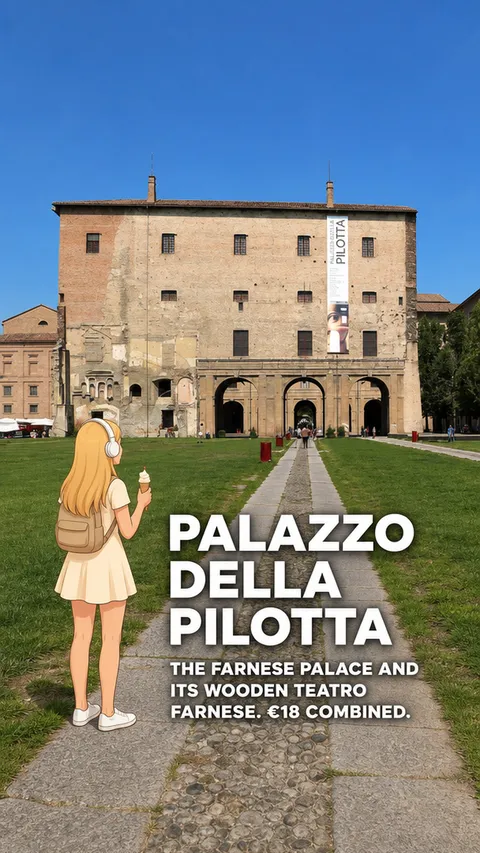
- Palazzo della Pilotta (€18 combined ticket, Tue to Sun 9:00 to 19:00, closed Mon): five museums in one vast Farnese complex, including the all-wood Teatro Farnese and the National Gallery with Correggio, Parmigianino and Leonardo's La Scapigliata.
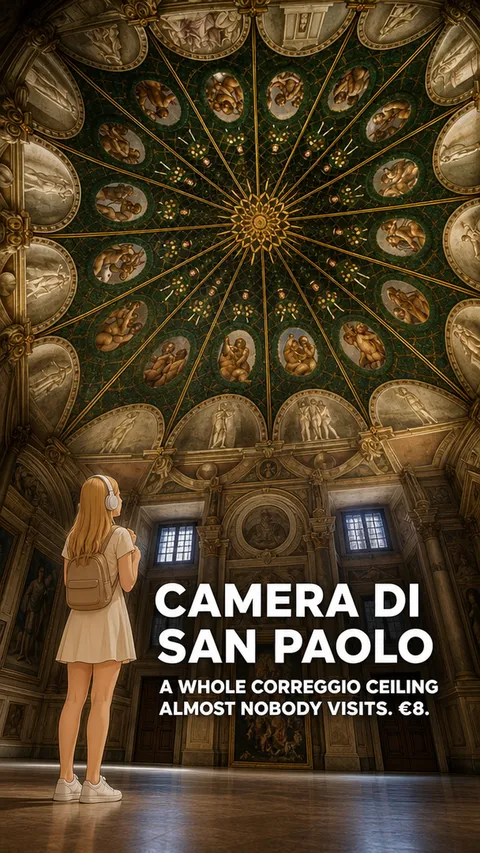
- Camera di San Paolo (€6 to €8, Mon to Sat 13:10 to 18:20, closed Sun and holidays): a single frescoed room in the former San Paolo convent where the young Correggio painted an illusionistic pergola in 1519. Almost always empty.
- Teatro Regio di Parma (guided tours ~€5 to €8, daily every hour 9:30 to 12:30 and 14:30 to 17:30, closed Mon): the neoclassical opera house where the Parma audience is famously the most demanding in Italy. Verdi's home temple.
- Parco Ducale (free, daily 7:00 to 20:00): a 208,000-square-metre ducal garden across the torrente, the perfect calm start or the evening aperitivo end.
- Strada Farini (free, always open): the pedestrian spine running south off Piazza Garibaldi, the street where Parma actually lives. Walk it after 18:00 for the passeggiata.
- Piazza Garibaldi (free, always open): the city's living room, on the site of the Roman forum, with the yellow Palazzo del Governatore and its solar sundial.
The route the tour walks with you
The tour starts from any stop, so you never have to backtrack, and it follows the order that makes sense on foot rather than the order a guidebook lists alphabetically. The Parma loop solves one specific problem: the historic centre is split by the torrente Parma, and the temptation is to cross it twice. The tour threads the sights as a single loop from the calm west bank, across the river, through the opera house, the main square, the cathedral piazza, the Camera, and the Pilotta, then back. No street gets walked twice if you do not want it to.
- 1Parco Ducale Free · open 6:00 to midnight
Start on the calm west bank. A 208,700-square-metre ducal garden of gravel avenues, clipped hedges and a central fountain pool, where locals jog and walk dogs before the city wakes. Walk the main axis toward the river, then cross on Ponte Verdi. Twenty unhurried minutes, and the reason the loop leads with it rather than ending here exhausted.
- 2Teatro Regio di Parma ~€5 tours · closed Mon
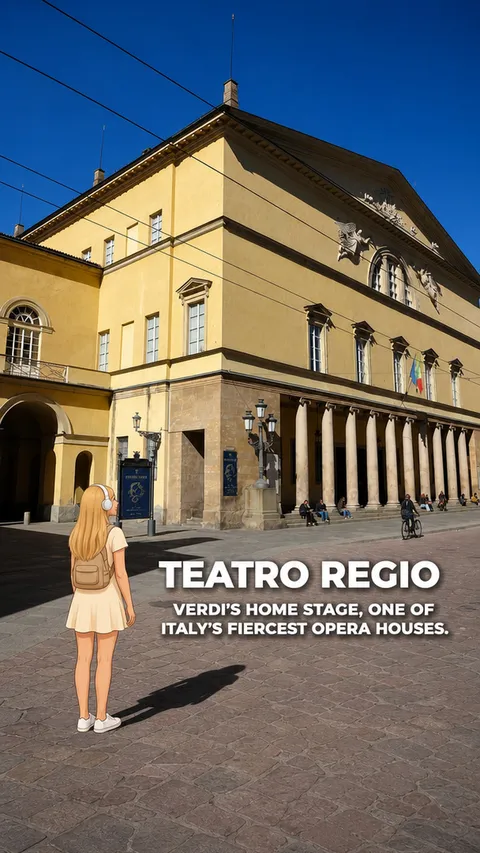
Cross the bridge and the pale neoclassical facade appears on Strada Garibaldi. For opera people this is hallowed ground alongside La Scala and La Fenice, founded by Maria Luigia and forever bound to Verdi, who was born nearby. The Parma audience is famously merciless and singers still fear this stage. Tour the red-and-gold horseshoe auditorium, or just admire the facade and move on.
- 3Piazza Garibaldi Free
The living room of Parma, on the site of the old Roman forum and the crossroads of the two main Roman roads. The Palazzo del Governatore with its clock and sundial faces the square, the statue of Garibaldi stands in the middle. The natural place to pause, get your bearings, and watch the city go about its day. Sit ten minutes with an espresso.
- 4Strada Farini Free
Runs south off Piazza Garibaldi, and it is where Parma actually lives. By day a pedestrian street of wine bars, salumerie and cafes; from around 18:00 it becomes the passeggiata, when half the city comes out to walk, drink an aperitivo and be seen. Stop at an enoteca for a glass of Lambrusco, the local fizzy red, paired with culatello and Parmigiano.
- 5Baptistery of Parma €12 · daily 10:00 to 18:00
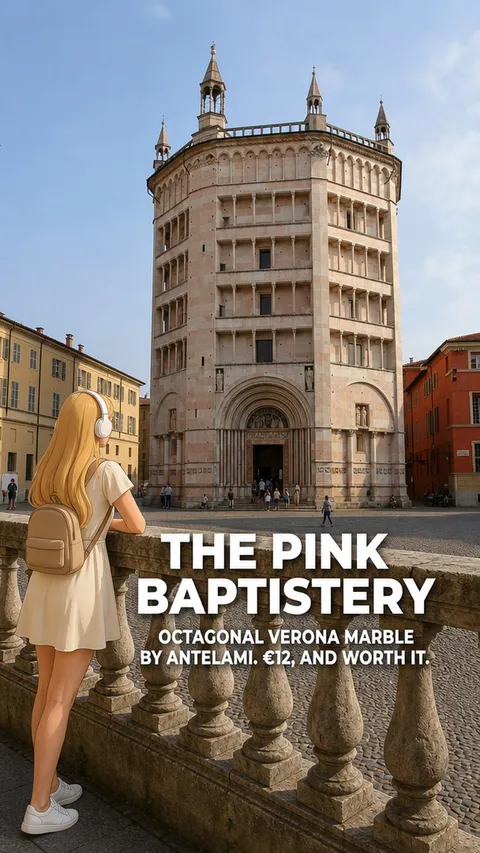
Turn into Piazza Duomo and the Baptistery stops you cold: an octagonal tower of pink Verona marble by Benedetto Antelami, the hinge between Romanesque and Gothic. Inside, the cupola is painted in concentric rings of medieval frescoes and Antelami's carved month-by-month reliefs ring the walls. The inside is genuinely better than the outside, which is saying a lot. Look up the moment you enter and let your eyes adjust.
- 6Parma Cathedral Free · 7:45 to 12:00, 15:00 to 19:20
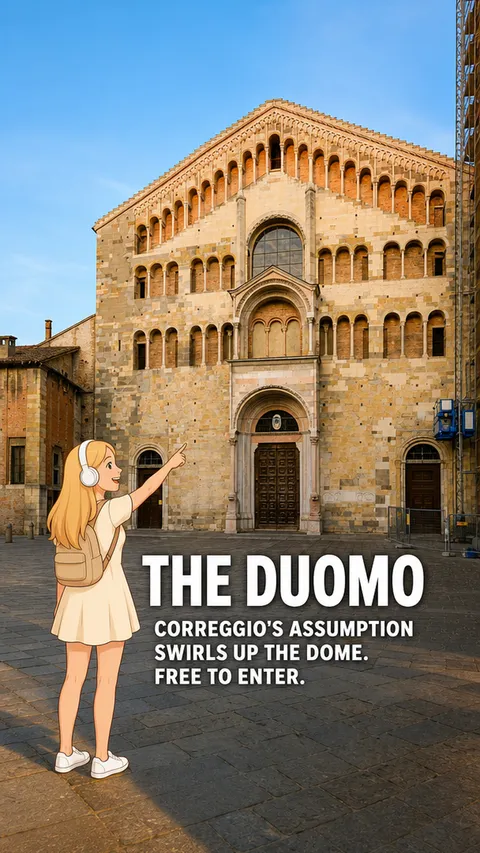
Right beside the Baptistery, a plain Romanesque gabled facade that gives nothing away. Walk to the crossing, look straight up into the dome. That swirl of figures spiraling toward heaven is Correggio's Assumption of the Virgin, painted in the 1520s, the fresco that rewrote how painters handled illusion and movement on a ceiling. Consecrated 1106, free to enter, working church. Bring coins for the light meter.
- 7Camera di San Paolo €6 to €8 · closed Sun, holidays
The stop most visitors miss, which is precisely why it is here. A single frescoed room in the former Benedictine convent of San Paolo, where the young Correggio, a few years before the cathedral dome, turned a vaulted abbess's chamber into an illusionistic pergola of vine trellises with playful putti peeking through ovals. Intimate, strange, almost always quiet. Fifteen peaceful minutes. Note the hours: closed Tuesdays in some sources, Sundays in others, so check before you commit.
- 8Palazzo della Pilotta €18 · Tue to Sun 9:00 to 19:00
The Pilotta closes the loop, a vast unfinished brick fortress-palace of the Farnese dukes facing Piazza della Pace by the river. The name comes from pelota, the Basque ball game Spanish soldiers played in its courtyard. Inside: the National Gallery with Correggio, Parmigianino, Leonardo, Canaletto and El Greco, plus the jaw-dropping all-wood Teatro Farnese, a Baroque theater rebuilt after wartime bombing. This is your time-sink stop. Budget at least 90 minutes, and stay until closing if the painting grabs you.
It runs in your browser, no app and no download. A voice guide walks the loop with you and leads a real conversation as you go: it greets you, tells the story between stops, asks what you actually want to see, and adapts. It is not a recording and not an audioguide. The map and step-by-step navigation get you from each stop to the next.
Insider Tips for the Parma Day Trip
Do
- Do the churches first thing in the morning. The cathedral and Baptistery close 12:00 to 15:00, so hit Piazza Duomo by 10:00 or save it for late afternoon
- Buy the €18 Pilotta combined ticket. Five museums, including the wooden Teatro Farnese, the best value in town
- Reserve popular restaurants like Officina Alimentare Dedicata or Cocchi at least two days ahead. They fill up
- Walk Strada Farini after 18:00, not at noon. The passeggiata is half the experience
- Eat torta fritta with salumi as your opener everywhere. It is the local ritual
- Bring flat shoes with grip. The centre is flat but paved in stone setts and cobbles around Piazza Duomo
Don't
- Do not try to combine the city with a Parmigiano or Prosciutto factory tour in one day. The dairies eat five to six hours on their own
- Do not drive into the historic centre. ZTL cameras will post you a fine months later
- Do not save the Pilotta for a Monday. It is closed, along with the Teatro Regio
- Do not call the torrente Parma a river, especially in autumn. Locals will correct you
- Do not skip the Camera di San Paolo just because it is one room. It is the most peaceful fifteen minutes in Parma
Luggage
Parma station has no left luggage. If you arrive with bags, use the Nannybag app or drop them at a partner shop in the centre for around €6 per bag. The whole day-trip loop is comfortably walkable with a small daypack, but a full suitcase will make the cathedral and the Pilotta a misery.
Buffer
Build a fifteen-minute buffer into your return. Parma station is small and well-signed, but the regional trains are unreserved and a packed service on a Sunday evening can leave you standing to Milan. If your schedule is tight, take an earlier Frecciarossa with a reserved seat.
Validate regional train tickets before boarding. Stamp a paper ticket in the green platform machine or activate the digital one in the Trenitalia app. An unvalidated regional ticket counts as no ticket, and the on-train fine is many multiples of the €8 fare.
More day trips from Milan
Out in the morning, back in time for dinner. Every route here fits in one full day.
What the Milan to Parma Journey Feels Like
The trip has a rhythm to it. The train slides out of Milano Centrale and across the flat Po plain, and after about half an hour the brick towers and rooftops of a small wealthy Italian city rise out of the haze. Parma station is small and human-scale, and the moment you walk out the door the air smells different: slower, less petrol, more bakery. The walk south into the centre takes you past everyday streets, not a tourist corridor, and within fifteen minutes the city opens out into Piazza Garibaldi, where the statue of Garibaldi stands in front of the yellow Palazzo del Governatore and old men sit at cafe tables arguing about opera.
Then the sticky moments people carry home. The first look up into Correggio's Assumption in the cathedral dome, when the ceiling seems to dissolve into a swirl of clouds and angels and you understand why the clergy supposedly asked for their money back. The pink-marble Baptistery glowing deeper rose in late afternoon sun, framed against the cathedral's pale stone. The Camera di San Paolo at noon, completely empty, the painted pergola overhead almost real enough to walk under. A plate of culatello and Parmigiano on Strada Farini at 18:30, when half the city is out walking and the Lambrusco in your glass is the same fizzy red the locals have been drinking for centuries. And the Parco Ducale at golden hour, leaves turning orange in autumn, the daMAT cafe pouring an aperitivo, before the short Frecciarossa ride back to Milan and the feeling that you have been somewhere quieter, older and better fed than the city you left that morning.
Milan to Parma: Your Questions Answered
How long is the train from Milan to Parma?
The Frecciarossa or Italo high-speed train takes 51 minutes from Milano Centrale, direct with no changes. The regional train takes 1h20 to 1h38 with intermediate stops.
How much does the train cost?
A Frecciarossa second-class fare runs from about €8 booked a week or two ahead to €12 to €16 bought on the day. The regional train costs from around €8 one-way, fixed by distance, with no advance-booking discount.
Do I need to book the train in advance?
For the Frecciarossa, yes, if you want the promo fares. Book on trenitalia.com or italotreno.com a week or more ahead. For the regional train, no. The price is the same on the day, just stamp the ticket in the green platform machine before boarding.
Is one day enough for Parma?
Yes, comfortably. The historic centre loop takes four to five hours, and a full day lets you add the Pilotta at leisure, a long lunch, and the evening passeggiata on Strada Farini. Most visitors say one day is the sweet spot.
Can I visit a Parmigiano Reggiano dairy on a day trip?
Yes, but not in the same day as the city. The caseifici are in the countryside outside Parma and a combined tour of a cheese dairy and a Prosciutto di Parma ham producer eats five to six hours. If the factory is your priority, rent a car or book a dedicated food tour, and save the city for another trip.
What should I eat in Parma?
Tortelli d'erbetta, pasta filled with ricotta, spinach and Parmigiano and drowned in melted butter. Torta fritta, fried dough rectangles wrapped around slices of Prosciutto di Parma and culatello. Anolini in brodo, small pasta discs in capon broth. And Lambrusco, the local light sparkling red, with everything. Reserve a table at Officina Alimentare Dedicata, Cocchi or I Tri Siochett at least two days ahead.
Is Parma cheaper than Milan?
Noticeably. Lunch at a proper osteria runs €25 to €35, a glass of Lambrusco at a Strada Farini enoteca is a few euros, and the cathedral and both main squares are free. The Pilotta at €18 for five museums is the best value ticket in the city.
Can I visit Parma on a Sunday or Monday?
Yes, with caveats. On Mondays the Pilotta and the Teatro Regio are both closed, so plan the paid interiors around that. On Tuesdays some sources list the Camera di San Paolo as closed, others say it shuts on Sundays and holidays; check the current hours before you commit. Sundays are lively for the passeggiata but restaurants book up, so reserve.
Is Parma safe to walk around?
Very. Parma is a wealthy, well-kept provincial city and the centre feels calm day and night, including during the evening passeggiata. Normal big-city precautions apply around the station. The main risk is sitting down at an unmarked restaurant and overpaying, so check prices before you order.
Plan Your Parma Day Trip
Take the early Frecciarossa from Centrale, walk the fifteen minutes into the centre, and let the tour do the planning. The free self-guided Parma tour runs in your browser with nothing to install: it greets you, walks the loop with you from the Parco Ducale to the Baptistery, the cathedral, the Camera di San Paolo and the Pilotta, tells the story between the stops, and adapts as you go. It is a real conversation with step-by-step navigation, not an audioguide and not a recording, and it starts from any stop with 100 free credits. Open it the moment you reach Piazza Garibaldi, and your only job is to look up.
