
Brescia Day Trip from Milan: Trains, Time, What to See
The fast train runs Milano Centrale to Brescia in 37 minutes, the regional from €7.40. Step off in the centre, open our free self-guided voice tour, and it walks you through two UNESCO sites, a Roman temple and a hilltop castle.
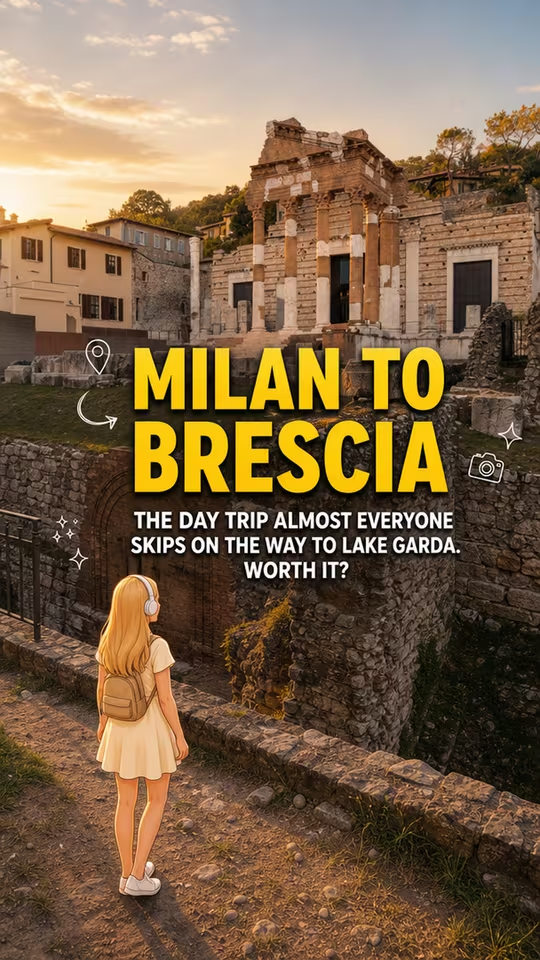
The Quick Answer: Milan to Brescia
Brescia is the easiest serious day trip you can take from Milan, and the one most travellers never make. The fast train covers the 88 kilometres east in about 37 minutes, the cheap regional in roughly an hour, and you land a short walk from a compact old town stacked with two UNESCO sites, a reconstructed Roman temple, a thousand-year-old round cathedral, and a hilltop castle with the best view in Lombardy. Almost everyone rides this exact line straight through on the way to Lake Garda or Verona. That is the whole reason Brescia stays uncrowded and worth your day.
| Question | Short answer |
|---|---|
| How long is the trip? | 36–38 min by Frecciarossa or Italo, about 66 min by Trenord regional |
| What does it cost? | From €7.40 each way on the regional, €15–35 each way on the fast train if booked ahead |
| How often do trains run? | High-speed roughly every 30 min, regional roughly hourly |
| Do I need to book ahead? | No for the regional (fixed fare), yes for the cheap Frecce and Italo seats |
| Is one day enough? | Yes. The centre is flat and small, with roughly 5–6 hours on the ground from a sensible start |
| Best day to go? | Tuesday to Sunday. The two paid highlights both close on Monday |
Is the Milan to Brescia Day Trip Worth It?
Yes, with one honest caveat. The train from Milan ringfences Brescia with industrial suburbs, so the first impression from the station is unremarkable. Push past it, walk five minutes into the old town, and the city changes character completely. Within a few hundred metres you have a Roman temple, a Lombard monastery, two cathedrals side by side, and a Renaissance square that looks more Venetian than Lombard. The recurring surprise for anyone who comes is how much there is, and how little of it is crowded. Locals still outnumber visitors in the piazzas, prices stay modest, and the heavy sights are stacked close enough to walk in a single loop.
The best of Brescia, stop by stop


The case against is narrow but real. Brescia is a city, not a resort, so if you came to Italy for lakes, beaches or postcard hill towns, it will feel urban. It will not out-icon the Colosseum or the Uffizi either. And the draws are mostly archaeological and architectural, so a traveller with no interest in Roman history or museums will get less from it than a culture-first one.
You already did Milan and want a lived-in Italian city instead of another museum queue.
You like Roman ruins and Renaissance squares without Florence-level crowds.
You came for lakes and beaches. Brescia is a working city, not a resort town.
You only want the marquee icons. Brescia is a slow burn, not a headline.
Good fit if you...
- Want Roman, medieval and Venetian layers in one walkable centre
- Prefer locals over tour groups and modest prices over Milan markups
- Are happy self-guiding a flat loop with one short hill
- Already know Milan and want somewhere genuinely different
Skip it (save Brescia) if you...
- Have only a few hours and want a lake or a famous icon
- Have no appetite for museums or archaeology
- Need everything in English (Brescia speaks less of it than Milan)
- Are travelling Monday, when both UNESCO highlights are shut
How to Get from Milan to Brescia by Train
Every sensible route from Milan to Brescia runs along the same Milano-Venezia rail corridor, and the train wins outright. There is no scenery argument for driving and no price argument for the bus, because the regional train already undercuts both on cost and convenience. The only real decision is which train: the cheap regional that runs hourly with no booking, or the high-speed Frecciarossa and Italo services that halve the time for a higher, bookable fare.
| Option | Time | Price each way | Frequency | Verdict |
|---|---|---|---|---|
| Regional (Trenord) | ~66 min | from €7.40, fixed | ~hourly | WINNER. Cheapest, no reservation, same fare all day. The default. |
| High-speed (Frecciarossa / Italo) | 36–38 min | €15–35 early, more last-minute | every ~30 min | Fastest. Worth it booked ahead or when the half-hour matters. |
| Bus (FlixBus) | ~1h 15 | from €7.98 | 3 per day | No real edge over the train, and leaves from Lampugnano, not Centrale. |
| Car (A4 motorway) | 40–65 min | tolls + fuel, plus parking grief | n/a | Unnecessary. ZTL limits and paid parking make the centre a hassle. |
The honest local line on driving: do not bring a car into the centre. Parking is mostly paid, the few free lots fill, and the historic core is a restricted-traffic zone. If you must drive, leave the car at a metro park-and-ride on the edge and ride one stop in. For a day trip from Milan, that is effort the train spares you entirely.

The Train in Detail
All trains leave from Milano Centrale and arrive at Brescia station, on the south edge of the centre. From there it is a flat 10-minute walk north to Piazza della Vittoria, or one stop on Brescia's single metro line to Vittoria station, dropping you in the middle of the old town. The metro runs until around midnight on weekdays and 1am on Saturdays, so an evening return is easy to time.
Two operators matter. Trenord runs the regional trains, which are the budget backbone: a fixed €7.40 second-class fare that never changes with demand, no seat reservation, and a roughly hourly service from early morning to late. Trenitalia runs the Frecciarossa and Frecciargento high-speed trains, and Italo is a separate private operator on the same line. The Freccia and Italo services cover the run in 36 to 38 minutes against the regional's 66, but their fares move with demand: cheap if you book weeks out, expensive if you walk up on the day.
Regional or Frecciarossa, which to book?
| Regional (Trenord) | High-speed (Frecciarossa / Italo) | |
|---|---|---|
| Time | ~66 min | 36–38 min |
| Price | from €7.40, fixed all day | €15–20 early, up to €40–110 last-minute |
| Booking | turn up and go | book ahead to lock the low fare |
| Best for | budget, flexibility, last-minute plans | speed, fixed timings, comfort |
The simple rule: if you are buying tickets at the station on the day, take the regional, because it is far cheaper than a walk-up Freccia and only half an hour slower. If you can plan and book a few weeks ahead, a low-fare Frecciarossa at €15–20 is a genuinely good deal for the time saved. For a relaxed day trip where you are sightseeing anyway, the extra half-hour on the regional costs you nothing but money saved.
Booking Strategy
The booking question only applies to the fast trains. Regional fares are fixed, so there is no advantage to buying a Trenord ticket early: grab it from a machine or the app on the day, validate if your ticket is the paper type, and go. For Frecciarossa and Italo it is the opposite. Those fares are cheapest 3 to 4 months out and climb steadily as seats sell, so the early-bird €15–20 seats vanish first.
A day return is just two singles. There is no special round-trip product to hunt for, so book the outbound for a morning that gets you in by 09:30 to 10:00, and either pin a fixed afternoon Freccia home or keep the regional open as a flexible fallback. If you hold a rail pass, note that the Frecce still charge a reservation fee, so on a pass the regional is effectively free where the Freccia is not.
Booking checklist
- Decide the mode first: regional for flexibility, fast train for speed.
- For a fast train, book 2 to 4 weeks ahead to catch the €15–20 fares.
- For the regional, buy on the day. The €7.40 fare will not be cheaper earlier.
- Aim to arrive Brescia by 09:30–10:00 so the museums are open when you reach them.
- Keep your return loose, or book a fixed Freccia if you want a guaranteed seat home.
Brescia in One Day
Here is the part that makes this a day trip and not a logistics puzzle: you do not need a plan. You step off the train, ride one metro stop or walk ten minutes to Piazza della Vittoria, and open our free self-guided Brescia tour in your browser. From there it leads. The guide is a voice that actually talks with you, greeting you, telling the story of Roman Brixia and the two cathedrals as you walk between them, asking what you want to see and adjusting the route to match. It runs in the browser with no app and no download, gives you step-by-step navigation through the medieval lanes, and starts you off with 100 free credits. You bring your feet, it handles the where-to-next.

The time math
Catch a train out of Milan around 08:30 to 09:00 and you reach Brescia between 09:30 and 10:00, right as the Capitolium and Santa Giulia open. Take a return any time up to roughly 19:00 to 20:00 and you still get a comfortable full day, because the regional runs late into the evening. That is five to six usable hours at a minimum, and closer to ten if you want a long, unhurried day with an aperitivo before the train home. The compact, flat centre means almost none of that time is lost to transit between sights.
What you'll see
One loop covers the lot, because Brescia stacks its heavy hitters within a few hundred metres of each other on and around Via dei Musei.
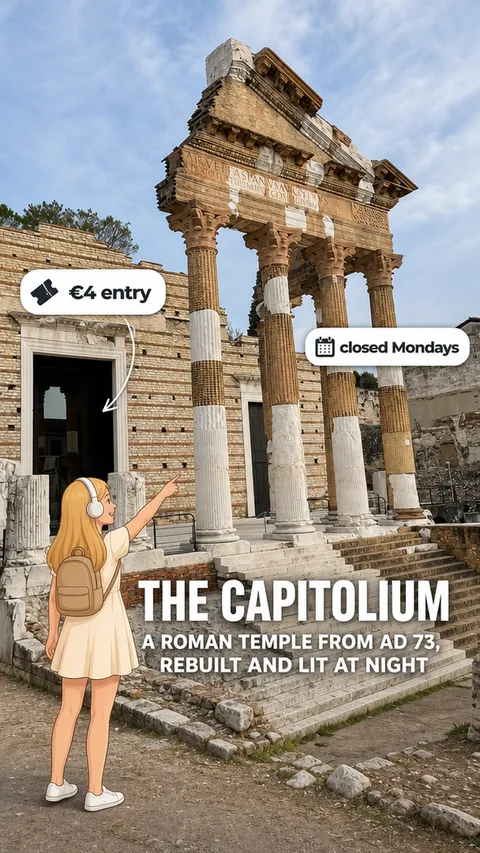
- Capitolium and Roman Forum (€4, Tue–Sun 10:00–18:00, closed Mon): the reconstructed Roman temple of AD 73 above the old forum, a UNESCO site and the image most people keep from the city. Pre-book online, entry is time-stamped.
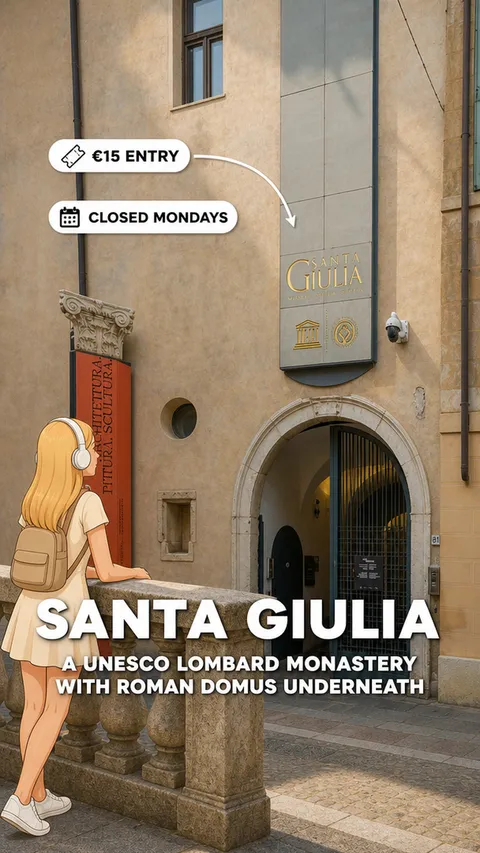
- Santa Giulia Museum (€15, Tue–Sun 10:00–18:00, closed Mon): a Lombard monastery founded by King Desiderius, now a museum spanning 3,000 years across 14,000 square metres, including the jewel-encrusted Cross of Desiderius and a Roman domus with mosaic floors. The one stop that can swallow two hours.
- Winged Victory (Vittoria Alata) (inside the Capitolium ticket): a life-size 1st-century bronze, one of the few to survive from antiquity, displayed without glass back on the site where it was found.
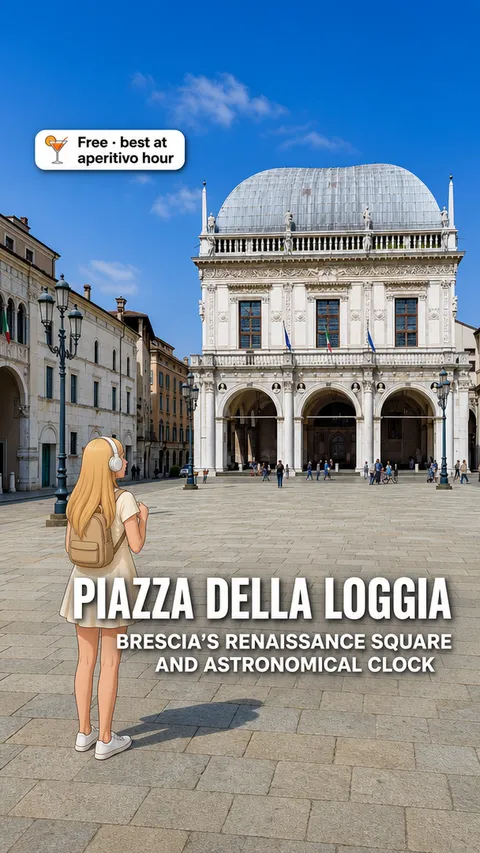
- Piazza della Loggia (free, always open): an elegant Renaissance square from Venetian rule, with arcades and a 1500s astronomical clock tower, the most photographed ensemble in town.
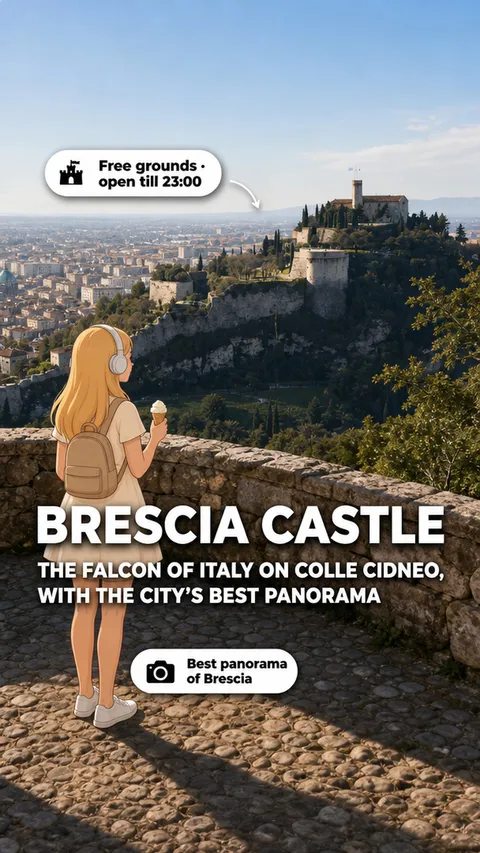
- Brescia Castle (grounds free, open daily ~6:00–23:00): a hilltop fortress on Colle Cidneo with ramparts, a drawbridge and a 360-degree panorama over the rooftops to the Alpine foothills. Museums inside are ticketed.
- The two cathedrals on Piazza Paolo VI (both free): the rare round 11th-century Old Cathedral beside the tall Baroque New Cathedral with one of Italy's largest domes, two duomos in one glance.
A combined Brescia Musei pass usually bundles the Roman area, Santa Giulia and the castle museums for less than buying them apart, so ask at either ticket desk before paying piece by piece.
The route the tour walks with you
The tour starts from any stop, so you never backtrack: open it wherever you arrive and it threads the loop in order, doing the one real climb once and getting paid back with the panorama. This is the route it walks with you, beginning at the southern gateway into the old town.
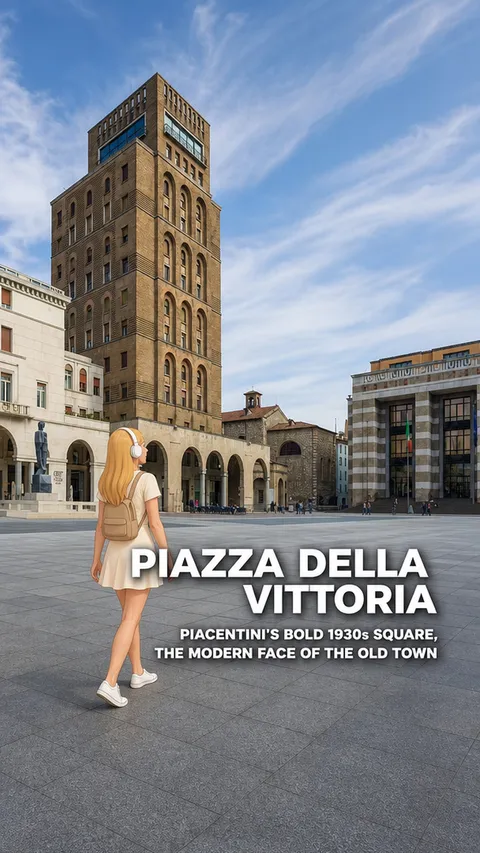
- 1Piazza della Vittoria Your entry point · free
The monumental 1930s square by Piacentini, severe marble and arcades, the modern face of the city before you step back a thousand years.
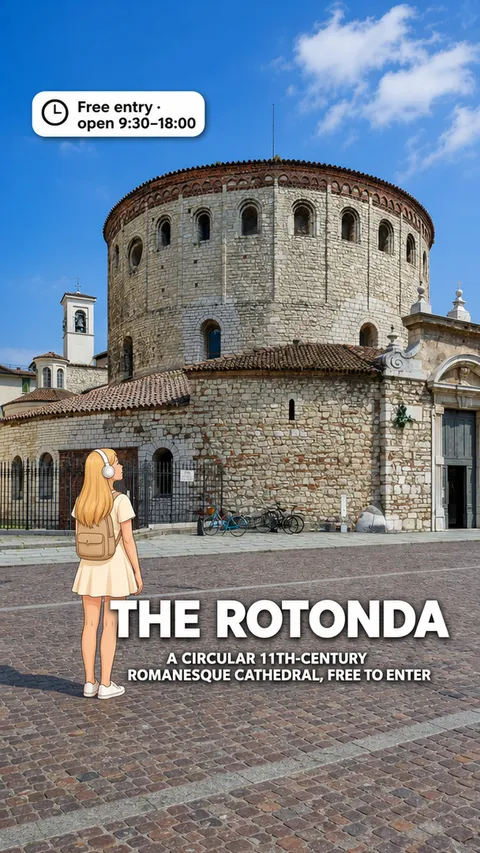
- 2Old Cathedral (Rotonda) Free
A squat circular Romanesque church sunk below the square, dim and bare in the best way, with a 6th-century crypt below.
- 3New Cathedral Free
Right beside the Rotonda, a tall Baroque facade in white Botticino marble under one of Italy's largest domes. The contrast in one glance is the point.
- 4Via dei Musei Free · walk
The ancient Roman main street, the spine of the walk, stringing monuments together for 800 metres toward the forum.
- 5Capitolium and Roman Forum €4 · ticket
The reconstructed temple columns above the UNESCO archaeological zone, with the Winged Victory bronze inside. Closed Mondays.
- 6Santa Giulia Museum €15 · ticket
The heavyweight, a Lombard monastery and the city museum, home to the Cross of Desiderius and a Roman domus. Budget up to two hours.
- 7Brescia Castle Grounds free
The only real climb of the day, up Colle Cidneo to ramparts and the best view in Brescia: red roofs, the two cathedral domes, and the mountains beyond.
- 8Piazza della Loggia Free
Down off the hill into the elegant Venetian-Renaissance square with its astronomical clock, the place to sit for a coffee.
- 9Palazzo della Loggia Free
The 16th-century town hall filling the square's west side, the finest Renaissance building in the city, drawing names like Sansovino and Palladio.
- 10Saints Nazarius and Celsus Church Free
A plain Neoclassical front hiding Titian's Averoldi Polyptych, the best painting on the route. Tight, split opening hours, so time it.
- 11Piazza del Mercato Free
The everyday close, an arcaded market square where you watch normal Brescian life before the one-minute stroll back to where you started.

It runs in your browser, no app and no download. A voice guide walks the loop with you and leads a real conversation as you go: it greets you, tells the story between stops, asks what you actually want to see, and adapts. It is not a recording and not an audioguide. The map and step-by-step navigation get you from each stop to the next.
Insider Tips for the Brescia Day Trip
Do
- Wear flat, thick-soled shoes. The whole centre is cobbles and polished marble that turns slick in rain
- Book the Capitolium online before you go. Entry is time-stamped, so anchor your day around the slot
- Order a Pirlo, the original wine-based Brescian aperitivo, not an Aperol Spritz
- Try casoncelli alla Bresciana, the local meat-filled pasta, for lunch
Don't
- Drive into the centre. ZTL limits and paid parking make it a genuine headache
- Visit on a Monday, when the Capitolium and Santa Giulia both close
- Skip the two paid sites to just walk the squares. You would miss the best of the city
- Expect a sleepy small town. Brescia is Lombardy's second city, with industrial edges
Money
Buy a combined Brescia Musei ticket rather than paying for the Capitolium and Santa Giulia separately. It usually bundles the Roman area, Santa Giulia and the castle museums for less than the sum of the parts. The big squares, both cathedrals, Via dei Musei and the castle grounds are all free, so the only unavoidable spend is the paid museums and whatever you eat.
Buffer
Santa Giulia is the time sink. It is genuinely large, and you can lose two hours there if you go deep, so decide upfront whether you want the full museum or just the Cross of Desiderius and the Roman domus. If you are tight on time, keep the two UNESCO sites, the castle and Piazza della Loggia, and cut the church interiors.
Both paid highlights, the Capitolium and Santa Giulia Museum, are closed on Mondays. Do this trip Tuesday to Sunday or you lose the two best things in the city. The Capitolium is also time-stamped, so book the entry slot online before you travel.
More day trips from Milan
Out in the morning, back in time for dinner. Every route here fits in one full day.
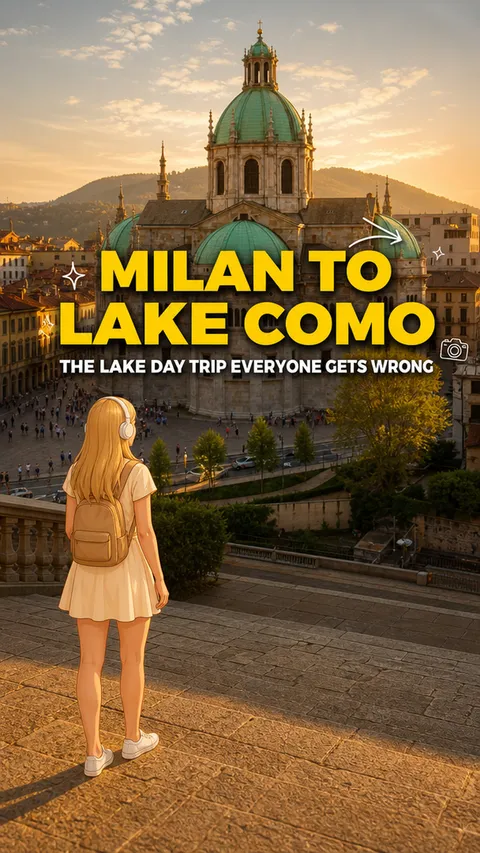
What the Milan to Brescia Journey Feels Like
The train ride sets up the trick the city plays. For the last stretch into Brescia you pass warehouses and industrial sprawl, and you start to wonder why anyone bothers getting off. Then you walk in from the station, the lanes narrow, the stone underfoot turns from modern paving to worn cobble, and the old town simply opens up. The shift is fast enough to feel staged.
Inside the centre the pace drops. This is not a city that performs for visitors, and you feel that immediately: life carries on around you, locals fill the cafe tables on Piazza della Loggia at dusk, and nobody is selling you anything. Brescia has long called itself the Lioness of Italy, after a fierce 19th-century stand, and there is a quiet confidence to the place that matches the name. People here will tell you it feels like Venice minus the water, and on Piazza della Loggia, under the Venetian arcades, you half believe them.
The single best moment is the climb to the castle. You do the one real hill of the day up Colle Cidneo, and at the top the whole city lays itself out below: terracotta roofs, the twin cathedral domes, the green hill you are standing on, and the Alpine foothills closing the horizon. It is free, it is shaded, and it is the payoff that turns a good day into a memorable one. Come down into Piazza della Loggia for an aperitivo as the light goes, and the day ends exactly where it should, with the train home a short walk away.
Milan to Brescia: Your Questions Answered
Is Brescia worth a day trip from Milan?
Yes, for the right traveller. You get two UNESCO sites, a Roman temple, a Lombard monastery, two cathedrals and a hilltop castle in a compact, flat, walkable centre, with far fewer crowds than Florence or Verona. The catch is the industrial first impression from the station, which you walk past in five minutes. If you like history and architecture over lakes and icons, it is one of the best day trips Milan offers.
How long is the train from Milan to Brescia?
About 36 to 38 minutes on a Frecciarossa or Italo high-speed train, and roughly 66 minutes on the cheaper Trenord regional. Both run from Milano Centrale to Brescia station, on the south edge of the old town.
How much does the Milan to Brescia train cost?
The regional is a fixed €7.40 each way, the same price whenever you buy it. High-speed Frecciarossa and Italo fares start around €15–20 each way if you book a few weeks ahead and can climb to €40–110 if you buy last-minute. For a budget day trip, the regional wins.
Do I need to book Milan to Brescia train tickets in advance?
Not for the regional, which has a fixed fare and no seat reservation, so you can simply turn up. For the high-speed Frecciarossa and Italo trains, booking 2 to 4 weeks ahead is the only way to get the cheap fares, since prices rise as seats sell.
What is there to do in Brescia in one day?
Walk one loop covering Piazza della Vittoria, the round Old Cathedral and the Baroque New Cathedral, Via dei Musei and the Roman Capitolium, the Santa Giulia museum, the hilltop castle for the panorama, Piazza della Loggia with its astronomical clock, and the market square. Add a Titian inside Saints Nazarius and Celsus if its short opening hours line up.
Are Brescia's museums open on Monday?
No. The Capitolium and Santa Giulia Museum, the two paid UNESCO highlights, both close on Mondays. Plan the trip for Tuesday to Sunday, or you lose the best of the city. The free squares, cathedrals and castle grounds stay open daily.
Do I need a car in Brescia?
No. The centre is small, flat and pedestrianised, and a single metro line links the train station to the old town in one stop. Driving in is actively discouraged because of restricted-traffic limits and difficult parking. The train from Milan is faster and cheaper than the hassle.
Can I combine Brescia with Lake Garda or Bergamo?
You can pair Brescia with Lake Garda since the same rail line continues east toward Desenzano and Peschiera, but doing both properly in one day is rushed. Brescia rewards a full day on its own. If you want two stops, treat Brescia as the main event and Garda as a brief evening add-on, not an equal half.
What should I eat in Brescia?
Order a Pirlo, the local wine-based aperitivo that predates the Aperol Spritz, on Piazza della Loggia or Piazza del Mercato. For lunch, look for casoncelli alla Bresciana, large meat-filled ravioli that is the signature local pasta. Prices in Brescia run noticeably gentler than Milan.
Plan Your Brescia Day Trip
You do not need to memorise any of this on the day. Take a morning train from Milano Centrale, ride one metro stop into the old town, and open our free Brescia tour in your browser. It greets you, walks you through the Roman temple, the two cathedrals, the monastery and the castle as a single conversation, navigates the medieval lanes for you, and starts from whichever stop you happen to be standing at. No app, no download, no audioguide reading at you, just a voice guide that adapts to what you want to see, with 100 free credits to start.
It runs in your browser, no app and no download. A voice guide walks the loop with you and leads a real conversation as you go: it greets you, tells the story between stops, asks what you actually want to see, and adapts. It is not a recording and not an audioguide. The map and step-by-step navigation get you from each stop to the next.
