
Verona Day Trip from Milan: The Honest Plan
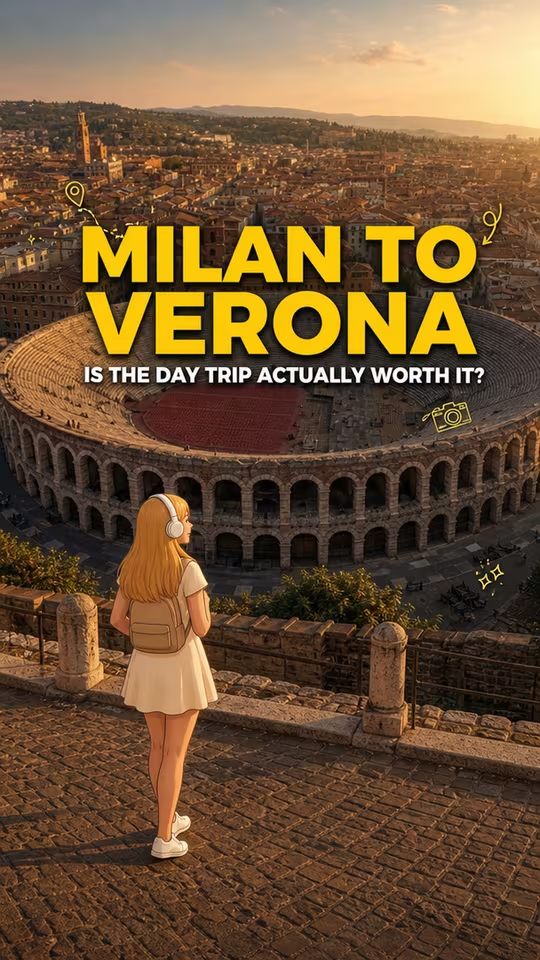
The high-speed train is the easy winner here, about 1h10 to 1h15 from Milano Centrale to Verona Porta Nuova, up to 42 trains a day, and a 20-minute walk into a Roman arena. Here is the honest day plan, the fare tricks that cut the price, plus a free, self-guided walking tour for the hours on the ground.
The Quick Answer: Milan to Verona
Take the train and stop overthinking it. Milano Centrale to Verona Porta Nuova runs in about 1 hour 10 to 1 hour 15 on a high-speed Frecciarossa or Italo, with up to 42 departures a day, roughly one or two an hour. Book a few weeks ahead and the fast train starts near €19.90. If you would rather save money than minutes, the Regionale Veloce is a flat €13.55, needs no booking, and takes 1h50 to 2h10. Either way you arrive a 20-minute walk from a Roman amphitheatre that predates the Colosseum. Is it worth it for a single day? Yes, easily. This is one of the shortest, highest-payoff day trips you can do out of Milan, and unlike the lakes it works rain or shine.
| Question | Answer |
|---|---|
| Fastest journey time | ~1h10 to 1h15 direct (Frecciarossa / Italo) |
| Frequency | Roughly 1 to 2 per hour, up to ~42 trains a day |
| Price from | €13.55 fixed on the regionale; ~€19.90 to 50 on the fast train by timing |
| Operators / how | Trenitalia (Frecciarossa), Italo, and Trenord regional. Bus and car are slower |
| First / last | Out from ~7:30 to 8:30 a.m. Last fast train back ~9:10 to 9:30 p.m. |
| Worth it as a day trip? | Yes. Short ride, compact city, Roman to Renaissance in one walkable centre |
Is the Milan to Verona Day Trip Worth It?
Most Milan day trips ask you to compromise. This one barely does. The ride is short enough that you are on Veronese cobblestones within ninety minutes of leaving Centrale, and the historic centre is so compact, roughly 1.2 km north to south, that you can see the headline sights and still eat a long lunch. Verona is a working Italian city of about 260,000 people that happens to wear two thousand years of history without making a circus out of it. After Milan's fashion-district pace, the change of gear is the whole point.
The best of Verona, stop by stop


The case for going is strong on its own terms. You get genuine Roman ruins, the Arena and Ponte Pietra and Porta Borsari, layered with medieval squares and a river bend that frames the city like a postcard. You also cross from Lombardy into the Veneto, which means different food and different wine: this is Valpolicella, Amarone, and Soave country, and the risotto comes cooked in red wine until the rice turns purple.
Seventy-five minutes from Centrale, and you trade Milan's hustle for Roman stone, river bridges, and Veneto wine.
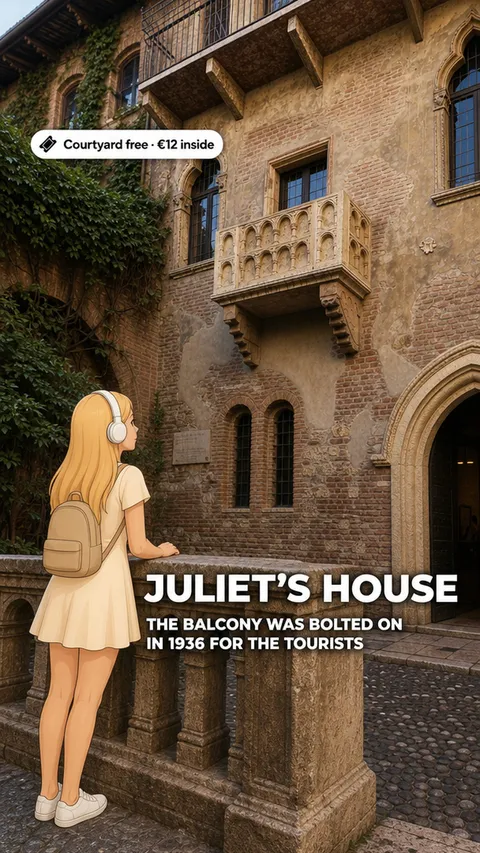
The honest counterpoint is expectation management, not logistics. If you are coming purely for the Romeo and Juliet connection, lower the bar now: Shakespeare never set foot in Verona, the famous balcony was added in 1936 to satisfy tourists, and the "house" is a 13th-century palazzo the city dressed up for the part. Treat the Juliet stuff as a 10-minute curiosity and give the Arena the hour it deserves. The other honest note: if you have already done Verona, Bergamo is faster and cheaper, and on a flawless-weather day the lakes are a different kind of pleasure.
If you came only for Juliet's balcony, recalibrate. It is 90 percent invented marketing.
Our call: for anyone spending three or more days in Milan who wants an authentic Italian city day, this is close to the perfect pick. Go for the Arena, the food, and the river at golden hour, treat the romance as a side dish, and you will have a full day with hours to spare.
Good fit if you...
- Have three or more days in Milan and want a real change of scene
- Love Roman, medieval, and Renaissance layers in one walkable centre
- Care about food and wine (Veneto, not Lombardy, on the plate)
- Want a short ride and a day that works rain or shine
Skip it (save Verona) if you...
- Came mainly for the Romeo and Juliet story and nothing else
- Have already done Verona (try Bergamo, 50 min, €5.50)
- Have one perfect-weather day better spent on Como or Garda
- Want to see an opera (start times run past the last fast train)
How to Get from Milan to Verona by Train
There are four realistic ways to get from Milan to Verona, and for a day trip the train wins on every axis that matters. The only real decision is which train: pay a little more for the fast one, or save €6 and a booking step on the regionale.

| Mode | Time | Price | Verdict |
|---|---|---|---|
| High-speed train (Frecciarossa / Italo) | ~1h10 to 1h15 | €19.90 to 50 | WINNER. Centrale to Porta Nuova, hourly, then a 20-min walk to the Arena |
| Regional (Trenord Regionale Veloce) | ~1h50 to 2h10 | €13.55 fixed | Cheapest, no booking, but slower with basic seats |
| Bus (FlixBus / Itabus) | ~2h20 | €7 to 10 | Cheap, but the gap with rail is too small to lose an hour |
| Car (A4 motorway) | ~1h40 to 2h | ~€15 toll each way plus parking | Pointless. ZTL fines, parking hassle, and sober in wine country |
The bus saves you a handful of euros and costs you an hour each way, which is a bad trade on a day trip: FlixBus runs Milano Lampugnano to Verona in about 2h20 from €6.98, Itabus and BlaBlaCar Bus sit in a similar €7 to 10 range. Driving is worse. It is roughly 153 km on the A4 with about €15 in tolls each way, Milan traffic out of the city is heavy, and Verona's historic centre is a limited-traffic zone (ZTL). Roll through the ZTL without a pass and the fine gets mailed to your home address abroad, or charged to the rental company with admin fees on top. You would also spend the day sober in the middle of wine country. The train drops you in the centre, lets you drink at lunch, and costs less once you price in fuel, tolls, and parking.
The Train in Detail
Two high-speed operators run the corridor and take almost exactly the same time. Trenitalia's Frecciarossa and the private Italo both leave from Milano Centrale (platforms 1 to 21) and reach Verona Porta Nuova in about 1h10 to 1h15, with up to 42 fast and regional services a day between them. Centrale is enormous and busy, so give yourself time to find the platform. The trains are clean, quiet, and comfortable, and they fill with Milan-to-Verona commuters in the morning and late afternoon, so a reserved seat is worth having.
One thing to get right at the far end: you arrive at Verona Porta Nuova, which sits about 2 km south of the old town. From there it is a flat 20-minute walk up Corso Porta Nuova straight to Piazza Bra and the Arena, or a 5 to 10 minute city bus if your feet are not in the mood. If you want to travel light for the day, the KiPoint left-luggage office on the station's ground floor charges about €6 for up to five hours and €10 for five to twelve.
Frecciarossa, Italo, or the regionale, which to book?
Carry no brand loyalty between the two fast operators: pick by price and departure time for your exact slot, because they run almost identical journeys and Italo is often a few euros cheaper. The real choice is fast versus cheap. One source warns that a direct Italo can require a change at Bologna while Italo's own site advertises a direct 1h12 service, so check the operator site at booking time rather than trusting a single timetable.
| Option | Time | Price | Best for |
|---|---|---|---|
| Frecciarossa / Italo (high-speed) | ~1h10 to 1h15 | €19.90 to 50 booked ahead | Saving an hour, weekends, comfort |
| Regionale Veloce (Trenord) | ~1h50 to 2h10 | €13.55 fixed, no booking | Budget, flexibility, off-peak weekdays |
The regionale is genuinely fine when you are not in a rush, but two warnings. The 8:43 is always packed with commuters, and on summer Saturdays the regional fills with lycra-clad cyclists and their bikes, so on weekends pay for the fast train. And you must validate a paper regional ticket in the little green or yellow machines on the platform before boarding, or you risk a steep fine. A high-speed e-ticket with a seat reservation needs no stamping.
Booking Strategy
High-speed fares are dynamic, so the single biggest lever on price is how early you buy. The €19.90 advance fare is real but limited, the standard window runs €30 to 50, and a walk-up same-day ticket can hit €70 or more. Book direct on the official Trenitalia or Italo app as soon as your date is fixed, not through a third-party reseller, which keeps changes easy and dodges commissions.
A neat local trick for a day trip: buy your outbound on the fast train if you want the early start, but buy the return on the regionale. It is cheaper, it needs no fixed time, and a flexible any-train ticket is exactly what you want at the end of a long day when you are full of wine and might miss a reserved slot by ten minutes. The two-hour amble back is no hardship when you are ready to nap. If you qualify, the named discount fares below cut the price further. Allocations are limited and terms shift, so confirm on the official site when you book.
| Discount fare | Who qualifies | Roughly |
|---|---|---|
| Frecciarossa "FrecciaYOUNG" | Under 30 | Up to ~50% off Base, limited seats |
| Frecciarossa "FrecciaSENIOR" | 60 and over | Up to ~50% off Base, limited seats |
| Trenitalia "Bimbi Gratis" / Family | Groups of 2 to 5 with kids under 15 | Children travel free, adults at Base |
| Italo "Young" | Under 30 | Discounted seats, book early |
| Italo "Senior" | 60 and over | Discounted seats, book early |
Booking checklist
- Book as early as you can on the official Trenitalia or Italo site or app, choosing Milano Centrale → Verona Porta Nuova.
- Compare both fast operators for your exact departure window, and check the direct-versus-Bologna routing on Italo before you buy.
- Consider an early Frecciarossa out and a flexible Regionale Veloce back to save money and keep your options open.
- Apply any youth, senior, or family fare you qualify for.
- On a high-speed ticket your e-ticket is already valid. On a regional paper ticket you must validate it in the platform machine before boarding.
- Expect a late track assignment at Centrale. The binario often shows only minutes before departure, which is normal.
Verona in One Day
Here is the part most day-trip guides bury, and it is the whole point: you do not need to plan a route. The train sets you down at Verona Porta Nuova, you walk twenty flat minutes up to Piazza Bra, and the colossal pink-limestone wall of the Arena greets you the moment you arrive. From there you open our free, self-guided Verona tour on your phone and start it from wherever you are standing. The voice guide takes the planning off your hands and walks the city with you, stop by stop, so the moment you reach the square becomes the first beat of the day rather than a logistics problem. No map-wrangling, no "now where to next", just the city and a guide that talks you through it.

The time math
Take an early train, around 7:30 to 8:30 a.m. from Centrale, and you are on Piazza Bra by roughly 9:00 to 9:30. The last direct fast train back leaves around 9:10 to 9:30 p.m., and the last regionale around 10:30, but plan around the second-to-last fast train rather than the very last one so you keep a cushion. Even a conservative day gives you a generous ten to eleven usable hours on the ground, which is more than enough to walk the whole loop, climb a tower, cross the bridges, and eat properly. The one exception is the opera: Arena performances start around 20:45 and run past midnight, well after the last fast train, so if you want a show, stay overnight.
What you'll see
The historic centre is small and the sights cluster, so a full day covers the lot without rushing. Hours and prices shift, so confirm the ticketed sights on their official sites before you go:
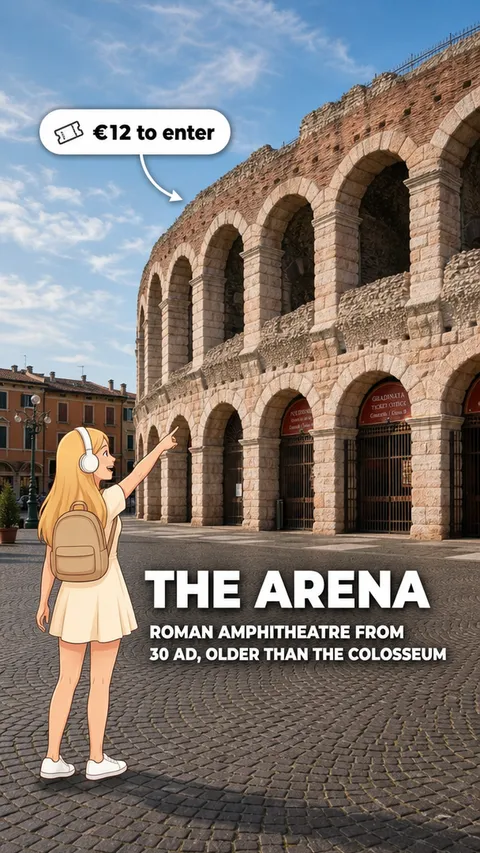
- Arena di Verona (€12, open ~9:00 to 19:00, closed Monday mornings): Roman amphitheatre from around 30 AD, older than the Colosseum, where the scale only really registers once you climb onto the original stone steps. Go in before 10:30, before the tour groups.
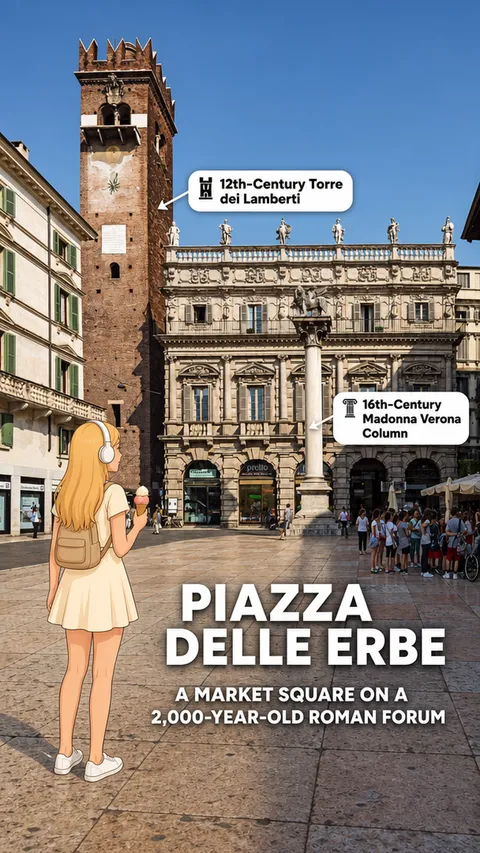
- Piazza delle Erbe (free): the medieval market square sits on the old Roman forum, a 2,000-year-old footprint ringed by frescoed palazzi. More atmospheric than St Mark's Square and a fraction as crowded.
- Casa di Giulietta (courtyard free, interior €12, closed Monday): worth ten minutes for the courtyard and the shiny bronze statue, skippable inside. Go in clear-eyed and it is a fun curiosity, not a shrine.
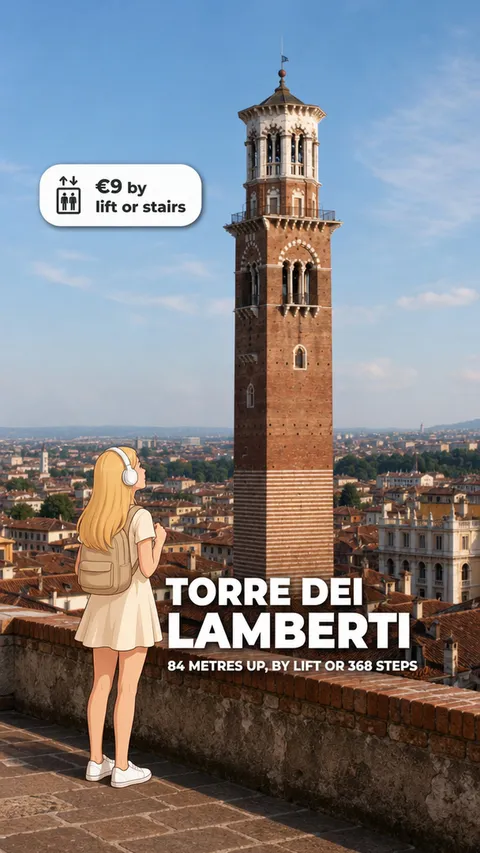
- Torre dei Lamberti (€9, lift plus 368 steps): 84 metres up for rooftops and church bells at eye level. The wider panorama is free from Castel San Pietro if you would rather climb.
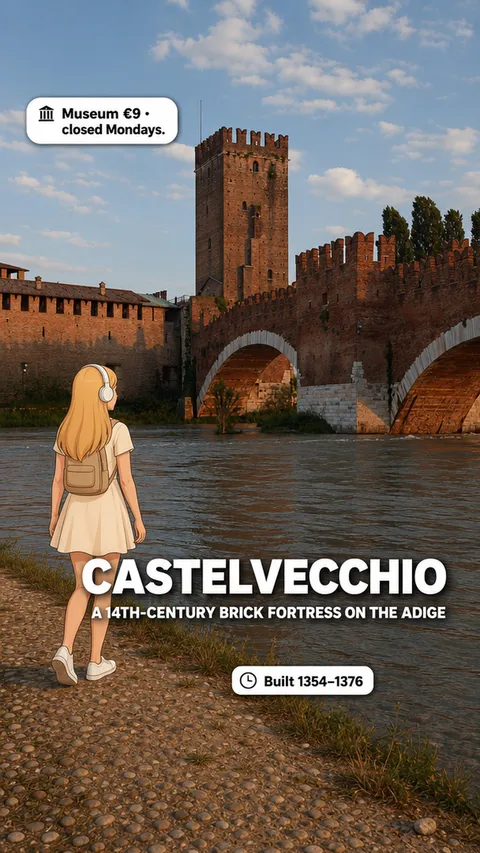
- Castelvecchio and Ponte Scaligero (museum €9, closed Monday): a 14th-century brick fortress on the Adige with a Mantegna and a Bellini inside, and a fortified bridge that turns deep red around 19:00 in summer.
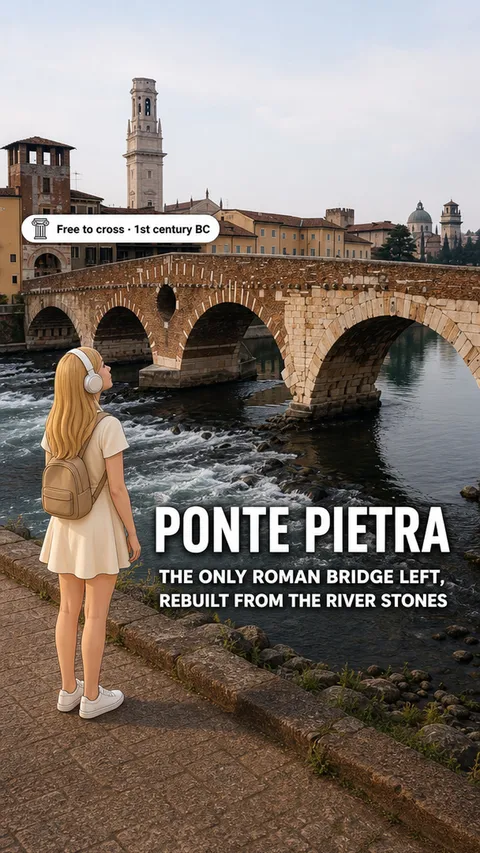
- Ponte Pietra (free): Verona's only surviving Roman bridge, blown up in 1945 and rebuilt from stones dredged out of the river. You can still tell the old blocks from the new by colour.
- Basilica di Sant'Anastasia (€4): the city's largest church, Italian Gothic, with Pisanello's "St George and the Princess" and a famous hunchback holy-water font.
The route the tour walks with you
Instead of a generic "see the Arena, then the squares" list, you walk one efficient loop and the tour walks it with you. Because it launches from any of its stops, you never backtrack to find an official start, you just begin where you are standing. This is the real fourteen-stop order, looping out from Piazza Bra through the squares and across the river and back, so you barely double back:
- 1Piazza Bra & Arena di Verona €12 · your start
The huge open square where you arrive from the station, dominated by the Roman amphitheatre. Photograph the pink limestone, then head northeast down Via Roma.
- 2San Fermo Maggiore Church Small fee inside
Two churches stacked on top of each other, Romanesque below and Gothic above, with a ship's-keel ceiling. The quiet plaza is a good spot to draw breath.
- 3Casa di Giulietta (Juliet's House) Courtyard free · interior €12
You hear the crowd before you see it. Free courtyard, the bronze statue, walls of love notes. Worth ten minutes, then push back out.
- 4Torre dei Lamberti €9
The striped 84-metre tower above the rooftops. Lift plus a few stairs to a 360-degree view, or just admire it from the base and walk through to the square.
- 5Piazza delle Erbe Free
The long market square over the Roman forum, frescoed facades and the winged Lion of St Mark on its column. Walk the middle slowly, then slip out under the Arco della Costa.
- 6Piazza dei Signori Free
The quiet, formal square next door, Dante's statue in the centre and the Loggia del Consiglio on one side. A sharp change of mood from the market.
- 7Arche Scaligere (Scaliger Tombs) Free to view
Gothic funeral monuments of Verona's medieval rulers, raised on columns behind an iron grate, equestrian statues on top. Visible in full from the street.
- 8Basilica di Sant'Anastasia €4
The largest church in town, soaring Gothic vaults, Pisanello's fresco, and the carved hunchback font. The plaza out front is a rest stop before the river.
- 9Ponte Pietra Free
Verona's oldest bridge, Roman stone pulled from the Adige and rebuilt after 1945. Stop halfway for the green water and the hills across the river.
- 10Teatro Romano & Museo Archeologico ~€4.50
A 1st-century BC Roman theatre built into the hillside, with an archaeological museum above it and the best city-view terrace in Verona. Much of the lower ruin is free from the street.
- 11Duomo di Verona (Cathedral) Small fee
Romanesque-Gothic cathedral with a pink-marble double porch, stone griffins at the door, and Titian's "Assumption" inside.
- 12Porta Borsari (Roman Gate) Free
A 1st-century white-limestone city gate stranded in a modern street, the old main entrance on the Via Postumia. Walk straight through the arches.
- 13Castelvecchio Museum €9
The red-brick Scaliger fortress on the riverbank, art by Bellini, Mantegna, and Pisanello inside, and the fortified bridge out the back, free to cross.
- 14Piazza Bra & Arena di Verona Loop close
Back to the open square, the Arena catching the evening light. Rest your feet under the trees before the walk back to Porta Nuova.

It runs in your browser, no app and no download. A voice guide walks the loop with you and leads a real conversation as you go: it greets you, tells the story between stops, asks what you actually want to see, and adapts. It is not a recording and not an audioguide. The map and step-by-step navigation get you from each stop to the next.
That whole loop is our free, self-guided Verona walking tour, and because it can be launched from any of its stops, you do not backtrack to find an official start, you just begin where you are. You open it the moment you reach Piazza Bra and it leads the loop with you from the Arena to Juliet's House, Piazza delle Erbe, the bridges, and Castelvecchio. It runs in your browser, with no app and no download. A voice guide walks the route and holds a real conversation as you go: it greets you, tells the story between stops, asks what you actually want to see, and shapes the route around your day. It is not a recording and not an audioguide. The map and step-by-step navigation get you from square to square without squinting at Google Maps. See the full route on the Verona walking tour page, and you get 100 free credits to try it.
Insider Tips for the Verona Day Trip
A Verona day has its own rhythm, and a few habits make it smoother. Get to the Arena before 10:30, because the tour groups invade at lunchtime and the queue grows fast. Wear thick-soled shoes, since the centre is paved end to end with large, uneven river stones that punish thin sneakers, and heels are a genuinely bad idea. Carry a refillable water bottle, because Italian restaurants do not give free tap water but Verona has free public drinking fountains everywhere, including on Piazza Bra. And eat two minutes off the main drag, never on Via Mazzini or in front of the Arena, where the same dishes cost about 30 percent more.
Do
- Get to the Arena before 10:30, ahead of the tour groups
- Buy the Verona Card (€27) if you will do Arena, Lamberti, and Castelvecchio
- Cross the Castelvecchio bridge at golden hour, around 19:00 in summer
- Validate a paper regional ticket before boarding
- Eat in the side streets, off Via Mazzini and the Arena view
- Take a left-side window seat home for Lake Garda at sunset
Don't
- Don't drive into the ZTL, the fines get mailed abroad
- Don't pay for coffee sitting down on Piazza Bra at the location markup
- Don't take the 8:43 regionale or a summer-Saturday regional, both packed
- Don't expect the real Romeo and Juliet, it is mostly invented
- Don't try to add Lake Garda the same day, do them separately
- Don't bother with the Arena €1.50 audio guide, skip it
If you take the cheaper regional train, validate the paper ticket in the platform machine before you board. Trenord staff estimate one in five tourists forgets, and the fine is large. The Verona Card starts the moment you tap it at your first attraction, not when you buy it, so pick it up the night before online or first thing at the Piazza Bra tourist office and tap it only when you are ready to start.
More day trips from Milan
Out in the morning, back in time for dinner. Every route here fits in one full day.
What the Milan to Verona Journey Feels Like
This is the part no timetable captures. The ride out is genuinely pleasant, clean fast trains slicing across the Lombard plain, business commuters with laptops, the kind of comfortable that makes ninety minutes vanish. Then Porta Nuova, the walk up Corso Porta Nuova, and the moment the Arena's wall rears up at the top of the square. People who do this trip remember sitting on the warm stone steps of the amphitheatre at the end of the day, watching the sun drop behind the Roman arches while the opera company rehearses Aida and the music rises out of the stage below.
The other thing people remember is the river. Walking across the Castelvecchio bridge at sunset, when the brick crenellations turn a particular shade of red, is the most photogenic ninety seconds in the city, and Ponte Pietra a few hundred metres upstream gives you the same Adige in a different frame. In between there is the small, very Italian rhythm of the day: an espresso standing at the bar for €1.30, the same coffee €3.50 the moment you sit down, a Valpolicella with lunch because you are in the Veneto and a glass on the train home is a perfectly legal and Italian thing to do.
Come for Romeo and Juliet if that is what pulled you here, there is no shame in it, but you stay for Verona itself. The honest line to end on is that twelve hours is enough to fall for the city and remember why you came to Italy in the first place. The only time it is not enough is opera night, the one situation where Verona genuinely demands that you stay over.
Milan to Verona: Your Questions Answered
Can you do Milan to Verona as a day trip?
Yes, and it is one of the easiest day trips from Milan. The high-speed train takes about 1h10 to 1h15 each way, so an early departure and an evening return leave you ten to eleven hours on the ground. The historic centre is compact and walkable, so a single day comfortably covers the Arena, the squares, the bridges, and a proper lunch.
How long is the train from Milan to Verona?
About 1 hour 10 to 1 hour 15 minutes direct on a Frecciarossa or Italo high-speed train between Milano Centrale and Verona Porta Nuova. The cheaper Regionale Veloce takes longer, roughly 1h50 to 2h10 depending on stops.
How much does the Milan to Verona train cost?
The Regionale Veloce is a flat €13.55 with no booking required. High-speed fares are dynamic: from around €19.90 booked a few weeks ahead, €30 to 50 in the standard window, and €70 or more walking up on the day. Youth, senior, and family fares cut the high-speed price further.
Frecciarossa or the regional train, which is better?
For a quick day or a weekend, take the fast train and save the hour. For budget or flexibility on a quiet weekday, the regionale is genuinely fine. A popular trick is to take an early Frecciarossa out and a flexible regionale back, since the cheaper any-train return suits a tired evening. Just remember to validate the paper regional ticket before boarding.
What are the first and last trains?
Sensible departures run from about 7:30 to 8:30 a.m. out of Centrale, getting you to Verona by roughly 9:00 to 9:30. The last direct fast train back leaves around 9:10 to 9:30 p.m., and the last regionale around 10:30. Plan around the second-to-last fast train rather than the very last one.
Which Verona station should I get off at?
Verona Porta Nuova. It is the main station, about 2 km south of the old town, a flat 20-minute walk or a short bus ride up to Piazza Bra and the Arena. There is a left-luggage office (KiPoint) on the ground floor if you want to travel light for the day.
Is the Verona Card worth it for a day?
Usually yes. The 24-hour card is about €27 and covers the Arena (€12), Castelvecchio (€9), the Lamberti tower (€9), the Roman Theatre, the Duomo, and San Zeno, plus city buses. Do the Arena, Lamberti, and Castelvecchio and you have already cleared the cost. Note that Juliet's House needs a separate timed reservation even with the card.
Is the bus or car a good alternative?
Not for a day trip. The bus is a little cheaper but takes about 2h20 each way, and the price gap with rail is too small to lose two hours of your day. A car means heavy Milan traffic, around €15 in tolls each way, parking outside the centre, and steep ZTL fines if you drive into the old town. The train is faster, cheaper once you count tolls and parking, and lets you drink at lunch.
Do I need to validate my ticket?
Only on the regional train. A paper regional ticket must be stamped in the green or yellow platform machine before you board, or you risk a large fine. A high-speed e-ticket with a seat reservation is already valid and needs no stamping.
Plan Your Verona Day Trip
You have the train sorted, which is the part most people get wrong. Now make the hours on the ground count with our free, self-guided Verona walking tour: open it the second you reach Piazza Bra, and start the loop wherever you are standing. A voice guide leads the route with you from the Arena to Juliet's House and across the river, holding a real conversation as you go, all in your browser with no app and no download. You get 100 free credits, and the full route is on the Verona tour page.
