Best Time to Visit Zakopane
Month-by-month weather, crowds and prices, plus a full calendar of festivals and events worth planning a trip around.
Best monthsJun, Sep
CheapestApr, Nov
AvoidFeb, Aug
BusiestJul, Aug, Dec
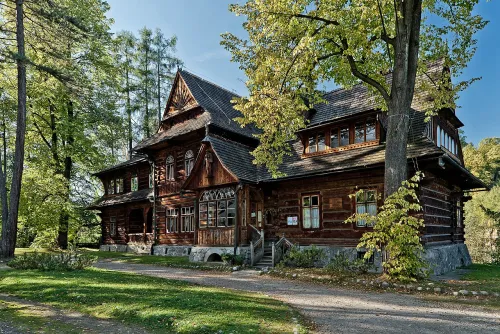
When is the best time to visit Zakopane?
Come in June or September. Both give you every attraction open, comfortable hiking weather and no school-group crush. September is the smarter pick: autumn light, queue-free Morskie Oko and Kasprowy Wierch, and rates around 130-200 zł a night, roughly 30-40% below summer. November is the cheapest and emptiest month but the Kasprowy cable car is shut for maintenance. Avoid the Małopolska winter holidays (2-15 February) and Folklore Festival week (21-27 August) unless you specifically want the crowds.
Start our tool and find your best time to visit Zakopane
Your perfect month
Free · ~30 seconds
or tap a month directly
What matters to you?
And this?
Best overall: Jun, Sep. June and September are the sweet spot: every attraction fully open, comfortable 20-25°C valley hiking, wildflowers in June or gold larch in September, and no school-group crush. September edges it on value, with rooms 30-40% below summer and walk-up access to Kasprowy Wierch and Morskie Oko with zero queue.
Best value: Sep, Nov. September gives you the full experience cheaply: 130-200 zł a night, cable car running, superb hiking, restaurants still on summer menus. November is even cheaper at 120-180 zł with a peaceful Krupówki, but the Kasprowy Wierch cable car is closed for its annual maintenance, so it suits low-key valley walks more than summit days.
Avoid: Feb, Aug. The Małopolska winter holidays (2-15 February) book out weeks ahead with domestic ski families, and rooms simply run out. Folklore Festival week (21-27 August) puts Krupówki shoulder-to-shoulder and packs the Morskie Oko trail from before 7 am. Christmas and New Year (24 Dec-2 Jan) carry the year's highest single-night rates.
- January: Tough month, 1°C. This is Zakopane at its most alpine and energetic: snow underfoot, ski jumpers in the sky and the highland-food smell of grilled oscypek on Krupówki. The World Cup weekend is electric if you love ski jumping and chaotic if you do not. Layer hard against the cold, and aim for mid-to-late January if you want the snow without the early-month crowds.
- February: Tough month, 3°C. If you have come to ski, February is the high point: deep snow, long days on the piste and a buzzing town. If you have not, it can feel relentless, with packed slopes, full restaurants and no spare beds. The late-February Makuszyński memorial ski race signals the first easing as the holiday crowds finally start to thin.
- March: Tough month, 6°C. March is the relaxed tail of winter: snow up high, sun starting to feel warm in the valley, and the slopes no longer elbow-to-elbow. It is the smart skier's month, when you get reliable upper-mountain snow at a fraction of the February price and rarely have to queue for the cable car.
- April: Good time, 10°C. April is for travellers who want Zakopane near-empty and do not mind unsettled weather. It is too late to ski reliably and too early for the high trails, but the wild crocus fields are a specific, photogenic draw, and the spring ski-jumping events under the Wielka Krokiew bring a last burst of winter-sport energy.
- May: Great time, 15°C. May is the couples' and walkers' month: green valleys, candlelit guesthouses at around 60% of peak prices, and trails you can have almost to yourself. The high routes are still opening week by week as the snow retreats, so check conditions, but the lower valleys are at their fresh, blossoming best.
- June: Great time, 20°C. June feels like Zakopane at ease: every attraction open, wildflowers in the valleys, long light evenings and no school-group crush. It is the first-timer's and family's month, warm enough for gentle walks like the pram-passable Dolina Białego, with the Restaurant Festival giving foodies a low-crowd excuse to linger.
- July: Good time, 21°C. July is busy, warm and trail-focused, with the whole region out hiking. The classic sights are spectacular but you have to plan around the crowds: dawn starts for Morskie Oko, online tickets for the cable car, and an eye on the afternoon storm clouds. When the guided-tour prices and queues climb, our live AI guide is the always-available, flat-priced alternative to an expensive pre-booked human guide, telling you the story of Krupówki and the highland heritage as you walk it in the cool of the morning, at 5 euro an hour or 20 all in, with 100 free credits to start.
- August: Tough month, 21°C. August is Zakopane at full volume. The Folklore Festival is a genuine highlight, with daily highlander parades, costume, music and the competition for the Golden Ciupaga, but the trade is total congestion in town and on the trails. Come for the festival and embrace it, or time your visit for the first half of the month and start every hike at dawn.
- September: Great time, 17°C. September feels like Zakopane exhaling. The trails are quiet, the light turns golden, and you can hike to the great lakes or ride the cable car without queueing or pre-booking. It is the value and quiet champion, romantic on a near-empty Krupówki and ideal for a first visit, with everything still open and the weather still kind.
- October: Good time, 12°C. October is the foliage month: cool, golden and almost empty, with the valleys at their most photogenic. It is a walker's and couple's quiet pleasure, just be aware the summit cable car may be down for maintenance, so plan around valley trails and the Gubałówka funicular, which stays open throughout.
- November: Good time, 6°C. November is Zakopane at its most introverted: grey, quiet and cheap, with the cable car down and the ski season not yet started. It suits low-key valley walks, museum visits and a calm Krupówki rather than summit days. Come for the price and the peace, and bring warm layers for the damp pre-winter chill.
- December: Tough month, 2°C. December is snow-town Zakopane at its most magical: chalets, mulled wine, fresh powder and the ski lifts spinning. It is festive and atmospheric but busy and pricey at the holidays, with New Year's Eve the single dearest night of the year. Come in early December or the 12-22 December window for the snow and market without the peak crush.
Zakopane weather by month
HighLowRainfall
Jan1°
Feb3°
Mar6°
Apr10°
May15°
Jun20°
Jul21°
Aug21°
Sep17°
Oct12°
Nov6°
Dec2°
| Month | Temp | Rain | Sun | Crowds | Prices | Highlight |
|---|---|---|---|---|---|---|
| Jan | 1° / -5° | 70mm · 14 rainy days | 4.3 h/day | ●●●●● | ●●●●● | FIS Ski Jumping World Cup Zakopane |
| Feb | 3° / -4° | 81mm · 15 rainy days | 5.5 h/day | ●●●●● | ●●●●● | Lesser Poland Winter School Holidays |
| Mar | 6° / -2° | 62mm · 13 rainy days | 7.9 h/day | ●●●○○ | ●●●○○ | Kornel Makuszyński Memorial Skiing |
| Apr | 10° / 2° | 98mm · 15 rainy days | 9.0 h/day | ●●○○○ | ●●○○○ | Red Bull Skoki w Punkt |
| May | 15° / 6° | 159mm · 18 rainy days | 9.8 h/day | ●●○○○ | ●●○○○ | Jazz Spring Zakopane |
| Jun | 20° / 11° | 138mm · 16 rainy days | 11.6 h/day | ●●○○○ | ●●○○○ | Zakopane Restaurant Festival |
| Jul | 21° / 12° | 158mm · 18 rainy days | 11.8 h/day | ●●●●○ | ●●●●○ | |
| Aug | 21° / 13° | 133mm · 15 rainy days | 10.7 h/day | ●●●●● | ●●●●● | International Festival of Highland Folklore |
| Sep | 17° / 9° | 137mm · 14 rainy days | 8.6 h/day | ●●○○○ | ●●○○○ | |
| Oct | 12° / 5° | 101mm · 12 rainy days | 6.7 h/day | ●●○○○ | ●●○○○ | |
| Nov | 6° / 0° | 62mm · 12 rainy days | 5.0 h/day | ●○○○○ | ●○○○○ | |
| Dec | 2° / -4° | 73mm · 13 rainy days | 3.7 h/day | ●●●●○ | ●●●●○ | Zakopane Christmas Market |
How we score this: weather = long-run climate normals (Open-Meteo), crowds & prices = relative season read, events checked yearly against official dates.
Best time to visit Zakopane: weather, prices & crowds
Best months for good weather
Jun, Jul, Sep
June and September give you the most reliable hiking weather: valley highs of 20-25°C, dry clear mornings, and far fewer of July's rapid afternoon thunderstorms over the Tatras. September is the driest and clearest of the three, with crisp 7:00-13:00 hiking windows.
Quietest months to avoid the crowds
Sep, Oct, Nov
From September to November the summer coach parties are gone. You walk up to Kasprowy Wierch with no queue, have the Krupówki promenade to yourself in the morning, and find guesthouses at a fraction of peak demand. October adds peak autumn foliage in Dolina Białego and Strążyska.
Cheapest time to visit Zakopane
Sep, Nov
September and November are the cheapest of the year: 3-star centre rooms run 130-200 zł in September and 120-180 zł in November, around 60-67% below the summer and ski-season peaks. November is the absolute floor, the trade being the Kasprowy cable car maintenance closure.
Best time for festivals and events
Jan, Feb, Dec
Deep winter is when Zakopane becomes a snow town: a near-certain white Christmas (about 80% snow-cover probability by 25 December), groomed pistes on Kasprowy Wierch and Gubałówka, and the FIS Ski Jumping World Cup roaring under the floodlit Wielka Krokiew on the second weekend of January with 40,000-plus fans.
How many days do you need in Zakopane?
Zakopane rewards three full days. The first covers the historic centre and its wooden villas, the second pushes into the mountains via Kasprowy Wierch or Morskie Oko, and the third lets you explore a quieter valley or ride the Gubałówka funicular at leisure. One day is doable for a highlights pass, but you will feel the rush; four days or more makes sense only if you want multi-day mountain routes or ski time.
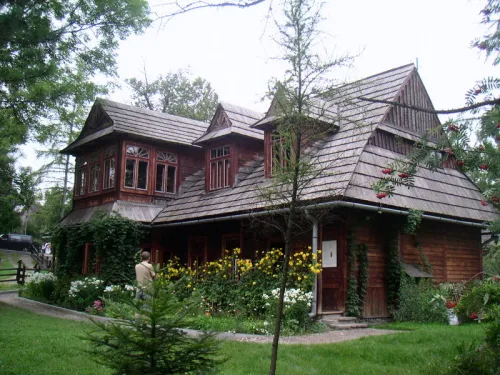
One day
Krupówki, the old cemetery, and a villa
Start at the Museum of Zakopane Style at Villa Koliba on ul. Kościuszki, the first house Witkiewicz built in 1892, then walk five minutes to Villa Atma on ul. Kasprusie to see the Szymanowski rooms. From there the Cmentarz na Pęksowym Brzyzku old cemetery is a ten-minute stroll, its hand-carved folk-art grave markers unlike anything else in Poland. End the afternoon on Krupówki for oscypek cheese at the Targ pod Gubałówką market and a quick look at the Tatra Museum at the promenade's head. The Zakopane Historic Walk covers all seven of these stops across 8.2 km in about 3.2 hours, a compact loop that shows the whole character of the town.
Two days
Into the Tatras: Kasprowy Wierch or Morskie Oko
Dedicate day two entirely to the mountains. The cleaner split: ride the Kasprowy Wierch cable car from Kuźnice (book on pkl.pl the day before in July and August) for ridge views at 1,987 m, or take the shuttle from Palenica Białczańska for the 9 km walk to Morskie Oko, Poland's most famous alpine lake. Start by 7:00 in peak months to beat the Palenica crowds, which top 30,000 visitors a day in summer. In the evening the Wielka Krokiew ski jump on ul. Droga do Skoczni is open until 17:00 with a funicular up the tower for 15 zł.
Three daysRecommended
A quieter valley and the Gubałówka panorama
Day three belongs to the gentler side of Zakopane. Walk the gravel path through Dolina Białego, a short valley west of the centre that feels remote but is pram-passable and free to enter. In the afternoon, take the Gubałówka funicular up from the top of Krupówki for the classic Tatra panorama, open daily 9:00 to 20:00. Finish with dinner at one of the Krupówki kitchens running highland produce: Kulig and Góralska Tradycja are two of the long-standing options.
Four days or more
Longer hikes, day trips, and ski time
A fourth day opens up more demanding Tatra routes: the Sarnia Skała viewpoint above Dolina Strążyska, the climb toward Giewont (allow 2.5 to 3 hours for descent, and leave the summit by 14:00 in summer to avoid the lightning-prone cross). Day trips to the wooden church village of Chochołów, 20 km north, or the salt mines at Wieliczka, an hour by road, fill a rest day well. In winter, extra days mean proper ski days on Kasprowy Wierch or the Gubałówka runs without feeling rushed.
Best time to visit Zakopane by traveller type
Same city, different trip. Here's the month that fits how you're travelling.
🧭
Best time to visit Zakopane for the first time
JunSep
Late June or early September. Both let you ride Kasprowy Wierch, hike to Morskie Oko and wander Krupówki without extreme queues, in pleasant 20-25°C weather. September is cheaper and has outstanding autumn light, so the whole highlights circuit works in one relaxed visit.
❤️
Best time to visit Zakopane for couples
MaySep
May for crocus bloom on the Kalatówki slopes and Chochołów meadows, green valleys and near-empty trails at about 60% of peak rates. September for gold-larch valleys, a crowd-free Morskie Oko and a genuinely romantic Krupówki once the summer coach parties have left.
💶
Best time to visit Zakopane on a budget
SepNov
September at 130-200 zł a night with the cable car running and full summer menus, or November at the year's floor of 120-180 zł with a peaceful Krupówki and uncrowded museums. Free or near-free sights help: Krupówki itself, Dolina Białego access and the Targ pod Gubałówką market cost nothing; the Tatra park trail ticket is just 10 zł.
🍝
Best time to visit Zakopane for food and wine
JunAug
Early June for the Restaurant Festival, when six kitchens including Kulig and Góralska Tradycja run special menus around highland spring produce. Or Folklore Festival week in late August for oscypek, grilled kiełbasa and kapuśniak from the stalls on Krupówki. Authentic spindle-shaped oscypek runs 25-40 zł at the Targ pod Gubałówką.
Worst time to visit Zakopane
The Małopolska winter school holidays in the first two weeks of February are the single hardest fortnight to visit: rooms sell out from October, guesthouses run at 100% capacity, and budget places simply disappear. Folklore Festival week in late August puts Krupówki shoulder-to-shoulder from early morning, packs the Morskie Oko trail before 7:00, and drives room rates to 400 to 560 zł a night, roughly triple the September price. The Christmas and New Year stretch from 24 December to 2 January carries the year's highest single-night rates and the same full-town pressure.
Still worth it for February still works well if skiing is the whole point and you book two-plus months out. Festival week in August is genuinely colourful and atmospheric: the traditional highland dance groups and the daily Krupówki parades are a real spectacle, and if the crowds do not bother you, the experience is memorable.
Go instead in June, September, when Zakopane is at its best.
Best time for a tour of Zakopane
Zakopane rewards walkers who time their visit carefully, because this mountain resort swings between two extremes: a winter ski town packed shoulder to shoulder with visitors in January, February, and again in August, and a quiet highland village that breathes freely in late spring and autumn. The sweet spot for the 8.2-kilometre circuit through town is late May through June, when temperatures sit between 14 and 19 °C, the Tatra peaks are still snow-capped but the paths are clear, and the crowds are thin enough that you can linger at the Tatra Museum without queuing. September is equally good: highs of 16 to 17 °C, only 14 rain days, and near-empty streets that make the stroll along Krupówki genuinely pleasant rather than a slow shuffle behind tour groups. Avoid August if you can: highs reach 21 °C but the town is heaving, with 15 rain days on top, and walking the funicular platform at Gubałówka among the crowds loses much of its appeal. January and February bring sub-zero lows (down to -5 °C), 14 to 15 rainy or snowy days, and the same packed atmosphere as peak summer, this time fuelled by skiers.
The upside of the AI Tourguide format is that the climate, not a departure sheet, sets your schedule. On a sunny September morning when Krupówki is quiet and the air has that cool highland edge, you simply open the tour in your browser and start your Zakopane tour at whatever hour suits the mountain light. The AI guide leads you through the route, telling stories about the wooden architecture at Villa Koliba, asking you what you notice, and adapting the conversation to your pace, whether you take twenty minutes at the Old Cemetery or push straight on to the ski jump. No login, no download, no fixed group to keep up with: just a voice-first guide talking with you the whole way, leaving you free to stop whenever the view earns it.

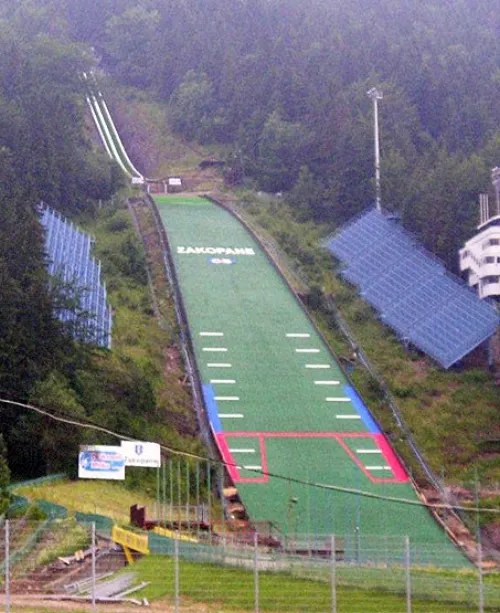
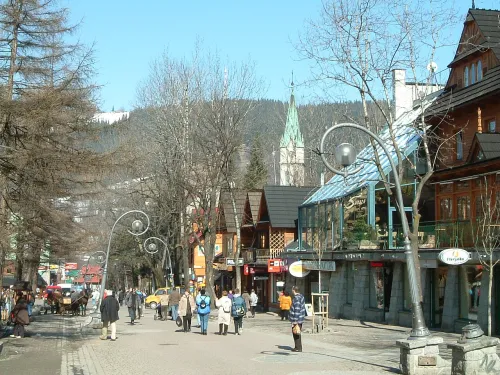 +3
+3All 7 stops are already on the map.
You just press start.
You just press start.
 AI Tourguide
You just read the route.
Now walk it with a guide in your ear.
Press start wherever you are, even hundreds of kilometres from Zakopane, and the guide begins telling its stories right away. In the city, pick any of the 7 stops to start from: it leads you there, then talks with you the whole route, asking, listening, remembering, and shaping the tour around your answers.
7stops8.2km3.2hours11languages
▶Start the tour freeFree to start · Runs in your browser · No app, no download
Zakopane events and festivals calendar
Annual highlights worth timing a trip around, listed month by month.
January
🏃 SportFIS Ski Jumping World Cup Zakopane Puchar Świata w Skokach Narciarskich
Jan 10–11
second weekend of January
The men's individual and team Large Hill (HS-140 Wielka Krokiew) World Cup, held here since 1979/80: a Super Team event and qualification on the Saturday, the individual competition with its first run at 16:00 on the Sunday, under floodlights.
🌸 Seasonal natureZakopane Snow Day
Jan 17 ~
third Saturday of January
A free community winter-activity day on the main square and slopes, with snow games, contests and animations aimed at families.
February
🌸 Seasonal natureLesser Poland Winter School Holidays Ferie zimowe Małopolska
Feb 2–15 ~
first two weeks of February
The two-week school holiday for the Lesser Poland region that includes Zakopane, when domestic ski tourism peaks and slopes and guesthouses run at full capacity.
🏃 SportKornel Makuszyński Memorial Skiing Memoriał Kornela Makuszyńskiego
Feb 28 – Mar 1
late February into early March
A historic children's and youth alpine ski competition on the local slopes, one of the oldest of its kind in Poland, held annually in late February or early March.
April
🏃 SportRed Bull Skoki w Punkt
Apr 1 ~
around the start of April
An invitational ski-jumping competition under the Wielka Krokiew featuring legends such as Adam Małysz and Janne Ahonen, in an informal entertainment format.
🏃 SportTatra Memorial Race Bieg Memoriału Tatrzan
Apr 9–11 ~
early to mid-April
A multi-day mountain-running and ski-touring competition in the Tatras over a long weekend.
🎵 MusicJazz Spring Zakopane Wiosna Jazzowa Zakopane
Apr 30 ~
late April into early May, around World Jazz Day
An international jazz festival anchored to World Jazz Day (30 April), with a prologue concert on Krupówki and further concerts in cultural venues across the town.
June
🍷 Food and wineZakopane Restaurant Festival Festiwal Restauracji Zakopane
Jun ~
during June
Six participating restaurants, including Kulig, Zbyrcok, La Prima, Trattoria Parmigiano, Grand Kasprowy and Góralska Tradycja, offering special menus and prix-fixe deals.
August
🎉 FestivalInternational Festival of Highland Folklore Międzynarodowy Festiwal Folkloru Ziem Górskich
Aug 21–27 ~
the last full week of August
A week-long celebration of highlander music, dance and costume from Poland and abroad, running since 1965, with groups competing for the Golden Ciupaga and daily parades and outdoor stages on Krupówki.
December
🎄 Christmas marketZakopane Christmas Market Jarmark Bożonarodzeniowy Zakopane
Dec 6 ~
first week of December through Epiphany
Wooden chalets on Niepodległości Square and Krupówki selling oscypek cheese, wool products, mulled wine and carved souvenirs, open daily 10:00-22:00.
🇮 HolidayZakopane New Year's Eve Sylwester w Zakopanem
Dec 31
31 December
A massive outdoor celebration on Krupówki with open-air concerts and fireworks over the Gubałówka hillside, drawing tens of thousands.
Insider tips for visiting Zakopane
The rules buried in forums, in one place.
- In July and August start the Morskie Oko hike by 6:30. The 9 km gravel road from Palenica Białczańska sees 30,000-plus visitors a day in peak season, and arriving at the carpark after 9:00 means a 2-3 km walk from forced roadside parking. The shuttle queue opens at 6:40; weekdays are notably thinner than weekends.
- Book the Kasprowy Wierch cable car online at pkl.pl up to 24 hours ahead. Without an advance ticket in July and August the ground-level queue at Kuźnice runs 2-3 hours and sells out by 10:00 on weekends. In March, June and September a walk-up is no problem.
- For the Małopolska winter holidays (2-15 February) book accommodation two-plus months out, as Polish families reserve en masse from October. To cut costs 20-30%, stay in Biały Dunajec or Poronin, 5-10 km out, and commute in.
- Check the Kasprowy Wierch maintenance window before booking an autumn trip. The cable car closes about three weeks in October-November (in 2025 it was 13 October to 7 November); the exact 2026 dates appear on pkl.pl closer to the time. The Gubałówka funicular stays open throughout, 9:00-20:00 daily.
- Carry the 10 zł Tatra National Park trail ticket and exact change. Validators sit at trailhead entries and inspectors check mid-trail, but there is no cash machine at Palenica Białczańska, so use the online app or bring coins before you set off for Morskie Oko, Dolina Białego or Sarnia Skała.
- Plan hikes to be off the trails by dark from 1 March to 30 November, when the Tatra park bans night hiking to protect wildlife and fines violators. Sunset runs around 20:30 in late June and 19:30 on 1 September. Descending from Giewont takes 2.5-3 hours, so leave the summit no later than 14:00 in summer, also the hour to be clear of the lightning-prone cross.
- Visit the Tatra Museum, the municipal museums and Villa Atma (the Szymanowski Museum) Tuesday to Sunday. All of them close on Mondays, so a Monday arrival meets locked doors. The Targ pod Gubałówką highlander market, by contrast, runs every day 9:00-19:00 year-round.
- Ride the Wielka Krokiew ski jump as a year-round attraction (9:00-17:00, 15 zł): the funicular lifts you up the tower to look down the in-run, a vertigo-inducing view even with no competition on. Late August adds Summer Grand Prix training on the ice-cooled track, the same floodlit setup that lets the World Cup run in January.
- The Corpus Christi procession (4 June) closes Krupówki entirely through the morning. The highland-dress procession is a genuine spectacle, so plan 9:00-12:00 to watch it, then the street reopens by midday. Do not try to drive or park in the centre that morning.
Public holidays in Zakopane
On these dates many shops and offices close, transport thins out, and sights can be mobbed or shut. Plan around them.
| Date | Holiday | What closes |
|---|---|---|
| Jan 1 | New Year's Day | Most shops closed, but Krupówki street-food stalls and some highlander restaurants stay open. Expect an accommodation check-out rush and a town still busy from the New Year crowds. |
| Jan 6 | Epiphany | Public holiday with Catholic masses and processions; many shops and offices closed. This is the day the Krupówki Christmas market winds up for the season. |
| Apr 5 | Easter Sunday | Most shops closed and churches packed. The deeply Catholic Podhale region holds processions in full highland dress, a striking sight even outside the big summer festivals. |
| Apr 6 | Easter Monday | Public holiday marked by the śmigus-dyngus water-throwing tradition. Outdoor stalls open but most shops stay shut; a possible price bump on the Easter weekend. |
| May 1 | Labour Day | Public holiday that bridges to 3 May for a four-day weekend, bringing mild crowds of domestic visitors and a slight lift in room rates. |
| May 3 | Constitution Day | Public holiday with patriotic ceremonies. Combined with Labour Day it makes a long weekend, so accommodation prices edge up across the early-May window. |
| Jun 4 | Corpus Christi | Public holiday with an outdoor religious procession in full góralski highland costume that closes Krupówki through the morning, a genuine cultural spectacle. The street reopens by midday. |
| Aug 15 | Assumption | Public holiday with all-day religious observance, falling inside Highland Folklore Festival week. The combination pushes the town to its maximum August crowds. |
| Nov 1 | All Saints' Day | Public holiday when the historic Cmentarz na Pęksowym Brzyzku cemetery is heavily visited with candles, a moving but crowded scene in an otherwise quiet month. |
| Nov 11 | Independence Day | Public holiday with patriotic events on Niepodległości Square. The quietest month of the year otherwise carries on as normal. |
| Dec 25 | Christmas Day | Almost all shops and restaurants closed and ski lifts on a reduced schedule, with hotels full. A still day in the middle of the December peak. |
| Dec 26 | Second Christmas Day | Public holiday with most venues reopening in the afternoon; the ski season is at its peak and the town stays busy through the holidays. |
Zakopane month by month
January in Zakopane
High1°C / 33°F
Low-5°C
Rain70mm / 14 rainy days
Sun4.3 h/day
Daylight9 h/day
Humidity80%
Crowds●●●●●Prices●●●●●
January is full-throttle winter Zakopane. Valley daytime highs sit between -2°C and +4°C and nights regularly drop to -10°C to -15°C, with the ski season in full swing on Kasprowy Wierch and Gubałówka. The FIS Ski Jumping World Cup roars under the floodlit Wielka Krokiew on the second weekend, drawing 40,000-plus fans, and the Christmas-New Year hangover keeps the town busy into mid-month. After about 12 January, once the World Cup has passed and before the February school holidays, prices and crowds soften noticeably.
The vibe This is Zakopane at its most alpine and energetic: snow underfoot, ski jumpers in the sky and the highland-food smell of grilled oscypek on Krupówki. The World Cup weekend is electric if you love ski jumping and chaotic if you do not. Layer hard against the cold, and aim for mid-to-late January if you want the snow without the early-month crowds.
Don't miss Ski or watch the World Cup under the Wielka Krokiew, then ride the same floodlit jump tower as a 15 zł attraction. Kasprowy Wierch (1987 m) and Gubałówka run groomed pistes, and on 17 January the free Zakopane Snow Day brings family snow games to the main square.
Crowd drivers The FIS World Cup (10-11 January) fills every town-centre hotel and triggers New Year residuals, the Christmas-New Year carryover, and the start of domestic ski-holiday demand toward month-end.
In season Deep-winter comfort food peaks: żurek sour rye soup, bigos hunter's stew and grilled highland kiełbasa from the Krupówki stalls warm you between runs.
Heads up New Year's Day (1 January) and Epiphany (6 January) close most shops, though Krupówki street-food stalls stay open. The Krupówki Christmas market ends on 6 January.
Ski-season high: 3-star centre rooms 350-520 zł, rising to 400-600 zł over the FIS World Cup weekend (10-11 January).
Events this month
🏃 SportFIS Ski Jumping World Cup Zakopane Puchar Świata w Skokach Narciarskich
Jan 10–11
second weekend of January
The men's individual and team Large Hill (HS-140 Wielka Krokiew) World Cup, held here since 1979/80: a Super Team event and qualification on the Saturday, the individual competition with its first run at 16:00 on the Sunday, under floodlights.
Zakopane's defining winter spectacle, drawing 40,000-plus fans and the single biggest annual spectator event. Hotel prices spike 20-30% that weekend, so book two-plus months ahead.
🌸 Seasonal natureZakopane Snow Day
Jan 17 ~
third Saturday of January
A free community winter-activity day on the main square and slopes, with snow games, contests and animations aimed at families.
A low-pressure, family-friendly mid-January draw, landing in the relatively soft window after the World Cup and before the February school-holiday crush.
February in Zakopane
High3°C / 37°F
Low-4°C
Rain81mm / 15 rainy days
Sun5.5 h/day
Daylight10 h/day
Humidity78%
Crowds●●●●●Prices●●●●●
February is the ski season at its absolute peak, dominated by the two-week Małopolska winter school holidays (2-15 February) when Polish families fill the slopes and guesthouses to capacity. Valley highs stay near -2°C to +4°C with the most reliable snow cover of the year. This is the single hardest fortnight to find a room, with budget places selling out from October. For skiers it is glorious; for anyone after a relaxed cultural or hiking trip, it is the month to avoid.
The vibe If you have come to ski, February is the high point: deep snow, long days on the piste and a buzzing town. If you have not, it can feel relentless, with packed slopes, full restaurants and no spare beds. The late-February Makuszyński memorial ski race signals the first easing as the holiday crowds finally start to thin.
Don't miss Peak skiing on Kasprowy Wierch and Gubałówka, sledging and the Targ pod Gubałówką market for oscypek and wool. From 28 February the 73rd Makuszyński youth ski race brings a colourful local-tradition close to the holiday season.
Crowd drivers The Małopolska ferie zimowe (2-15 February) is the most intense ski-crowd block of the year, with domestic ski tourism at maximum and 100% occupancy common.
In season Still the heart of żurek and bigos season; warming highland soups like kapuśniak and grilled cheese carry the cold days on the slopes.
Year's hardest rooms to find: 380-560 zł a night, surging to 450-650 zł during the Małopolska ferie (2-15 February).
Events this month
🌸 Seasonal natureLesser Poland Winter School Holidays Ferie zimowe Małopolska
Feb 2–15 ~
first two weeks of February
The two-week school holiday for the Lesser Poland region that includes Zakopane, when domestic ski tourism peaks and slopes and guesthouses run at full capacity.
The most intense ski-crowd fortnight of the year. Book months ahead or expect no availability; for a relaxed cultural or hiking trip, avoid it entirely.
🏃 SportKornel Makuszyński Memorial Skiing Memoriał Kornela Makuszyńskiego
Feb 28 – Mar 1
late February into early March
A historic children's and youth alpine ski competition on the local slopes, one of the oldest of its kind in Poland, held annually in late February or early March.
A colourful local sports tradition that caps the end of the ferie season, a low-key way to catch Zakopane's ski-town character as the crowds start to thin.
March in Zakopane
High6°C / 43°F
Low-2°C
Rain62mm / 13 rainy days
Sun7.9 h/day
Daylight12 h/day
Humidity73%
Crowds●●●○○Prices●●●○○
March is the late ski season with good snow cover holding until late in the month, but with the February crush gone and far fewer Polish school groups. Spring melt begins toward month-end. It is a genuinely good-value window: you can still ski the upper Kasprowy Wierch runs, prices have dropped to mid-range, and Kasprowy walk-up access is easy without the peak-season queues. From 1 March the Tatra night-hiking ban begins, so plan to be off the trails by dark.
The vibe March is the relaxed tail of winter: snow up high, sun starting to feel warm in the valley, and the slopes no longer elbow-to-elbow. It is the smart skier's month, when you get reliable upper-mountain snow at a fraction of the February price and rarely have to queue for the cable car.
Don't miss Ski the upper Kasprowy Wierch runs, which often hold skiable snow well into spring, with a queue-free walk-up. Lower-altitude valley trails begin to thaw, so save serious Tatra hikes for later and enjoy the easy spring skiing.
Crowd drivers The school holidays are over and the late ski season keeps a steady but moderate flow; the Makuszyński race spills into the first days of the month.
In season Winter highland cooking lingers: this is still strong territory for bigos, żurek and oscypek before the spring menus arrive.
Prices ease to 220-320 zł a night as the school groups leave and the late ski season runs on.
Events this month
🏃 SportKornel Makuszyński Memorial Skiing Memoriał Kornela Makuszyńskiego
Feb 28 – Mar 1
late February into early March
A historic children's and youth alpine ski competition on the local slopes, one of the oldest of its kind in Poland, held annually in late February or early March.
A colourful local sports tradition that caps the end of the ferie season, a low-key way to catch Zakopane's ski-town character as the crowds start to thin.
April in Zakopane
High10°C / 51°F
Low2°C
Rain98mm / 15 rainy days
Sun9.0 h/day
Daylight14 h/day
Humidity73%
Crowds●●○○○Prices●●○○○
April is the spring shoulder and Zakopane's awkward in-between month: the ski lifts are closing, the hiking season has not yet opened, and the weather is cold and often rainy. Lower forest paths turn to mud as the snowpack thaws, with avalanche risk on the upper slopes, so most marked Tatra routes stay closed until late May. The reward is the crocus bloom, which carpets the Kalatówki slopes and the Chochołów meadows in the last two weeks. Apart from Easter, it is the quietest and cheapest month after November.
The vibe April is for travellers who want Zakopane near-empty and do not mind unsettled weather. It is too late to ski reliably and too early for the high trails, but the wild crocus fields are a specific, photogenic draw, and the spring ski-jumping events under the Wielka Krokiew bring a last burst of winter-sport energy.
Don't miss Walk to the crocus fields on the Kalatówki slopes or out to Chochołów village (20 km) in the last fortnight of April. The Red Bull Skoki w Punkt invitational (around 1 April) and the Tatra Memorial Race (9-11 April) add spring spectacle. The well-maintained Morskie Oko road stays accessible while higher trails are still closed.
Crowd drivers A genuine low, broken only by the Easter weekend and a couple of spring sporting events. The hiking season has not started, so general pressure is light.
In season The first spring highland produce begins to appear, the lead-in to June's Restaurant Festival, while the winter soups remain on most menus.
Heads up Easter Sunday (5 April) closes most shops with churches packed and highland-dress processions; Easter Monday (6 April) brings the śmigus-dyngus water tradition with most shops shut.
The year's quiet low point at 170-260 zł a night, with the Easter weekend running 30-40% higher.
Events this month
🏃 SportRed Bull Skoki w Punkt
Apr 1 ~
around the start of April
An invitational ski-jumping competition under the Wielka Krokiew featuring legends such as Adam Małysz and Janne Ahonen, in an informal entertainment format.
A fun spring spectacle that has grown quickly in its early editions, with ticket demand rising each year. Pairs well with the very end of the ski season.
🏃 SportTatra Memorial Race Bieg Memoriału Tatrzan
Apr 9–11 ~
early to mid-April
A multi-day mountain-running and ski-touring competition in the Tatras over a long weekend.
Brings a sporty, adventurous crowd into the shoulder season; expect possible road closures around the event.
🎵 MusicJazz Spring Zakopane Wiosna Jazzowa Zakopane
Apr 30 ~
late April into early May, around World Jazz Day
An international jazz festival anchored to World Jazz Day (30 April), with a prologue concert on Krupówki and further concerts in cultural venues across the town.
One of Poland's top jazz events, set in a relaxed shoulder season with free outdoor concerts and easy crowds.
May in Zakopane
High15°C / 58°F
Low6°C
Rain159mm / 18 rainy days
Sun9.8 h/day
Daylight15 h/day
Humidity75%
Crowds●●○○○Prices●●○○○
May is the early hiking season and one of Zakopane's quiet pleasures. The alpine meadows green up, the late crocus bloom carries over from April, temperatures turn pleasant and crowds stay light. Permanent snow usually clears the higher trails by late May, so the full Tatra hiking network gradually reopens through the month. The Labour Day to Constitution Day bridge (1-3 May) brings a brief domestic long-weekend crowd, but otherwise it is excellent value with near-empty trails.
The vibe May is the couples' and walkers' month: green valleys, candlelit guesthouses at around 60% of peak prices, and trails you can have almost to yourself. The high routes are still opening week by week as the snow retreats, so check conditions, but the lower valleys are at their fresh, blossoming best.
Don't miss Catch the tail of the crocus bloom on the Kalatówki slopes, hike the greening lower valleys, and ride Kasprowy Wierch as a walk-up. The Jazz Spring concerts around World Jazz Day (30 April) carry into early May with free outdoor sets on Krupówki.
Crowd drivers The early-May long weekend (1-3 May) brings a short domestic crowd; otherwise the hiking season is just opening and international pressure stays low.
In season Highland spring produce comes into season, and the gourmet kitchens that join June's Restaurant Festival start trialling their warm-weather menus.
Strong value at 160-240 zł a night, edging up only around the early-May long weekend.
Events this month
🎵 MusicJazz Spring Zakopane Wiosna Jazzowa Zakopane
Apr 30 ~
late April into early May, around World Jazz Day
An international jazz festival anchored to World Jazz Day (30 April), with a prologue concert on Krupówki and further concerts in cultural venues across the town.
One of Poland's top jazz events, set in a relaxed shoulder season with free outdoor concerts and easy crowds.
June in Zakopane
High20°C / 67°F
Low11°C
Rain138mm / 16 rainy days
Sun11.6 h/day
Daylight16 h/day
Humidity75%
Crowds●●○○○Prices●●○○○
June is one of the two best months to visit. The hiking season is fully open, the Tatra wildflowers are out, and valley highs reach a comfortable 20-25°C, all before the Polish summer holidays trigger the July crush. Day-trippers from Kraków begin to arrive but the town still breathes. It is the wettest month alongside July, with rapid afternoon thunderstorms over the Tatras, so hike the 7:00-13:00 window. The Restaurant Festival and the Corpus Christi procession add cultural colour.
The vibe June feels like Zakopane at ease: every attraction open, wildflowers in the valleys, long light evenings and no school-group crush. It is the first-timer's and family's month, warm enough for gentle walks like the pram-passable Dolina Białego, with the Restaurant Festival giving foodies a low-crowd excuse to linger.
Don't miss Hike Morskie Oko or the valley trails with manageable crowds, ride Kasprowy Wierch as an easy walk-up, and catch the Restaurant Festival across six town kitchens. The Corpus Christi procession (4 June) closes Krupówki through the morning in full highland dress, a genuine spectacle.
Crowd drivers Kraków day-trippers begin and the early summer draw builds, but the Polish school holidays start in late June to early July, so June stays short of the peak.
In season The Restaurant Festival anchors the month, with kitchens like Kulig and Góralska Tradycja building special menus around highland spring produce.
Heads up Corpus Christi (4 June) is a public holiday whose procession closes Krupówki to traffic through the morning; the street reopens by midday.
Pre-summer value at 180-260 zł a night, before the July school-holiday rates take hold.
Events this month
🍷 Food and wineZakopane Restaurant Festival Festiwal Restauracji Zakopane
Jun ~
during June
Six participating restaurants, including Kulig, Zbyrcok, La Prima, Trattoria Parmigiano, Grand Kasprowy and Góralska Tradycja, offering special menus and prix-fixe deals.
Good shoulder-season foodie value built around highland spring produce, landing in an uncrowded June before the summer rush.
July in Zakopane
High21°C / 69°F
Low12°C
Rain158mm / 18 rainy days
Sun11.8 h/day
Daylight16 h/day
Humidity75%
Crowds●●●●○Prices●●●●○
July is high summer and one of the two busiest months. The Polish summer holidays are in full swing, the Morskie Oko queues turn extreme, and Kasprowy Wierch cable-car waits stretch to 2-3 hours without an advance ticket. German and Czech tourists join the Polish crowds. Valley temperatures of 20-28°C are pleasant rather than punishing, but afternoon thunderstorms are a serious ridge hazard, so the smart hiking window is 7:00-13:00. Weekdays are noticeably thinner than weekends on the big trails.
The vibe July is busy, warm and trail-focused, with the whole region out hiking. The classic sights are spectacular but you have to plan around the crowds: dawn starts for Morskie Oko, online tickets for the cable car, and an eye on the afternoon storm clouds. When the guided-tour prices and queues climb, our live AI guide is the always-available, flat-priced alternative to an expensive pre-booked human guide, telling you the story of Krupówki and the highland heritage as you walk it in the cool of the morning, at 5 euro an hour or 20 all in, with 100 free credits to start.
Don't miss Start the 9 km Morskie Oko walk by 6:30 to beat the crowds, book Kasprowy Wierch online at pkl.pl up to 24 hours ahead, and time summit hikes like Giewont to descend by 14:00 ahead of the storms. The Wielka Krokiew ski jump runs year-round as a 15 zł attraction.
Crowd drivers Polish summer school holidays drive the peak, joined by heavy German and Czech travel. Morskie Oko sees over 30,000 visitors a day and the Kasprowy queues sell out by 10:00 on weekends.
In season Highland street food is everywhere now: grilled oscypek with cranberry, kiełbasa and placki ziemniaczane from the Krupówki and Gubałówka market stalls.
Summer peak pricing at 300-440 zł a night as Polish school holidays drive demand.
August in Zakopane
High21°C / 70°F
Low13°C
Rain133mm / 15 rainy days
Sun10.7 h/day
Daylight14 h/day
Humidity76%
Crowds●●●●●Prices●●●●●
August is the year's busiest month, combining peak summer holidays with the International Festival of Highland Folklore (21-27 August). During Festival week Krupówki is shoulder-to-shoulder and the Morskie Oko trail is packed from before 7 am. The Assumption holiday (15 August) lands mid-festival and pushes crowds to their absolute maximum. Weather stays in the 20-28°C valley range with the same afternoon-thunderstorm pattern as July. It is colourful and atmospheric, but the least comfortable month if you dislike crowds.
The vibe August is Zakopane at full volume. The Folklore Festival is a genuine highlight, with daily highlander parades, costume, music and the competition for the Golden Ciupaga, but the trade is total congestion in town and on the trails. Come for the festival and embrace it, or time your visit for the first half of the month and start every hike at dawn.
Don't miss Catch the daily Folklore Festival parades and outdoor stages on Krupówki, with international highlander groups competing for the Golden Ciupaga. Beat the trail crush with a pre-7 am Morskie Oko start, and watch the late-August Summer Grand Prix ski-jump training on the Wielka Krokiew.
Crowd drivers The 57th Highland Folklore Festival (21-27 August) is the summer's biggest crowd-driver, stacked on peak Polish holidays and the Assumption public holiday (15 August).
In season Festival week turns Krupówki into a highland food fair: oscypek, grilled kiełbasa, kapuśniak and regional specialities from the stalls.
Heads up The Assumption (15 August) is a public holiday with all-day religious observance, falling inside Festival week and intensifying the crowds.
Peak summer at 340-500 zł a night, surging to 400-560 zł during Folklore Festival week (21-27 August).
Events this month
🎉 FestivalInternational Festival of Highland Folklore Międzynarodowy Festiwal Folkloru Ziem Górskich
Aug 21–27 ~
the last full week of August
A week-long celebration of highlander music, dance and costume from Poland and abroad, running since 1965, with groups competing for the Golden Ciupaga and daily parades and outdoor stages on Krupówki.
Zakopane's biggest summer cultural event, and the year's peak crowd-driver: colourful and atmospheric, but it puts Krupówki shoulder-to-shoulder and pushes Festival-week rooms to 400-560 zł a night.
September in Zakopane
High17°C / 62°F
Low9°C
Rain137mm / 14 rainy days
Sun8.6 h/day
Daylight13 h/day
Humidity79%
Crowds●●○○○Prices●●○○○
September is arguably the best month of all. The summer crowds are gone now that schools are back, the hiking is excellent, and Kasprowy Wierch and Morskie Oko become walk-up, queue-free experiences. It is drier and clearer than the summer, with the first autumn colours arriving in the upper valleys late in the month. Prices fall to the year's floor, around 67% below peak, while restaurants still run their full summer menus. For value, weather and calm combined, nothing beats it.
The vibe September feels like Zakopane exhaling. The trails are quiet, the light turns golden, and you can hike to the great lakes or ride the cable car without queueing or pre-booking. It is the value and quiet champion, romantic on a near-empty Krupówki and ideal for a first visit, with everything still open and the weather still kind.
Don't miss Hike Morskie Oko or the Dolina Pięciu Stawów with zero queue, ride a walk-up Kasprowy Wierch (book before the autumn maintenance window), and catch the first autumn colours in the upper valleys from late September. Authentic oscypek runs 25-40 zł at the Targ pod Gubałówką.
Crowd drivers Polish school holidays are over and the summer tourists have left, so general pressure drops sharply; this is the post-summer lull.
In season Restaurants keep their full summer menus while early-autumn produce arrives, making September a quietly excellent month to eat well at low-season prices.
The cheapest month of the year at 130-200 zł a night, roughly 60-67% below the summer peak.
October in Zakopane
High12°C / 54°F
Low5°C
Rain101mm / 12 rainy days
Sun6.7 h/day
Daylight11 h/day
Humidity79%
Crowds●●○○○Prices●●○○○
October is peak autumn foliage and the quietest hiking month. The larch and beech forests around Dolina Białego, Dolina Strążyska and the Gubałówka hillside turn gold and orange, peaking in the first week, with the upper valleys colouring slightly earlier. Crowds are minimal. The catch is the Kasprowy Wierch cable car, which closes for about three weeks of annual maintenance from mid-October into early November, so check pkl.pl before relying on it. Some guesthouses begin to close for the season.
The vibe October is the foliage month: cool, golden and almost empty, with the valleys at their most photogenic. It is a walker's and couple's quiet pleasure, just be aware the summit cable car may be down for maintenance, so plan around valley trails and the Gubałówka funicular, which stays open throughout.
Don't miss Walk the gold-larch valleys of Dolina Białego and Strążyska at peak colour in the first half of the month. With the Kasprowy cable car likely in maintenance, ride the Gubałówka funicular (9:00-20:00 daily) for the views instead, and time hikes to be off the trails by the earlier dusk.
Crowd drivers The quietest hiking month, with foliage drawing a trickle of photographers and walkers but no real crowds; some guesthouses close, thinning the town further.
In season Hearty autumn highland cooking returns, with bigos, mushroom dishes and warming soups suiting the cooler days; the Targ pod Gubałówką market runs daily for oscypek and produce.
Quiet autumn value at 140-210 zł a night, with some guesthouses starting to close for the off-season.
November in Zakopane
High6°C / 44°F
Low0°C
Rain62mm / 12 rainy days
Sun5.0 h/day
Daylight9 h/day
Humidity83%
Crowds●○○○○Prices●○○○○
November is the quietest, cheapest month of the year, a pre-ski shoulder with minimal events. The Kasprowy Wierch cable car is typically closed for around three weeks of maintenance into early November, and many restaurants run reduced hours. Reliable valley snow usually arrives only by late November. The reward is solitude and the lowest prices going: a peaceful Krupówki, uncrowded museums, and rooms from 120-180 zł. The night-hiking ban lifts on 30 November as winter trail access opens up.
The vibe November is Zakopane at its most introverted: grey, quiet and cheap, with the cable car down and the ski season not yet started. It suits low-key valley walks, museum visits and a calm Krupówki rather than summit days. Come for the price and the peace, and bring warm layers for the damp pre-winter chill.
Don't miss Walk the quiet lower valleys and visit the museums uncrowded (closed Mondays). On All Saints' Day the historic Cmentarz na Pęksowym Brzyzku glows with candles. The Gubałówka funicular stays open, and once the cable-car maintenance ends and snow arrives late month, the first winter trails open.
Crowd drivers The pre-ski shoulder, with the cable car closed and few events, keeps visitor pressure at its annual minimum; All Saints' Day (1 November) briefly busies the old cemetery.
In season A good month for hearty highland comfort food like bigos and żurek, though check ahead as some restaurants run reduced off-season hours.
Heads up All Saints' Day (1 November) and Independence Day (11 November) are public holidays; many guesthouses and some restaurants run reduced hours or close for the pre-ski lull.
The year's price floor at 120-180 zł a night, with the Kasprowy cable car closed and many restaurants on reduced hours.
December in Zakopane
High2°C / 36°F
Low-4°C
Rain73mm / 13 rainy days
Sun3.7 h/day
Daylight8 h/day
Humidity82%
Crowds●●●●○Prices●●●●○
December brings the Christmas market and the opening of the ski season, with near-certain snow: about an 80% chance of snow cover by the 25th, making a white Christmas almost guaranteed. Wooden chalets line Niepodległości Square and Krupówki from early December, open daily 10:00-22:00. The Christmas and New Year stretch (24 December to 2 January) is the most expensive of the year, ending with the huge open-air Sylwester celebration on Krupówki. Early and mid-December are far better value than the holiday peak.
The vibe December is snow-town Zakopane at its most magical: chalets, mulled wine, fresh powder and the ski lifts spinning. It is festive and atmospheric but busy and pricey at the holidays, with New Year's Eve the single dearest night of the year. Come in early December or the 12-22 December window for the snow and market without the peak crush.
Don't miss Wander the Krupówki Christmas market for oscypek, mulled wine and carved souvenirs, ski the freshly opened Kasprowy Wierch and Gubałówka pistes, and join the open-air Sylwester concert and fireworks over the Gubałówka hillside on New Year's Eve.
Crowd drivers The Christmas market, the ski-season opening and the Christmas-New Year holidays drive crowds, peaking around Sylwester on 31 December when tens of thousands gather on Krupówki.
In season Peak season for winter highland cooking: żurek, bigos and grilled oscypek at every market stall, with mulled wine to match the snow.
Heads up Christmas Day (25 December) closes almost all shops and restaurants with ski lifts on a reduced schedule; Second Christmas Day (26 December) sees most venues reopen in the afternoon.
Festive peak at 300-480 zł a night, with the 24 December to 2 January stretch the year's most expensive at 450-700 zł.
Events this month
🎄 Christmas marketZakopane Christmas Market Jarmark Bożonarodzeniowy Zakopane
Dec 6 ~
first week of December through Epiphany
Wooden chalets on Niepodległości Square and Krupówki selling oscypek cheese, wool products, mulled wine and carved souvenirs, open daily 10:00-22:00.
It pairs the market with the ski-season opening and near-certain snow for a genuinely atmospheric setting, but it gets very busy from 23 December to 2 January, the year's most expensive nights.
🇮 HolidayZakopane New Year's Eve Sylwester w Zakopanem
Dec 31
31 December
A massive outdoor celebration on Krupówki with open-air concerts and fireworks over the Gubałówka hillside, drawing tens of thousands.
The most expensive single night of the year, with hotel rates doubling. Book three-plus months ahead, or stay in Nowy Targ and commute in.
Frequently asked questions
What is the best time to visit Zakopane?
June and September are the best overall. Both give you every attraction open, comfortable 20-25°C valley hiking and no school-group crush. June adds Tatra wildflowers and the Restaurant Festival; September is the smarter pick for value, with autumn light, walk-up queue-free access to Morskie Oko and Kasprowy Wierch, and rooms around 130-200 zł a night, roughly 30-40% below the summer peak.
What is the cheapest time to visit Zakopane?
September and November are the cheapest. September runs about 130-200 zł a night with the cable car operating, superb hiking and full summer restaurant menus. November is the absolute floor at 120-180 zł, but the Kasprowy Wierch cable car is closed for maintenance and many restaurants are on reduced hours, so it suits low-key valley walks more than summit days.
What is the worst time to visit Zakopane?
It depends what you want. For a relaxed cultural or hiking trip, avoid the Małopolska winter holidays (2-15 February), when domestic ski families fill every room weeks ahead, and Highland Folklore Festival week (21-27 August), when Krupówki is shoulder-to-shoulder and Morskie Oko is packed from before 7 am. Christmas and New Year (24 December to 2 January) carry the year's highest rates, up to 700 zł a night.
When is the best time to hike in Zakopane?
June and September are ideal. The full Tatra trail network is open, valley temperatures sit at a comfortable 20-25°C, and September in particular is dry, clear and crowd-free. Avoid April and early May, when lower paths are muddy and higher routes stay closed by snow until late May. In July and August start big hikes like Morskie Oko by 6:30 and descend exposed summits like Giewont by 14:00 to avoid afternoon thunderstorms; the night-hiking ban runs 1 March to 30 November.
When is the ski season in Zakopane?
Reliable valley snow arrives by late November, and the groomed pistes on Kasprowy Wierch (1987 m) and Gubałówka run roughly December to March, with the upper Kasprowy runs often skiable into May. February is the peak, dominated by the Małopolska school holidays (2-15 February) when slopes are at capacity. For the best snow with softer crowds, aim for mid-to-late January, after the World Cup and before the ferie, or March.
Will there be snow in Zakopane at Christmas?
Almost certainly. Sitting at 850 m altitude, Zakopane has roughly an 80% probability of snow cover by 25 December, far higher than most lowland European cities. That near-guaranteed white Christmas, plus the Krupówki Christmas market and the opening ski season, is the main reason December hotel rates surge to 300-480 zł, and up to 450-700 zł over the holiday peak.
How do I avoid the crowds at Morskie Oko and Kasprowy Wierch?
Time and tickets are everything in July and August. Start the 9 km Morskie Oko walk by 6:30, as the trail draws over 30,000 visitors a day and arriving at the carpark after 9:00 forces a 2-3 km extra walk. Book Kasprowy Wierch online at pkl.pl up to 24 hours ahead, since the walk-up queue at Kuźnice hits 2-3 hours and sells out by 10:00 on weekends. In June, September and weekdays generally, the queues largely vanish.
When is the Highland Folklore Festival in Zakopane?
The International Festival of Highland Folklore runs the last full week of August, 21-27 August in 2026, with daily highlander parades, music, dance and costume on Krupówki and groups competing for the Golden Ciupaga. It is Zakopane's biggest summer cultural event, colourful and atmospheric, but it makes the busiest and most expensive week of the year, with Festival-week rooms reaching 400-560 zł a night, so book well ahead.
How many days do you need in Zakopane?
Two to three days cover the essentials: a day hiking to Morskie Oko, a day on Kasprowy Wierch and the Gubałówka funicular, plus time on Krupówki, the Wielka Krokiew ski jump, the Tatra Museum and the historic Pęksowy Brzyzek cemetery. Add a day in winter for skiing or in summer for a second high-mountain hike like the Dolina Pięciu Stawów. The compact town centre is easily walkable in a short stay.

Any month, any day: your guide is already there
Whatever date you pick, a private human guide gets pricier and harder to book on weekends, holidays and in peak season. Our live AI guide, the one that walks with you and answers anything you ask out loud, works the opposite way.
One flat price, every day
No holiday, weekend, night or peak-season surcharge. A private guide in Zakopane runs well over 100 euro for a half day, and more on holidays. Ours stays the same.
Available the moment you want it
Start at midnight or at dawn, on Christmas, in the snow, in the August heat. No sold-out high season, no booking weeks ahead.
Your pace, no meter running
Pause for a long lunch, restart after dark, repeat a stop. The tour simply waits for you.
Free to try, a fraction of the cost
Test it for free, then a transparent flat price that undercuts any private guide, in every season.
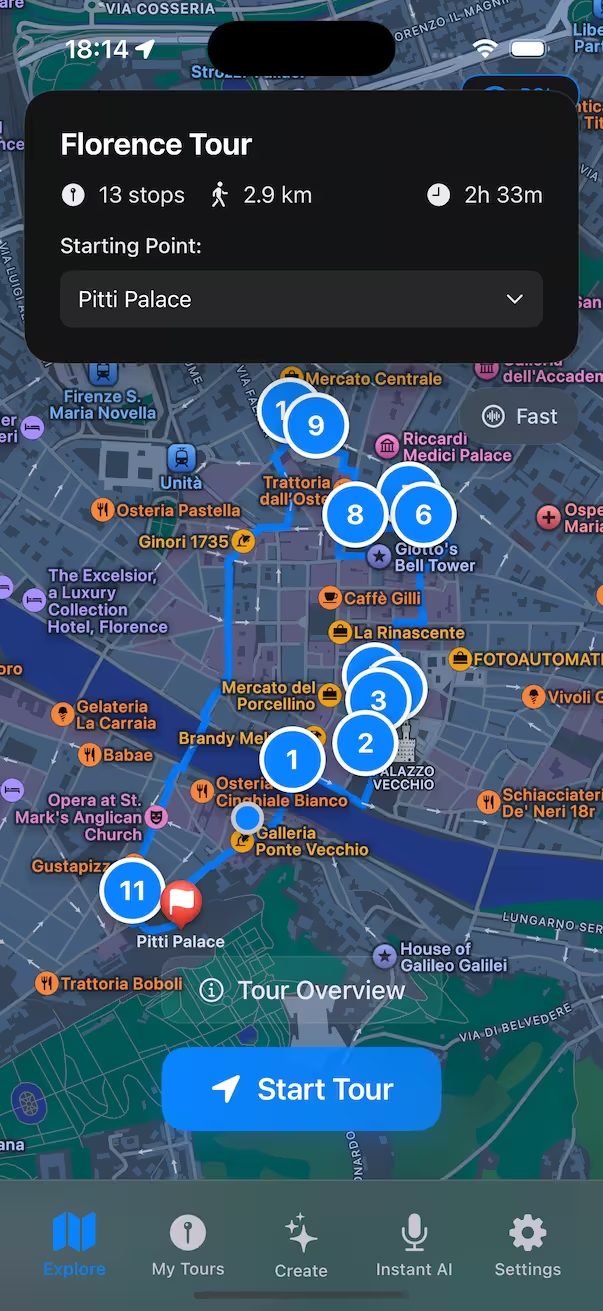
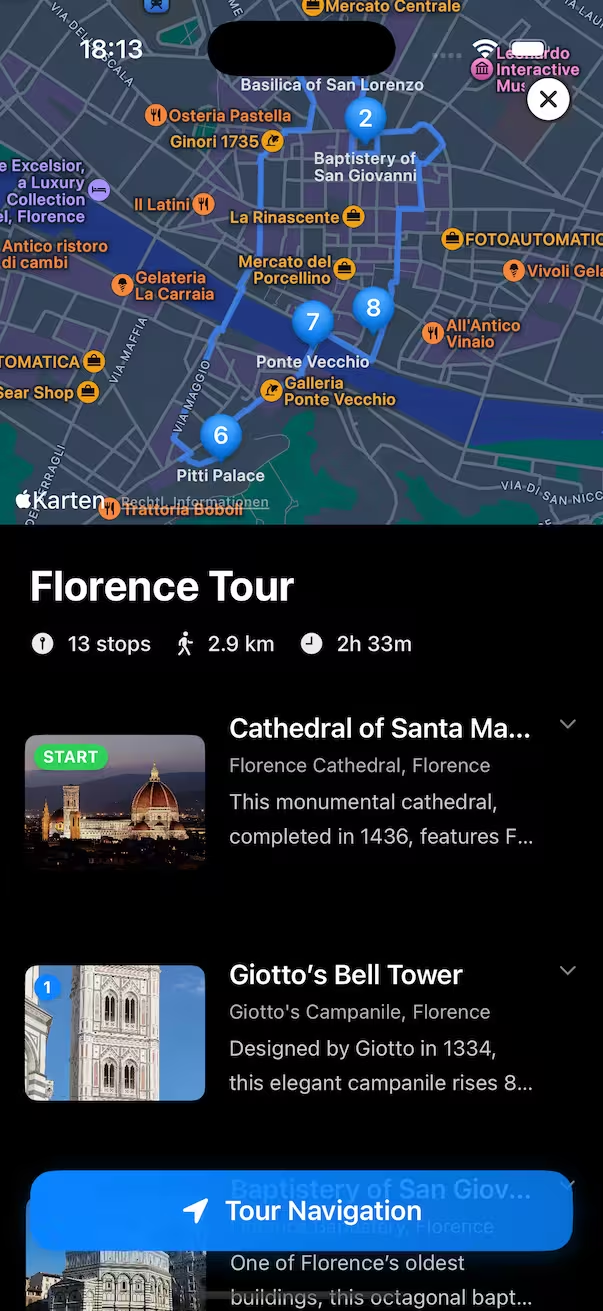
The classic Zakopane tour: 7 stops, 8.2 km, about 3 h on foot
Your live AI guide and the self-guided Zakopane route, together in your browser.