
Florence to Orvieto Day Trip: Train, Funicular, the Plan
The train is the right answer on this route, ~2h10 from Firenze S.M.N., and a funicular then hauls you up onto a volcanic rock where the streets are level, the Duomo blazes gold mosaic, and 2,500-year-old caves sit under your feet. Here is the honest day plan, with a free self-guided walking tour for the hours on the ground.
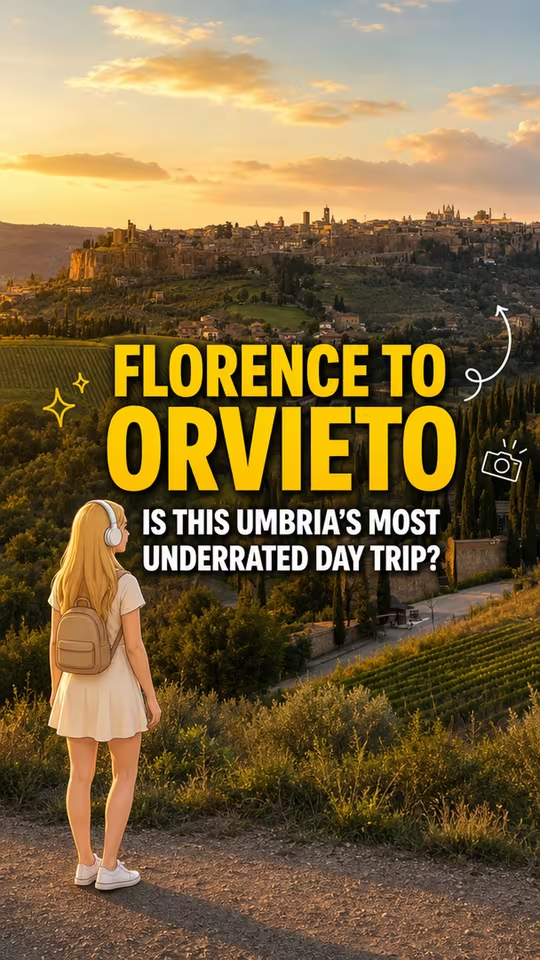
The Quick Answer: Florence to Orvieto
The smart way from Florence to Orvieto is the train, and once you know the geography it is not close. Trenitalia regional trains run from Firenze Santa Maria Novella to Orvieto in about 2 hours 10 minutes, several times a day, for €10.50 to €15 one way. If you can grab one of the six weekly Intercity services, the run drops to about 1h38. Either way you arrive at Orvieto station at the base of the cliff, and a funicular (every 10 minutes, €1.30) hauls you up to Piazza Cahen in five minutes, dropping you straight into the medieval town. No taxi, no bus, no uphill slog.
As a day trip Orvieto is a quiet winner. The whole town fits on a flat slab of volcanic tufa barely a kilometer across, the streets are level once you are up top, and the four heavy hitters, the Duomo, the underground caves, St. Patrick's Well, and the central tower, sit within a ten-minute walk of each other. You can absolutely "do" Orvieto in a day.
| Question | Answer |
|---|---|
| Fastest journey time | ~1h38 by Intercity (6/week). ~2h10 by the regional train, which is the day-tripper default |
| Frequency | Regional trains every 2-4 hours from early morning to ~8:30 p.m. IC limited |
| Price from | €10.50 regional one way (walk-up). Intercity €15-25 one way |
| Operators / how | Trenitalia regional + Intercity. FlixBus once daily, not practical for a day trip |
| First / last | First regional around 5:30-6:00 a.m.; last back from Orvieto ~7:30-8:30 p.m. Confirm on trenitalia.com |
| Worth it as a day trip? | Yes. Compact, dramatic, lighter on crowds than the Tuscan big names, with a Duomo that rivals anything in Siena |
Is the Florence to Orvieto Day Trip Worth It?
Yes, with one honest caveat: Orvieto is a small town, not a city, and people who show up expecting another Florence or Rome come away disappointed. Set that expectation aside and Orvieto becomes one of the most rewarding day trips you can take from Florence. The town floats on a 150-meter volcanic cliff above the Umbrian plain, the historic core is fully medieval because the cliff's perimeter simply would not let it sprawl, and the cathedral facade alone is worth the train ticket.
The best of Orvieto, stop by stop


The "absolutely go" case rests on three things. First, the Duomo's golden mosaic facade and the Signorelli frescoes inside the San Brizio chapel are genuinely world-class, the kind of art people visit Siena or Assisi to see. Second, the town is quiet. After the crush of the Uffizi queue and the Ponte Vecchio selfie wall, Orvieto feels like a deep breath. Third, it is small enough to actually finish in a day, which is not true of Florence itself.
Compact, calm, and the Duomo facade plus the underground caves are real heavy hitters. A focused day delivers it.
The "skip it" camp is small and mostly about prioritization. If you only have three days in Tuscany and have not yet seen Siena, the Cinque Terre, or even Pisa, Orvieto is the wrong cut to make first. It is also a town of stairs (the well, the tower, the cliff-edge walk), so anyone with knee trouble or a stroller should plan carefully.
If your Tuscany time is short, take Siena or the Cinque Terre first. Orvieto rewards a calmer itinerary.
Our call: if you have a spare day in Florence, an early train gets you to Orvieto by 10:00 a.m., and the four core sights plus a long lunch and a glass of Orvieto Classico fill the day without ever feeling rushed. The town is special, and most people wish they had stayed overnight.
Good fit if you...
- Have a free day in Florence and can leave early
- Are tired of Tuscan crowds and want a quieter hill town
- Love a dramatic setting (a town on a cliff)
- Want art and history without queueing for it
Skip it (save Orvieto for later) if you...
- Have only 2-3 days in Tuscany and have not seen Siena or Cinque Terre
- Hate stairs and steep drops (the well, the tower, the cliff walks)
- Expect a "big city" day of museums and shopping
- Are fixated on Tuscan hill towns like San Gimignano instead
How to Get from Florence to Orvieto by Train
You can reach Orvieto from Florence four realistic ways, and for a day trip the train wins so clearly that the other options barely need discussing.

| Mode | Time | Price | Verdict |
|---|---|---|---|
| Trenitalia regional train | ~2h10 | €10.50-15 one way | WINNER. Frequent, cheap, drops you at the funicular |
| Trenitalia Intercity (IC) | ~1h38 | €15-25 one way | Faster, but only 6/week. Grab it if the timing fits |
| FlixBus (Villa Costanza to Orvieto Scalo) | ~2h | from €18.98 | Once daily. Useless for a day trip |
| Car (A1 autostrada) | ~1h39 drive | fuel + tolls + parking | Only worth it for a Civita di Bagnoregio combo |
| Rideshare (BlaBlaCar) | ~2h14 | ~€9 | Once daily, unreliable for a return |
The reason the train wins is geography, not just convenience. Orvieto station sits at the foot of the cliff, and the funicular leaves from right outside the door. Five minutes after you step off the train you are standing in Piazza Cahen inside the medieval town. The bus, by contrast, drops you at Orvieto Scalo near the station anyway, so you have still got the funicular climb ahead, and the bus runs only once a day from Florence. Driving looks competitive on paper, but the old town is closed to non-resident traffic, you must park at the base, and the A1 toll + fuel costs more than the train ticket. There is no scenario where the car saves the day unless you are pairing Orvieto with Civita di Bagnoregio or a winery.
Train + funicular, end of decision. The funicular is part of the experience, not just a transfer.

The Train in Detail
The workhorse is the Trenitalia regionale, running on the same Rome-Florence-Milan mainline that you would take to Rome, just stopping early. From Firenze Santa Maria Novella to Orvieto, regional trains take about 2 hours 10 minutes, with departures roughly every 2 to 4 hours from before 6:00 a.m. until the 7:30-8:30 p.m. window. They are not glamorous, but they are cheap, reliable, and you do not need to book ahead.
The faster option is the Intercity (IC), which covers the run in about 1h38, but IC services on this leg run only about six times a week, so most day-trippers will not get one to line up. If the timetable does throw you an IC on your day, take it. Frecciarossa high-speed services do run the Florence-Rome corridor, but only a handful stop at Orvieto, and when they do the fare is much higher. For a day trip, treat the regional train as your default and the IC as a bonus.
A few practical things to know. Orvieto is a small station, so platform changes are easy to spot, but check the departures board on trenitalia.com or the Trenitalia app before you leave Florence. The regional trains do not require advance purchase and tickets are not tied to a specific departure, so buy a round trip in the morning and stay flexible on the way home.
Regional or Intercity, which to book?
If both are available on your day, the IC saves you about 30 minutes each way, which is real on a day trip. The regional is the safer default because it runs every day. Price-wise, the IC at €15-25 is roughly double the regional at €10.50-15, but the time saving is meaningful. If you can pin your day to an IC pair, do. Otherwise the regional is perfectly fine.
| Compare | Regional | Intercity (IC) |
|---|---|---|
| Time | ~2h10 | ~1h38 |
| Frequency | Daily, every 2-4 hours | ~6 per week |
| Price from | €10.50 one way | €15 one way |
| Booking | No need to book ahead | Book ahead for price |
| Verdict | The day-tripper default | Faster, if the timing fits |
Booking Strategy
There is not much to overthink here, which is part of the appeal, but a few moves save money and stress.
Book the Intercity ahead, ignore the regional. Regional fares are fixed, so buying weeks early does nothing. The IC, on the other hand, behaves like a Frecciarossa: it gets more expensive closer to the day, so if you have committed to an IC pair, book it on trenitalia.com a few weeks out.
Buy a round trip in the morning. Regional tickets are not time-specific. Buy both legs at Firenze S.M.N. and you stay flexible on the way home.
Validate if it is a paper regional ticket. Older regional paper tickets need stamping in the platform machine before boarding. Tickets bought on the app or picked up as a QR code do not. The fine for an unstamped paper ticket is real, and Trenitalia does not care that you are a tourist.
Where to buy. Trenitalia app and trenitalia.com are the cleanest. Omio works too if you are juggling other operators. Avoid buying through third-party resellers who add a fee on top.
Booking checklist
- Pick a day, then check trenitalia.com for the regional pairs around 7:00-8:00 a.m. out and 6:00-7:00 p.m. back.
- If an Intercity lines up both ways and you can commit, book it now for the lower fare.
- For regional trains, buy a round-trip ticket at Firenze S.M.N. in the morning, or on the Trenitalia app.
- Stamp paper regional tickets in the platform machine before boarding.
- Aim for the second-to-last train back, never the very last.
Orvieto in One Day
Here is the part most day-trip guides bury, and it is the whole point: you do not need to plan a route. You step out of the funicular at Piazza Cahen, on the eastern edge of the medieval town, open our free self-guided Orvieto tour, and start it from wherever you are standing. The voice guide takes the planning off your hands and walks the rock-top town with you, stop by stop, so the short walk in from the funicular becomes the first beat of the day rather than a logistics problem. No paper map, no Google Maps squinting, no trying to figure out which sights need timed tickets.

The time math
Catch a regional around 7:00-8:00 a.m. from Florence and you are at Piazza Cahen by about 10:00 a.m. The funicular starts at 7:15 a.m. and runs every 10 minutes until about 8:30 p.m. in summer, so do not stress about missing it. Last trains from Orvieto back to Florence fall in the 7:30-8:30 p.m. window, but treat the second-to-last as your real last train. That gives you roughly eight usable hours on the ground, more than enough for the Duomo, the underground caves, St. Patrick's Well, a long lunch, and a sunset walk along the cliff.
What you'll see
Here is what a day-tripper should not miss, with the practical reality attached:
- Orvieto Cathedral (Duomo) (€8; daily 9:30-19:00): the Gothic masterpiece begun in 1290, golden mosaics on the facade, and Luca Signorelli's apocalypse frescoes in the San Brizio chapel inside. Shoulders and knees must be covered. The single biggest reason to come.
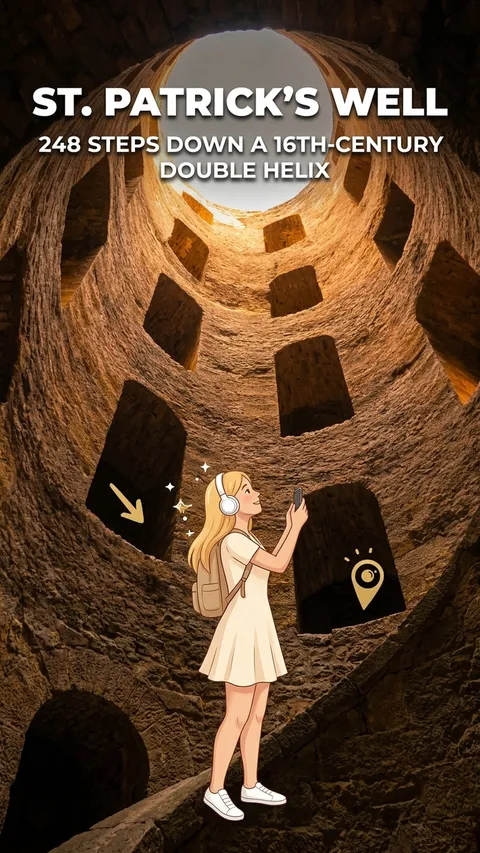
- St. Patrick's Well (Pozzo di San Patrizio) (€5; daily 9:00-19:30 high season): Antonio da Sangallo's 53-meter double-helix well, 248 steps down and 248 back up, with 70 windows punched through the rock. Climb it if your knees allow.
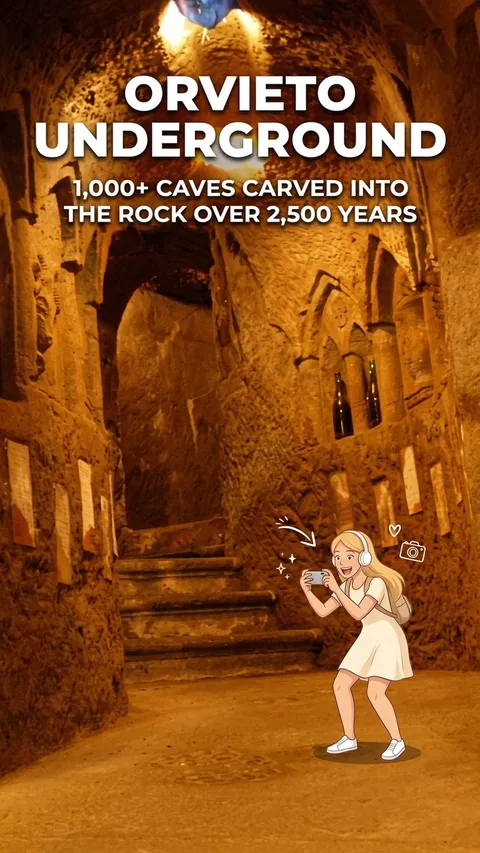
- Orvieto Underground (€8; guided, ~60 min): a guided descent into 2,500-year-old Etruscan and medieval caves underneath the town, dovecotes, olive presses, cisterns. Tours run several times a day, book ahead in peak season.
- Torre del Moro (€3.80; daily 10:00-18:00, later in summer): the central 12th-century civic tower, with a lift partway up and the best 360 view over the rooftops and the valley.
- Fortezza Albornoziana & public gardens (free): the 14th-century papal fortress at Piazza Cahen, with cliff-edge gardens and the panorama back over the Paglia valley. The natural warm-up on the way in.
The route the tour walks with you
Instead of a generic "see the Duomo, then the well" list, you walk one efficient west-to-east line and the tour walks it with you. This is the seven-stop order, starting at the fortress by the funicular and finishing in the quiet medieval western quarter at San Giovenale, pointing you back toward the funicular and your train:
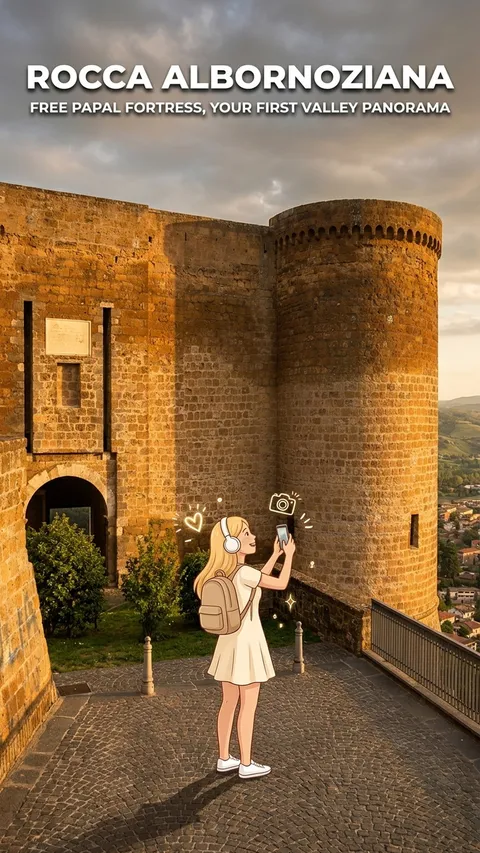
- 1Rocca Albornoziana Free · your start
Step out of the funicular at Piazza Cahen and the fortress is right there, a 14th-century papal stronghold built to keep Orvieto under church control. Walk to the far edge of the public gardens inside and the panorama opens over the whole Paglia valley below. Fifteen minutes to get your bearings, then head west onto Corso Cavour.
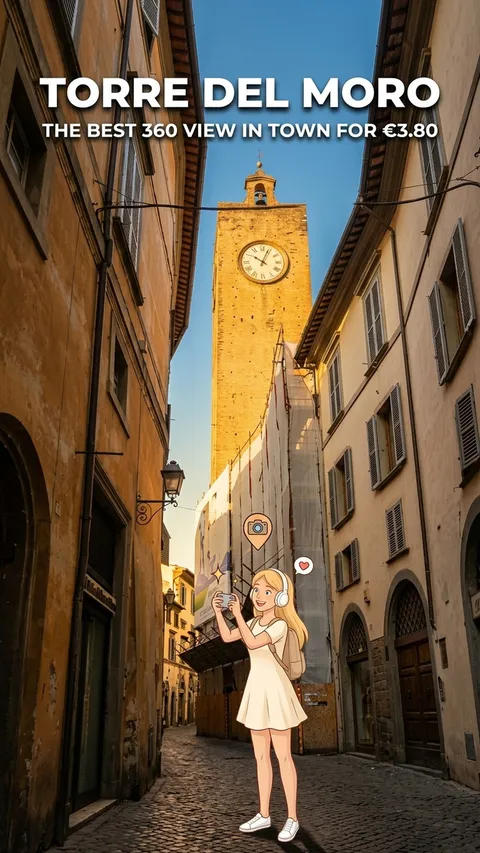
- 2Torre del Moro €3.80
Corso Cavour runs straight to the crossroads where this 12th-century civic tower stands, the dead center of town. A lift takes you partway up, then stairs. The 360 view over the rooftops, the Duomo, and the valley dropping away on all sides is the best single view in Orvieto.
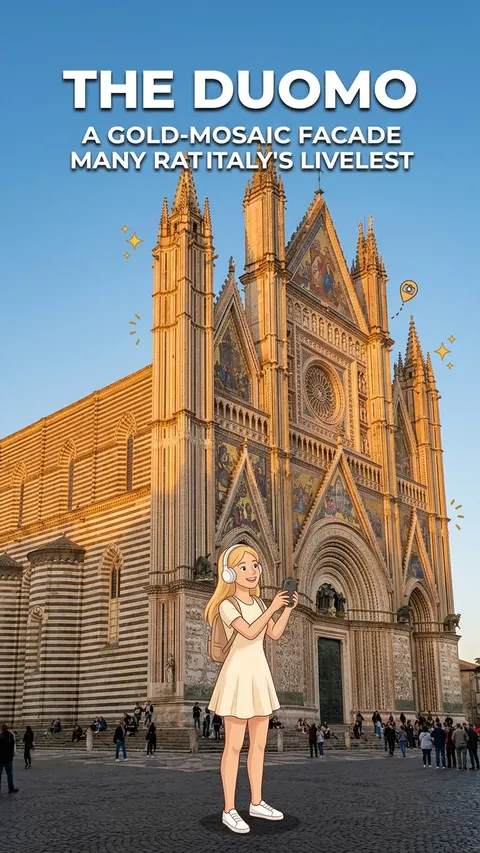
- 3Piazza del Duomo Free
You turn the corner and the cathedral facade fills the end of the piazza, a wall of gold mosaic and carved marble that genuinely stops people mid-step. Ringed by the Opera del Duomo and the Faina archaeological museums. Stand here ten minutes before committing to any tickets.
- 4Orvieto Underground €8 guided
A few steps from the cathedral square, an unassuming door leads down into the rock. A guided hour through Etruscan wells, medieval cisterns, olive presses, and dovecotes cut into the tufa over 2,500 years. Book the first English slot when you arrive. Bring a layer; it is cool year-round.
- 5Orvieto Cathedral €8
Construction began in 1290 under Pope Nicholas IV; Lorenzo Maitani shaped the facade. Inside, the San Brizio chapel holds Luca Signorelli's Last Judgment frescoes (1499-1504), writhing bodies and apocalypse that Michelangelo is said to have studied before the Sistine. Forty-five minutes minimum, dress for the dress code.
- 6St. Patrick's Well €5
Back near Piazza Cahen, Antonio da Sangallo's 1527-1537 double-helix well, 248 steps down to the water and 248 back up on a separate spiral, so mules carrying water never crossed paths. Skip it if your knees are unhappy, otherwise it is genuinely memorable.
- 7Church of San Giovenale Free
The streets narrow and the crowds thin as you reach the western lip of the rock. San Giovenale, consecrated in 1004, is the oldest church in Orvieto, plain Romanesque stone covered in faded medieval frescoes, often with no other visitors. The cliff-edge terrace just outside looks straight out over the valley you saw at the start.
It runs in your browser, no app and no download. A voice guide walks the loop with you and leads a real conversation as you go: it greets you, tells the story between stops, asks what you actually want to see, and adapts. It is not a recording and not an audioguide. The map and step-by-step navigation get you from each stop to the next.
That whole loop is our free, self-guided Orvieto walking tour, and because it can be launched from any of its stops, you do not backtrack to find an official start, you just begin where you are. You open it the moment you step out of the funicular and enter the loop at the Rocca. It runs in your browser, with no app and no download. A voice guide walks the route with you and leads a real conversation as you go: it greets you, tells the story between stops, asks what you actually want to see, and adapts to your answers. It is not a recording and not an audioguide. The map and step-by-step navigation get you from the funicular to the Duomo to the well without squinting at Google Maps. See the full route on the Orvieto walking tour page, and you get 100 free credits to try it.
Insider Tips for the Orvieto Day Trip
The single biggest rookie error on this route is driving into the old town. The historic center is closed to non-resident traffic, the medieval streets are too narrow for a parked car anyway, and the local police are not sympathetic. Park at the base, take the funicular, full stop. After that, the mistakes are about timing and tickets.
Do
- Take the train + funicular, not the car
- Buy the Orvieto Carta Unica (€25) if you plan to see the Duomo, Underground, Well, and Torre
- Book the Underground tour as soon as you arrive, slots sell out
- Visit the well late in the day, it is quieter than morning
- Try the Orvieto Classico white, the town's signature wine
- Wear proper shoes for the basalt cobbles and the tufa caves
Don't
- Don't drive into the old town, it is a ZTL with camera fines
- Don't skip the Underground tour because of the queue at the Duomo
- Don't expect Orvieto to be a "big city" day
- Don't leave the last train as your only option home
- Don't take only red wine at an enoteca, white is what Orvieto is famous for
- Don't try to rush it on a 13:00 arrival, the timed sights will not fit
The Carta Unica (€25 online, sometimes €28 with fees) covers the Cathedral, the Underground tour, Torre del Moro, Museo Claudio Faina, and St. Patrick's Well, valid for a year, one visit per site. If you are doing four of those five, it pays off. Buy it at the tourist office in Piazza del Duomo, at Piazza Cahen, or at cartaunica.it.
For lunch, step a block off Corso Cavour. Trattoria la Palomba (Via Cipriano Manente 16) is the classic for wild boar ragù and umbricelli; Trattoria del Moro Aronne is a local favorite for broad bean carbonara; Cantina Foresi on Piazza Duomo has 13th-century tufa cellars beneath the shop, so ask the owner to take you down. Stand at the bar for coffee; it is roughly half the price of sitting.
Cathedral dress code is shoulders and knees covered, no hats. You will be turned away at the door. And the Underground tour sells out in peak season, so buy that ticket the moment you arrive in Piazza Cahen, not after lunch.
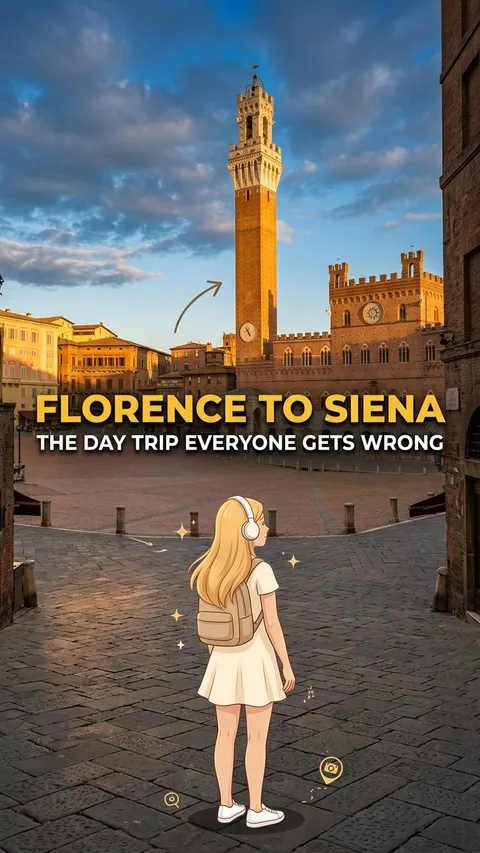
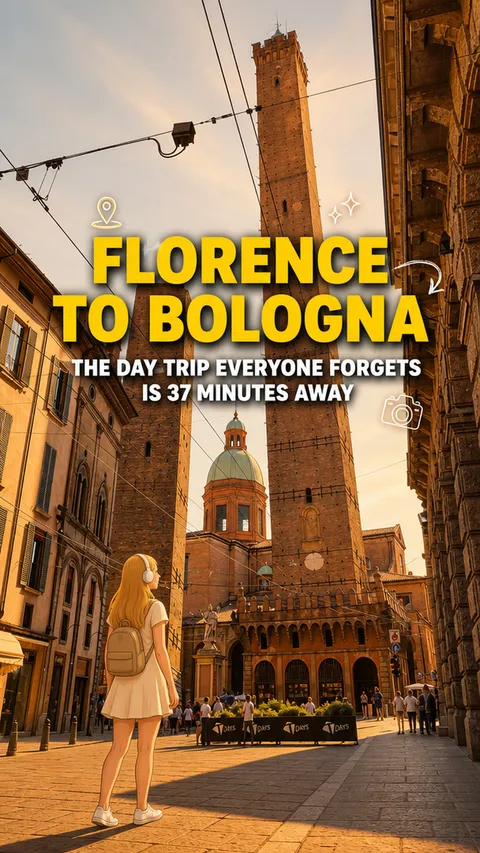
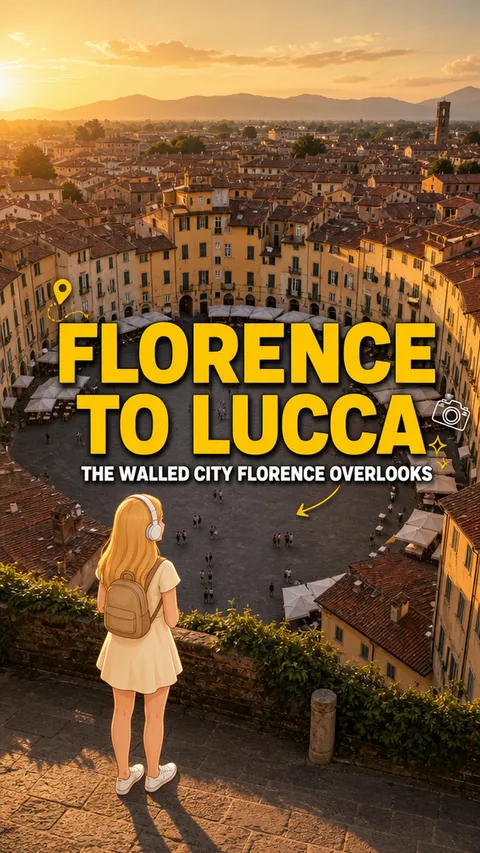
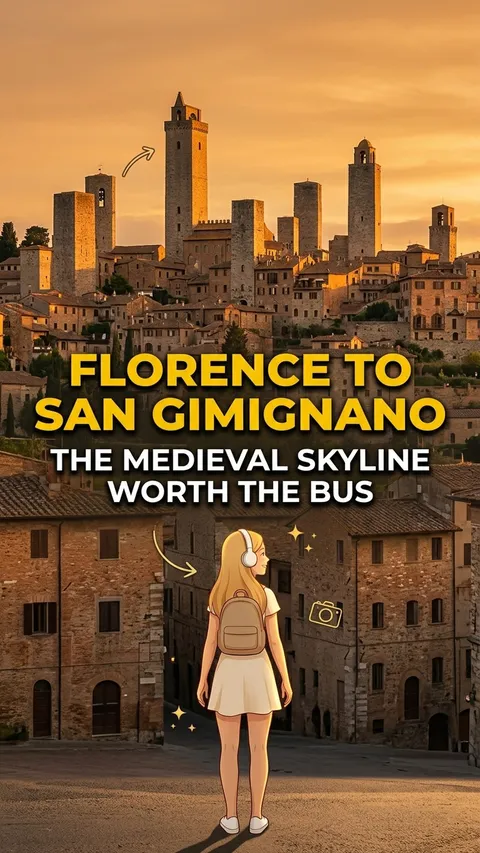
More day trips from Florence
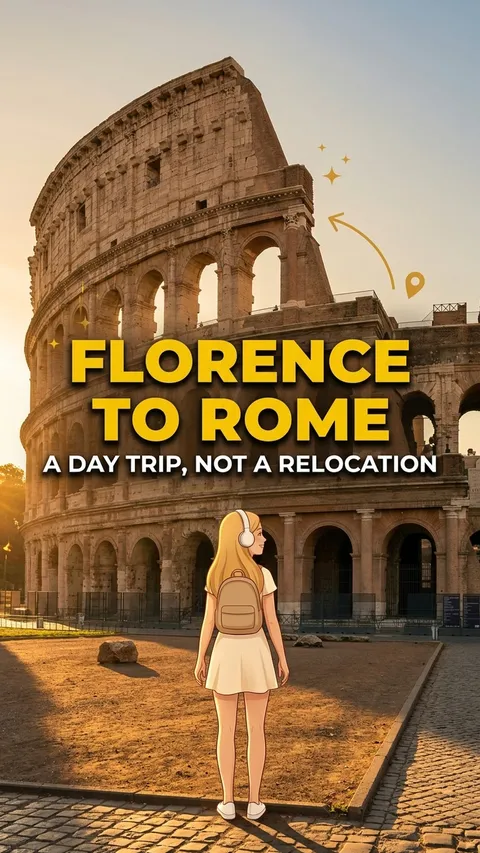
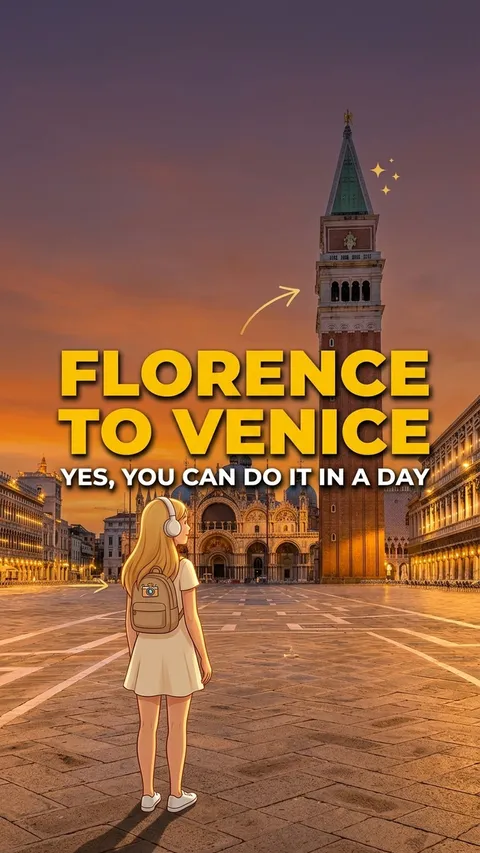
Out in the morning, back in time for dinner. Every route here fits in one full day.

What the Florence to Orvieto Journey Feels Like
This is the part no timetable can give you. Orvieto is a town people come back from genuinely moved, and the texture of the day is half the point.
The funicular sets the tone. You step into a small carriage at Orvieto Scalo, the cliff rises sheer in front of you, and five minutes later you are gliding up the rock face, the valley opening behind you. By the time you reach Piazza Cahen you have already left the station far below, and the town in front of you is fully medieval, brownstone facades and cobble lanes, the kind of place where you instinctively lower your voice.
The Duomo is the moment most people do not expect. The facade is a wall of gold mosaic and striped marble, and almost everyone stops mid-step the first time they see it. The striped basalt-and-travertine bands are hypnotic, the mosaics glow in late afternoon sun, and the bas-reliefs by Lorenzo Maitani tell Genesis to Last Judgment in stone. People literally sit on the ground in front of it and stare.
Then there are the odd, human details that stick. The underground dovecote rooms, round and carved out of the tufa, where medieval Orvietans raised pigeons for the table. The double helix of St. Patrick's Well, where you walk down one spiral and up another, never crossing the path of anyone going the other way. The quiet western edge at San Giovenale, where the medieval frescoes are faded and layered and you are often the only visitor, the cliff dropping away just outside the door.
In the evening, after the day-trippers drain out, the town turns magical. The funicular lanterns light the single track on the way back down, the cafés on Corso Cavour empty out, and you understand why every local quote about Orvieto comes back to the same idea: it is a village on a rock, and people who live there chose to stay. If you can possibly spare the night, do. The morning train back to Florence will wait.
Florence to Orvieto: Your Questions Answered
Can you do Orvieto as a day trip from Florence?
Yes, easily. The regional train is about 2h10 each way and the funicular from Orvieto station lands you in the medieval town in five minutes. With a 7:00-8:00 a.m. start you get the Duomo, the underground caves, St. Patrick's Well, the Torre del Moro, a long lunch, and a sunset walk along the cliff, all comfortably.
Is the train or the bus better from Florence to Orvieto?
The train, clearly. FlixBus runs only once a day from Villa Costanza to Orvieto Scalo, which is useless for a day trip. The regional train runs multiple times daily from Firenze S.M.N., is cheaper than the bus, and arrives at the same place.
How long does it take to get from Florence to Orvieto?
About 2 hours 10 minutes on the regional train, the day-tripper default. The Intercity does it in about 1h38, but only runs about six times a week. Frecciarossa high-speed services occasionally stop at Orvieto but you should not plan around them.
How much does it cost?
The regional train is €10.50-15 one way, walk-up, no booking needed. The Intercity is €15-25 one way, book ahead for the lower fare. The funicular is €1.30 each way. Add €25 for the Orvieto Carta Unica if you plan to see the big five sights, otherwise budget €8 each for the Duomo and the Underground, €5 for the well, and €3.80 for the tower.
Where does the train leave from and arrive?
It leaves Firenze Santa Maria Novella, Florence's main station, and arrives at Orvieto station at the base of the cliff. The funicular leaves from outside the station door and runs every 10 minutes to Piazza Cahen inside the medieval town.
Do I need to book the train in advance?
Not for the regional. Regional fares are fixed and tickets are not time-specific, so buy a round trip on the morning. Book the Intercity ahead if you can pin your day to it, because the price climbs closer to departure.
What should I not miss in one day?
The Duomo (and the San Brizio chapel inside), the Orvieto Underground guided tour, St. Patrick's Well, and the Torre del Moro view. Buy the Carta Unica if you plan to do four of those, and book the Underground tour as soon as you arrive, because slots sell out.
Should I drive instead?
Only if you are pairing Orvieto with Civita di Bagnoregio or a winery visit. For a straight day trip, the train is simpler and cheaper. The old town is closed to non-resident traffic, the ZTL is camera-enforced, and the funicular makes the climb for you.
When is the best time to visit?
Spring (April to May) and autumn (September to October) for pleasant weather, lighter crowds, and full opening hours. Summer is hot and busy with day-trippers from Rome. Winter has shorter hours and some sights close for lunch.
Plan Your Orvieto Day Trip
You have the train sorted, and that is the part most people get wrong. Now make the hours on the ground count. The seven-stop loop above is our free, self-guided Orvieto walking tour, and because it starts from any stop, you launch it the second you step out of the funicular. Open it and start walking with 100 free credits.
