
Florence to Perugia Day Trip: Why This Underrated Route Wins
Two hours on a Regionale train from Santa Maria Novella and you are standing in a medieval hill town that almost nobody visits. Here is the honest verdict, the timetable math, and a free self-guided walking tour for the hours on the ground.
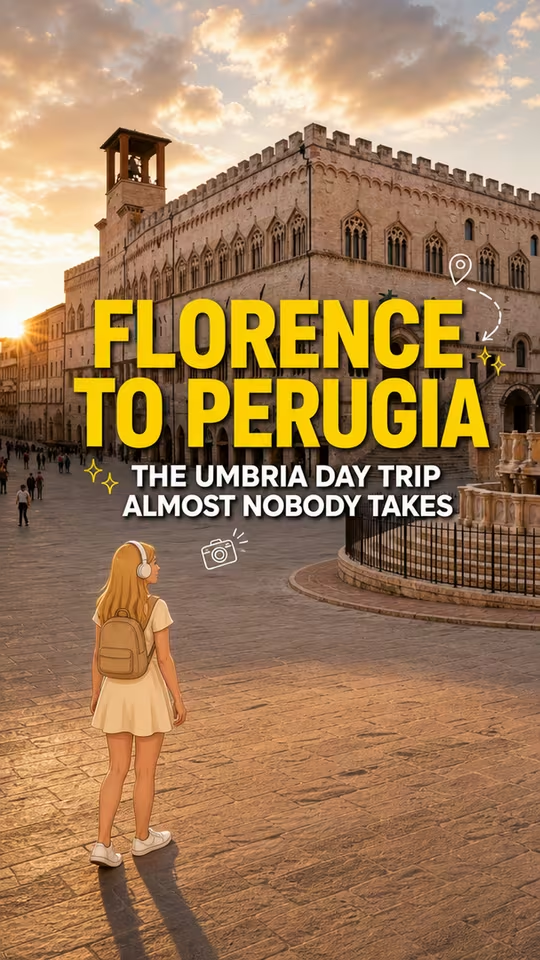
The Quick Answer: Florence to Perugia
The smart way from Florence to Perugia is the Trenitalia Regionale Veloce from Firenze Santa Maria Novella to Perugia Fontivegge, roughly two hours each way, with 5 to 7 direct trains a day depending on the day of the week. Fares are fixed by distance at about €19 one way, so there is no booking stress and no reward for committing early. The catch is that Perugia sits off the main north-south rail line, so the timetable is thinner than it is for Rome or Bologna, and missing the last train is a real problem. Plan around it and you trade a slightly longer ride for one of the most underrated hill towns in Italy.
| Question | Answer |
|---|---|
| Fastest journey time | ~1h25 on the few faster services; ~2h00 to 2h15 on most Regionale Veloce |
| Frequency | 5-7 direct trains a day (Mon-Fri 7, Sat 5, Sun 7), plus options with a quick change at Terontola-Cortona |
| Price from | €19 one way, fixed by distance (no advance discount). Bus from ~€12, BlaBlaCar from ~€9 |
| Operators / how | Trenitalia Regionale Veloce. FlixBus also runs twice daily |
| First / last | First train around 6:30-7:00 a.m., last direct back around 8:00-9:00 p.m. (check Trenitalia for the date) |
| Worth it as a day trip? | Yes, with eyes open. Two hours each way is the long edge of feasible, but Perugia rewards it |
Is the Florence to Perugia Day Trip Worth It?
Here is the honest call first: yes, Perugia is one of the best day trips you can take out of Florence if you want a genuine contrast to Tuscany's main circuit, and yes, the two-hour ride each way is the price you pay. Both are true. Perugia is the regional capital of Umbria, "the green heart of Italy," and it sits on a hilltop looking south over a wide valley of olive groves and Apennine ridges. It is a working university city, a chocolate town, and a medieval-Etruscan palimpsest stacked on top of itself, and almost no foreign visitor goes there.
The best of Perugia, stop by stop


The "absolutely go" case is simple. If Florence has started to feel like a Renaissance museum under open sky, packed with tour groups, Perugia is the antidote: a walkable, lived-in medieval city where the cathedral steps fill with students at dusk, where a bowl of black-truffle pasta costs less than a Florentine coffee, and where you can stand on a 2,300-year-old Etruscan gate with nobody trying to sell you a selfie stick.
Crowd-free, authentic, cheap, and architecturally stunning. A genuine contrast to Florence, not a lesser version of it.
The "give it a miss" case is the timetable. Two hours each way is a real chunk of a day, and Perugia's station sits in the valley below the historic centre, which adds 15 to 20 minutes each way on the Minimetrò or on foot. If you only have three days in Florence and have not seen the Uffizi or the Duomo, stay. If you want a faster hit, Siena is 1h15 by bus and Orvieto is 1h30 by train.
Two hours each way is the long edge of a day trip. Skip it if you have not yet seen Florence's own headline sights.
Our call: if you have a spare day, an early start in you, and any curiosity about Umbria, go. The centre is small enough to walk in a day, the truffle-and-chocolate food scene punches above its weight, and the sights are astonishingly under-visited for their quality. Just know what you are signing up for on the timetable.
Good fit if you...
- Have a free day in Florence and can leave at 7:00 a.m.
- Want a crowd-free alternative to Siena or Pisa
- Love Etruscan and medieval layers, not just Renaissance
- Are into truffles, chocolate, and Umbrian country cooking
- Don't mind a two-hour ride each way
Skip it (save Perugia for longer) if you...
- Have not yet seen the Uffizi or climbed the Duomo
- Want the shortest, easiest day trip (Siena and Pisa are quicker)
- Expect another Florence, with marquee Renaissance art at every corner
- Travel on a Sunday with inflexible timing
- Hate hills
How to Get from Florence to Perugia by Train
You can reach Perugia from Florence four realistic ways, and the obvious one, the train, is also the right one for a car-free day trip. The only debate is whether you mix in a car for a Cortona-or-Lake-Trasimeno loop on the way back, which is the one scenario where driving wins.

| Mode | Time | Price | Verdict |
|---|---|---|---|
| Train (Trenitalia Regionale Veloce) | ~2h, a few at 1h25 | €19 one way | WINNER. Fixed fare, no booking stress, scenic run past Lake Trasimeno |
| Train via Terontola-Cortona change | ~2h15-2h30 | from €19 | Same fare, slightly longer. Useful when the direct slot doesn't fit |
| FlixBus (twice daily) | ~2h20 | €12-20 | Less frequent than the train, similar time. Departures from Villa Costanza |
| Car (A1 then SS) | ~1h45-1h50 | fuel + toll + parking | Only worth it for a Cortona or Lake Trasimeno loop. ZTL headache in town |
| BlaBlaCar | ~1h50-2h10 | from ~€9 | Cheapest option if timing lines up. Less reliable for the return |
The reason the train wins is the combination of price-fixed fares, a scenic run that skims the northern shore of Lake Trasimeno, and not having to think about parking in a hill city whose historic centre is a maze of ZTL zones and "incredibly narrow" streets that go through archways. Perugia's station is in the valley, not the centre, but the Minimetrò and the Rocca Paolina escalators handle that climb for you for a couple of euros.
The train is the consensus best option for a car-free day trip. Fixed fares, no booking pressure, a view of Lake Trasimeno on the way.

The Train in Detail
The workhorse is the Trenitalia Regionale Veloce (fast regional), run by Italy's national operator. It leaves from Firenze Santa Maria Novella and arrives at Perugia Fontivegge, the city's main station, which sits in the modern lower town about 2 km from the historic centre.
A few practical things make this easy. Regional fares are fixed by distance, so a ticket costs the same whether you buy it two months out or two minutes before the doors close. That is the day-tripper's dream: pick your day based on the weather, look up the timings the night before, and buy at the station in the morning. Most services run direct in around 2h to 2h15. A small number of faster services come in at 1h25 to 1h31, but they are infrequent, so do not plan around them. Some journeys involve a quick change at Terontola-Cortona junction, which is straightforward and adds only a few minutes.
Two practical warnings. If you are using a paper ticket, you must validate it in the green or yellow machines at the station before boarding, or you risk a fine on board. Digital tickets do not need physical validation but must be "checked in" via the Trenitalia app before the train's scheduled departure time. And note that there is no food car on Regionale trains, so grab a coffee and a cornetto at SMN before you board.
Direct or via Terontola-Cortona, which to book?
Take whichever fits your day. There is no price difference, no comfort difference, and the Terontola-Cortona change is a quick same-platform hop on most runs. The only reason to prefer the direct is one less moving part with luggage.
| Compare | Direct Regionale Veloce | Via Terontola-Cortona |
|---|---|---|
| Time | ~2h, a few at 1h25 | ~2h15 to 2h30 |
| Price | €19 one way | €19 one way |
| Changes | None | 1, usually same-platform |
| Verdict | Best, when the slot fits | Useful filler when direct gaps are too wide |
Booking Strategy
There is not much to overthink here, and that is the appeal. Regional fares do not move, so the strategy is about timing your day, not gaming a price curve.
No need to book ahead for the price. Regional fares are fixed by distance. You will pay the same €19 at the station on the day as you would two months out, so do not commit early and lock yourself into bad weather.
Buy a round trip in the morning. Trenitalia regional tickets are valid on any train on the route for roughly the next four hours after validation, so a round-trip ticket lets you come back on whichever direct train fits your evening. Just remember to validate each leg before boarding.
Where to buy. Trenitalia.com, the Trenitalia app, the ticket machines at SMN, or the staffed counters. For paper tickets, validate in the green or yellow machines before boarding.
Do not gamble on the last train. Perugia is off the main line, and direct trains are limited. Treat the second-to-last train as your real last train, and check the exact time for your travel date on Trenitalia. Missing the last one genuinely leaves you stranded or reaching for a €150-plus taxi.
Booking checklist
- The night before, check Trenitalia for the exact direct trains Firenze SMN to Perugia Fontivegge on your date.
- Note the last two direct returns to Florence, and plan to be at Perugia Fontivegge for the second-to-last.
- Buy a round-trip regional ticket in the morning, at the station, via app, or at the machines.
- Validate the paper ticket in the green or yellow machine before boarding each leg.
- If using the app, check in the digital ticket before the scheduled departure time.
Perugia in One Day
Here is the part most day-trip guides bury, and it is the whole point: you do not need to plan a route through Perugia. You step off the train at Fontivegge, ride the Minimetrò (or the Rocca Paolina escalators) up into the historic centre, open our free self-guided Perugia tour, and start it from wherever you are standing. The voice guide takes the planning off your hands and walks the city with you, stop by stop, so the climb from the station becomes the first beat of the day rather than a logistics problem. No transfer headache, no map-staring. That short stroll from the upper station to Piazza IV Novembre is exactly where the day actually starts working.

The time math
Catch the first or second direct train out of Florence, around 6:30 to 7:00 a.m., and you can be on Piazza IV Novembre by 9:00 to 9:30 a.m. Budget 2h15m each way on the train plus 15 to 20 minutes door-to-door from platform to piazza via the Minimetrò. The last reasonable direct train back leaves Perugia around 8:00 to 9:00 p.m., but treat the second-to-last as your real last. That gives you roughly eight to ten useful hours in Perugia, which is more than enough to walk the loop, see the National Gallery, eat a long lunch, and sit on the cathedral steps at dusk.
What you'll see
Here is what a day-tripper should not miss, with the practical reality attached:
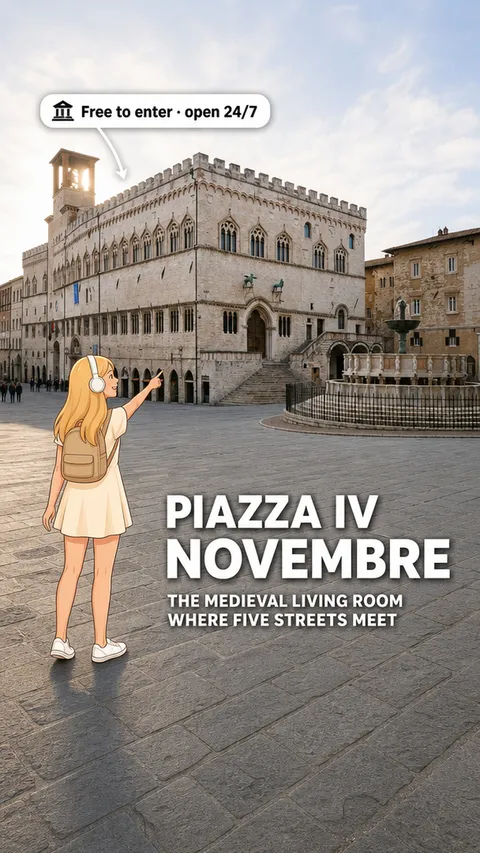
- Piazza IV Novembre (free, open 24/7): the asymmetric heart of the city, where five medieval streets converge on the old Roman forum. Anchored by the cathedral, the Palazzo dei Priori, and the Fontana Maggiore. The social stage of Perugia for 2,000 years.
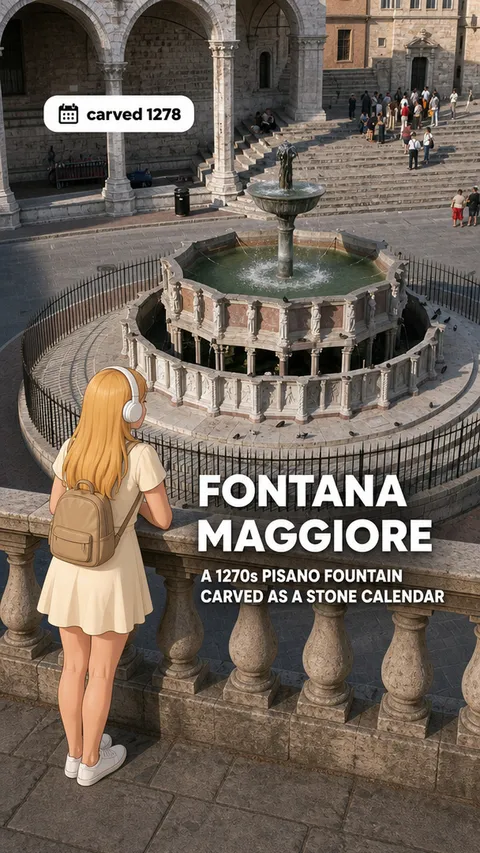
- Fontana Maggiore (free): a 1270s two-basin fountain by Nicola and Giovanni Pisano, wrapped in carved panels showing the months, the labours of farm work, biblical scenes, and Aesop. Read it like a stone calendar.
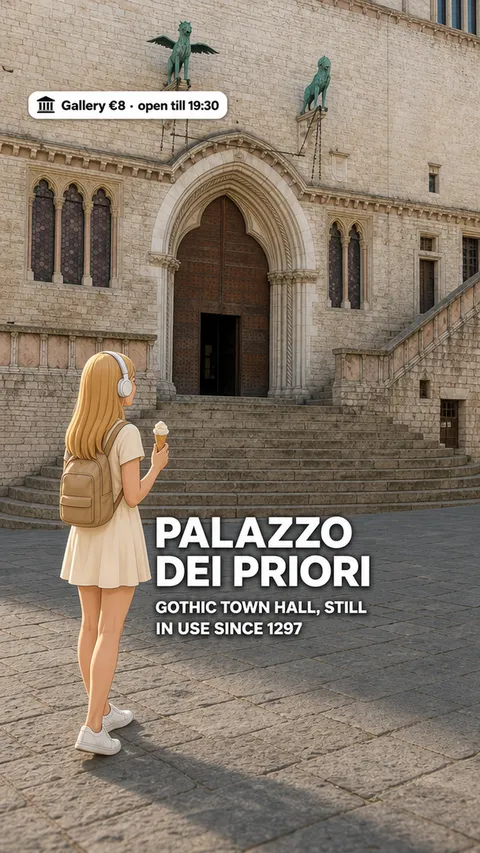
- Palazzo dei Priori & National Gallery of Umbria (€8 standard, €12 with exhibitions): the Gothic town hall, still partly civic offices, with the Galleria Nazionale inside it on the Corso Vannucci side. Open daily 8:30 a.m. to 7:30 p.m. Closed Mondays November-June. Free for under-18s, €2 for EU citizens 18-25.
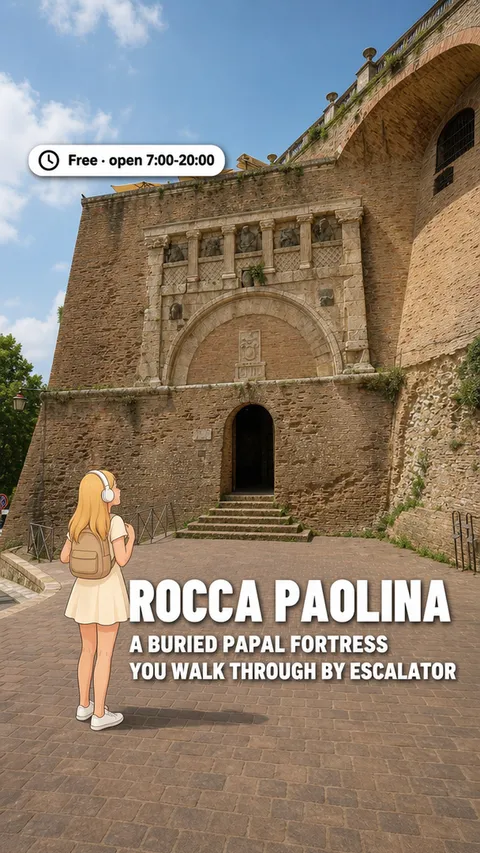
- Rocca Paolina (free): the buried 16th-century papal fortress, now a network of underground vaults threaded with escalators that link the upper town to the lower bus terminal. Open daily, main entrance at Porta Marzia 7:00 a.m. to 8:00 p.m.
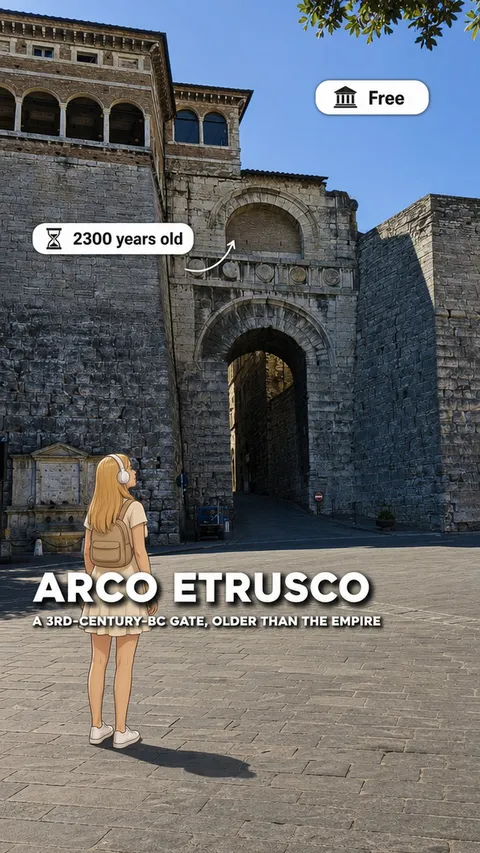
- Arco Etrusco (free): a 3rd-century-BC travertine gate, the most complete of the seven ancient entries to the Etruscan city, topped by an Augustan inscription that still reads AUGUSTA PERUSIA.
- Cathedral of San Lorenzo (free): the Gothic duomo on the cathedral side of Piazza IV Novembre, famous for its unfinished facade. Open 7:30 a.m. to 12:30 p.m. and 3:30 to 7:30 p.m. Steps outside are the evening hangout spot.
The route the tour walks with you
Instead of a generic "see the square, then the gallery" list, you walk one efficient loop and the tour walks it with you. This is the eleven-stop order, starting at Piazza IV Novembre in the heart, dropping south to the buried Rocca and the valley-view terrace, swinging east to the archaeology museum, then climbing back north past Raphael's only Perugia fresco, the old aqueduct lane, and the Etruscan gate, ending where you began:
- 1Piazza IV Novembre Free · your start
Five medieval streets pour into this asymmetric square over the old Roman forum. Fountain in the middle, town hall to the right, duomo behind. Open 24/7 and the natural anchor for a loop, because every other stop is downhill or a short climb from here.
- 2Fontana Maggiore Free
A few steps and you are at the 1270s Pisano fountain, the symbol of the city. Walk a full slow circle around the lower basin: the panels read like a calendar, one per month, with the labours of farm work and signs of the zodiac.
- 3Palazzo dei Priori Free civic rooms · closed Tuesdays
The wall of medieval Gothic stone on the square's south flank, with a bronze griffin and lion above the portal and the famous fan-shaped staircase sweeping up to a side door. Public rooms are free to enter when open.
- 4National Gallery of Umbria €8 · open till 19:30
Inside the same palazzo, entered from the Corso Vannucci side. The largest collection of Umbrian painting anywhere: Perugino, Pinturicchio, Piero della Francesca. Give it at least 90 minutes if you go in.
- 5Rocca Paolina Free · open 7:00-20:00
Corso Vannucci ends at Piazza Italia and there you step onto escalators that drop you inside a buried papal fortress. The pope flattened an entire medieval quarter to build it in the 1540s; the city later tore it down but the vaults survived.
- 6Giardini Carducci Free · open 24/7
The terrace garden directly on top of the fortress, with the best valley view on the loop: hills, farmland, and on a clear day the silhouette of Assisi across the plain. The bench stop, halfway through the walk.
- 7National Archaeological Museum of Umbria €8 · open 8:30-19:00
In the old San Domenico cloisters, holding the Etruscan and Roman finds that explain why Perugia existed long before the medieval city. Standout is the Cippus Perusinus, one of the longest Etruscan inscriptions ever found.
- 8Chapel of San Severo €4 · closed Mondays
A small chapel at one of the highest points in the city, holding the only fresco Raphael ever painted in Perugia, a Trinity with saints from around 1505, finished after his death by his old teacher Perugino. One wall, two masters.
- 9Via dell'Acquedotto Free
The quietest stretch of the walk: a raised footpath along the top of a medieval aqueduct that once fed the Fontana Maggiore. House fronts drop away on both sides, laundry strung between windows. Feels like a private back route, because it more or less is.
- 10Arco Etrusco Free
Round the corner and the wall is older than the Roman Empire. The Etruscans built this gate in the 3rd century BC; Augustus rebuilt the upper section in 40 BC and left an inscription reading AUGUSTA PERUSIA across the top.
- 11Cathedral of San Lorenzo Free · closed over lunch
The loop closes back at the square, where the duomo flanks the cathedral side. The facade is unfinished, bare brick where marble was meant to go. The steps outside are where Perugia's students gather at dusk. You are back where you started.
It runs in your browser, no app and no download. A voice guide walks the loop with you and leads a real conversation as you go: it greets you, tells the story between stops, asks what you actually want to see, and adapts. It is not a recording and not an audioguide. The map and step-by-step navigation get you from each stop to the next.
That whole loop is our free, self-guided Perugia walking tour, and because it can be launched from any of its stops, you do not backtrack to find an official start, you just begin where you are. You open it the moment you come up from the Minimetrò and enter the loop at Piazza IV Novembre. It runs in your browser, with no app and no download. A voice guide walks the route with you and leads a real conversation as you go: it greets you, tells the story between stops, asks what you actually want to see, and adapts to your answers. It is not a recording and not an audioguide. The map and step-by-step navigation get you from the square to the Rocca to the Etruscan Arch without squinting at Google Maps. See the full route on the Perugia walking tour page, and you get 100 free credits to try it.
Insider Tips for the Perugia Day Trip
The single biggest rookie error on this route is treating Perugia like a small town. It is a proper regional capital with a university, a national gallery, and an Etruscan layer underneath, and it rewards a full day, not a quick stop. The second-biggest error is underestimating the station-to-centre climb. The third is missing the last train.
Do
- Take the first or second direct Regionale out of SMN, around 6:30-7:00 a.m.
- Buy a round-trip regional ticket in the morning (€19 each way, fixed)
- Ride the Minimetrò or the Rocca Paolina escalators up; do not walk the hill
- Sit on the cathedral steps at dusk; it is where Perugia lives in the evening
- Eat the truffle pasta and the Baci chocolate; this is Umbria's food capital
- Plan the day around the second-to-last return train, never the very last
Don't
- Don't try to drive into the historic centre; it is a ZTL maze with mailed fines
- Don't assume Perugia is "just a small town" and give it half a day
- Don't trust Google Maps on the escalator shortcuts; look for "scala mobile centro storico"
- Don't count on the very last direct train; if you miss it, you are stuck
- Don't visit the cathedral, chapel, or town hall rooms over the 13:00-15:30 lunch closure
- Don't expect the Minimetrò to run late; it closes around 21:05 Mon-Sat
A few specific notes. Sandri dal 1860 on Corso Vannucci is the historic cafe, chandeliers and faded frescoes and uniformed waiters, open 7:30 a.m. to 8:00 p.m. and closed Mondays. For lunch, grab a torta al testo, the regional flatbread stuffed with cured meats and greens, from a counter spot for a few euros. For dinner, Osteria a Priori is the easy introduction to Umbrian dishes and wines. And whatever else you do, sit on the cathedral steps in Piazza IV Novembre around aperitivo hour with a plastic cup of spritz from the nearest shop and watch Perugia be itself.
The Minimetrò closes early: roughly 21:05 Monday to Saturday and 20:45 on Sundays. If you are aiming for a late dinner before the last train back to Florence, walk or escalator back down to Fontivegge station rather than counting on the ride. And check Trenitalia for the exact last direct train on your travel date, because Perugia is off the main line and the timetable thins out fast after 8:00 p.m.
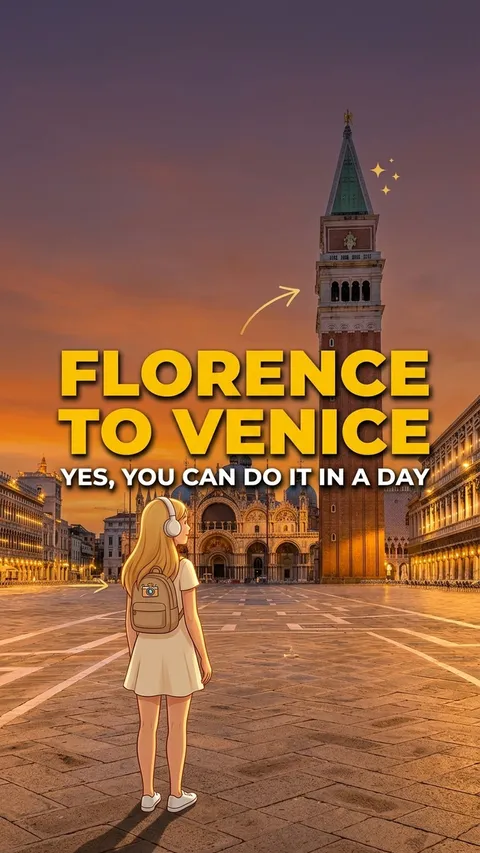
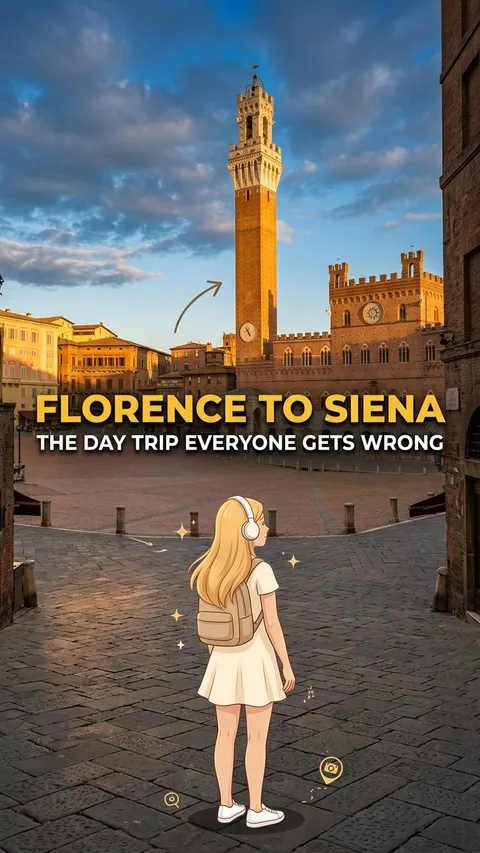
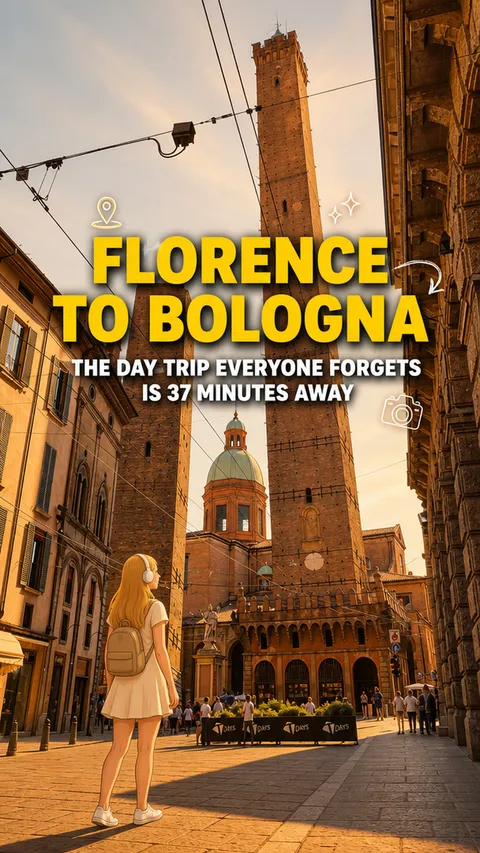
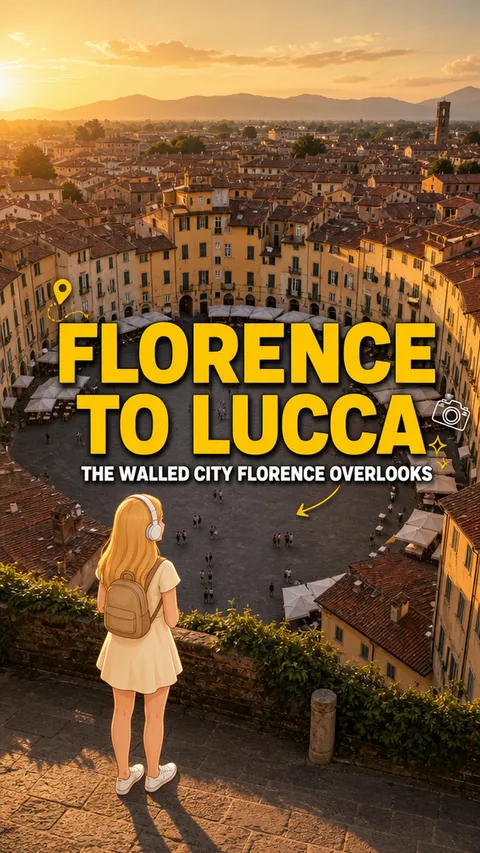
More day trips from Florence
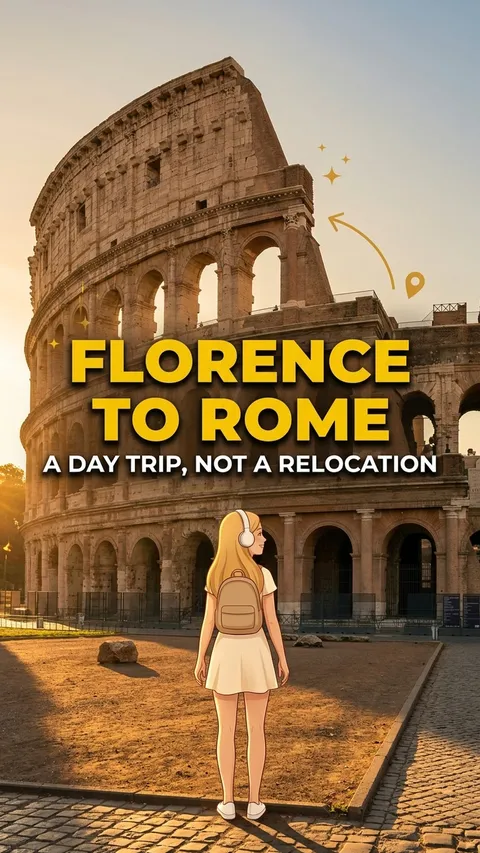
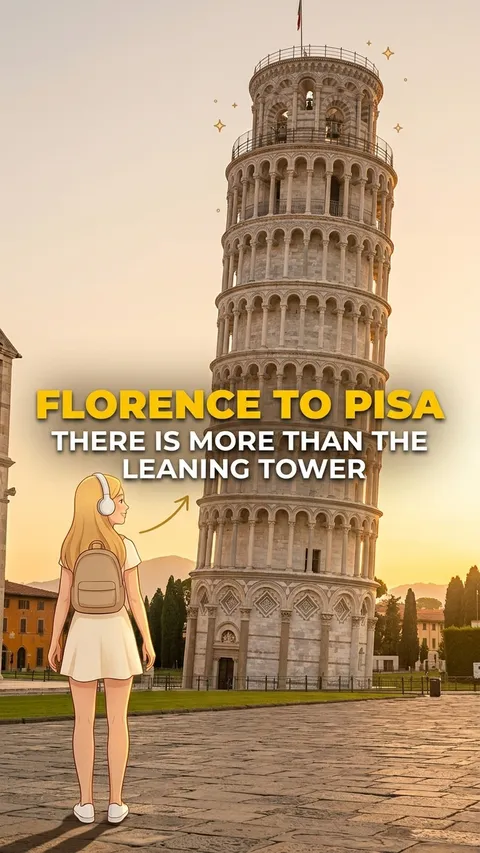
Out in the morning, back in time for dinner. Every route here fits in one full day.
What the Florence to Perugia Journey Feels Like
This is the part no timetable can give you. The train run itself is half the point: the line climbs out of the Arno valley, crosses the Tuscan border into Umbria, and skims the northern shore of Lake Trasimeno, with water views and glimpses of lakeside castles from the carriage window before it climbs into the hills toward Perugia. It is one of the more underrated rail runs in central Italy, and on a clear morning it sets the day up beautifully.
Then Perugia itself. The first thing you notice is that the city feels stacked, layered, folded in on itself. It is a jumble of Etruscan walls, medieval towers, papal fortifications, underground vaults, and steep alleyways, and the famous escalators inside the Rocca Paolina carry you through the buried streets of a medieval neighbourhood that has not seen daylight in 500 years. You ride down through arched doorways and house walls, with commuters rushing past on their phones, and the city genuinely feels like archaeology you can walk through.
The second thing you notice is the absence of crowds. Perugia is a university city with one of Italy's oldest institutions, and the historic centre belongs to its students. By day, the centre is busy but never heaving. By evening, when the day-trippers in most Italian towns would be replaced by a different cohort of day-trippers, here the cathedral steps simply fill with locals and international students buying beers in plastic cups from the nearest shop and sitting on warm stone until late. The schedule here is "purely Perugian, so unbothered about catering to outsiders," as one regular visitor puts it, and you find yourself constantly getting the rhythm wrong before you stop trying.
The food is the third thing. Umbria is Italy's truffle heartland, and in Perugia truffles are "not a luxury reserved for fine dining rooms but more of an everyday staple when the season's right." Hand-rolled strangozzi al tartufo nero, thick square-edged pasta tossed in olive oil, garlic, and shavings of local black truffle, is the dish to order, and almost every restaurant has at least one truffle plate on the menu. Add the city's chocolate identity, Baci Perugina wrapped in love notes, and a year-round Eurochocolate shop on Piazza IV Novembre, and you have a day that feels less like a Florence add-on and more like a different country an hour and a half down the line.
Florence to Perugia: Your Questions Answered
Can you do Perugia as a day trip from Florence?
Yes. The direct Regionale Veloce is about two hours each way with 5 to 7 trains a day, and with an early start you can be on Piazza IV Novembre by 9:30 a.m. and stay through dinner. Just know that two hours each way is on the long edge of a feasible day trip, so plan around the second-to-last return train rather than the very last one.
Is the train or the bus better from Florence to Perugia?
The train, clearly. It runs more frequently (5-7 times a day against FlixBus's twice daily), has a fixed fare of about €19 that does not change, skims Lake Trasimeno on the way, and drops you at Perugia Fontivegge where the Minimetrò and Rocca Paolina escalators carry you up to the centre for a couple of euros. FlixBus is slightly cheaper at €12-20 but less flexible.
How long does it take to get from Florence to Perugia?
About 2 hours on most direct Regionale Veloce trains, with a few faster services at 1h25. Services that require a change at Terontola-Cortona come in around 2h15 to 2h30.
How much does it cost?
The regional train is about €19 one way, fixed by distance, with no advance discount. FlixBus is €12-20. BlaBlaCar starts around €9 if the timing works. The Minimetrò from the station up to the centre is €1.50 for a single.
Where does the train leave from and arrive?
It leaves Firenze Santa Maria Novella and arrives at Perugia Fontivegge, in the modern lower town about 2 km from the historic centre. From there you ride the Minimetrò (5 minutes to Pincetto, €1.50) or walk the Rocca Paolina escalators up into the old town in about 15 to 20 minutes door-to-door.
Do I need to book the train in advance?
No. Regional fares are fixed by distance, so you pay the same €19 at the station on the day as you would two months out. Pick your day based on the weather, buy a round-trip in the morning, and validate the paper ticket in the green or yellow machines before boarding. The only reason to commit early is peace of mind.
What should I not miss in one day?
Piazza IV Novembre and the Fontana Maggiore, the National Gallery of Umbria (€8) if you have time, the Rocca Paolina underground escalators, the Etruscan Arch, and the cathedral steps at dusk. Eat strangozzi al tartufo for lunch and grab a Baci chocolate on the way out of town.
Should I drive instead?
Only if you are building a Tuscan-Umbrian loop with stops at Cortona, Lake Trasimeno, or Montepulciano on the way. For a straight Perugia day trip, skip the car: the historic centre is a maze of ZTL zones with camera-enforced fines, the streets are "incredibly narrow," and parking in the lower town plus the Minimetrò or escalators up is faster than trying to find a legal space near the centre.
When is the best time to visit?
Spring (April to June) and early autumn (September to October) for pleasant weather, thinner crowds, and the tail of truffle season. Summer is hot but the city is lively. Avoid the Eurochocolate festival dates in October unless you are going specifically for it, because accommodation availability gets tight.
Plan Your Perugia Day Trip
You have the train sorted, and that is the part most people get wrong on this route. Now make the hours on the ground count. The eleven-stop loop above is our free, self-guided Perugia walking tour, and because it starts from any stop, you launch it the second you come up from the Minimetrò. Open it and start walking with 100 free credits.
