
Florence to Bologna Day Trip: The 37-Minute Food Run
Bologna is the closest major city to Florence by fast train: about 37 minutes, one every 15 to 20 minutes, from around €15 booked ahead. Here is the honest plan for Italy's food capital in a day, plus a free, self-guided walking tour for the hours on the ground.
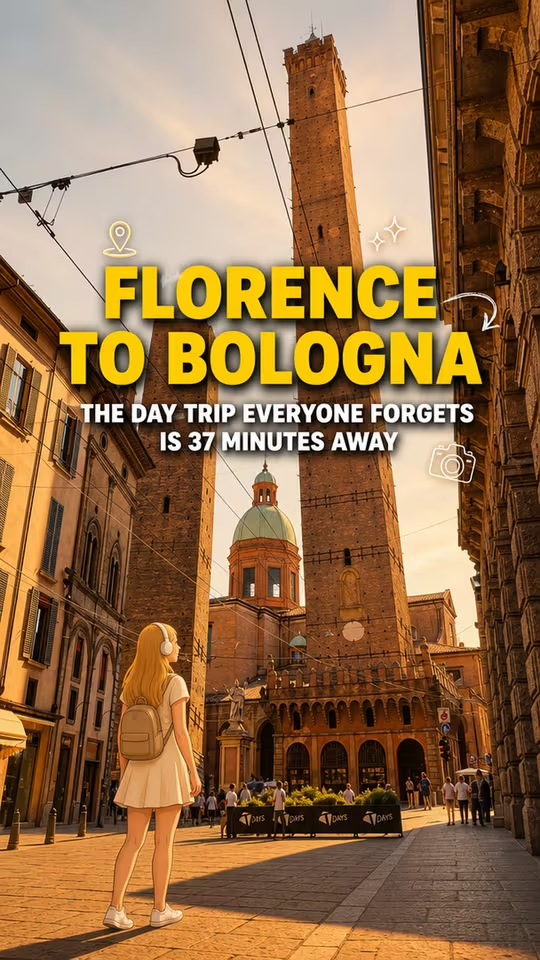
The Quick Answer: Florence to Bologna
Bologna is the closest major city to Florence by rail, and that is the whole reason this works so well. The high-speed train covers the distance in about 35 to 37 minutes, runs direct every 15 to 20 minutes through the day, and starts around €15 when you book ahead. Two operators go head to head on the line, Trenitalia (Frecciarossa and Frecciargento) and the private Italo, which keeps fares honest, so book whichever is cheaper or better timed on your date. You board in the center of Florence at Firenze Santa Maria Novella (SMN), ten minutes from the Duomo, and step off at Bologna Centrale, a flat 20-minute walk into the old town under a continuous portico. Of every day trip from Florence this is the easiest to pull off, and the one where the food alone justifies the ticket.
| Question | Answer |
|---|---|
| Fastest journey time | About 35 to 37 minutes on Frecciarossa, Frecciargento, or Italo. Regional trains take 1h15 to 2h30 |
| Frequency | Direct high-speed trains every 15 to 20 minutes, 50-plus a day. You are never locked into one departure |
| Price from | Around €9 to €25 one way on advance high-speed; €8 to €12 on the regional. Last-minute peak fares run 3 to 4 times higher |
| Operators / how | Trenitalia (Frecciarossa, Frecciargento) and Italo. Firenze SMN to Bologna Centrale, both central |
| First / last train | Aim for an 8:30 to 9:00 a.m. train out; return trains run late into the evening |
| Worth it as a day trip? | Yes. Bologna is flat, compact, and made for a self-guided walk. One day genuinely does it justice |
Is the Florence to Bologna Day Trip Worth It?
Short answer: yes, and more clearly than most Florence day trips. Bologna is small enough that one focused day actually covers it, unlike Rome or Venice. The historic core is flat, pedestrianized, and so tightly packed that you could throw a stone from Piazza Maggiore and hit three of the main sights. Add a 37-minute train each way and you have a rare thing: a day out with almost no wasted hours.
The best of Bologna, stop by stop


Bologna's nickname is La Grassa, "the fat one," and that is the real pull. This is the birthplace of tagliatelle al ragu, tortellini in brodo, mortadella, and lasagne verdi, with Parma ham, Parmigiano Reggiano, and traditional Modena balsamic all a short hop away. The Quadrilatero market lanes off Piazza Maggiore, Via Pescherie Vecchie, Via Clavature, Via Drapperie, overflow with fresh-pasta windows, salumerie, and old-school delis, and a mortadella sandwich runs €3 to €5 while a plate of hand-cut tagliatelle costs a fraction of what the same dish fetches in Florence's tourist center.
The closest, easiest food-focused day trip from Florence. 37 minutes each way and one flat, walkable city.
The other reason to go is that Bologna feels lived-in. It carries the energy of the oldest university in the Western world, founded in 1088, with tens of thousands of students, and it draws far fewer international tourists than Florence, so it reads like a working Italian city rather than a museum with a ticket line. The 38-plus kilometers of porticoes, a UNESCO World Heritage site since 2021, mean you can walk almost the entire route in the rain or the August heat and stay covered the whole way. More than one seasoned traveler has said they would spend the week in Bologna and make Florence the day trip.
Skip it only if you came for scenery. Bologna is flat, inland, and about food, porticoes, and street life, not postcard hills.
Our call: this is the day trip for when you want a real meal and a real city, not a checklist of monuments. If your idea of a good day out is a slow lunch, a tower climb, and an aimless wander under arcades, Bologna is close to perfect. If you came to Tuscany chasing cypress-lined hills and hilltop towns, spend the day on Siena or a Chianti drive instead and save Bologna for a trip when food is the point.
Good fit if you...
- Care about food and want the source of ragu, tortellini, and mortadella
- Like a flat, walkable, low-stress city you can cover in a day
- Want somewhere more lived-in and less touristy than Florence
- Would rather eat and wander under porticoes than queue for museums
Skip it (save Bologna) if you...
- Came for Tuscan hills, vineyards, and hilltop towns
- Want a beach, a lake, or dramatic landscape
- Have your heart set on world-famous single sights over atmosphere
- Have already eaten your way across Emilia-Romagna
How to Get from Florence to Bologna by Train
There is really only one sensible way from Florence to Bologna, and it is the fast train. The Apennine mountains sit between the two cities, so driving and the bus both slow to a crawl over the ridges, and the high-speed line is so quick and frequent that everything else falls away. Every honest read of this route lands on the same verdict: take the train.

| Mode | Time | Price | Verdict |
|---|---|---|---|
| High-speed train (Frecciarossa / Italo) | ~37 min | €9 to €25 advance; more last-minute | WINNER. Downtown to downtown, one every 15 to 20 min, barely longer than a coffee |
| Regional train (Regionale Veloce) | 1h15 to 2h30 | €8 to €12, no booking | The budget pick. Cheap and frequent, but roughly triples the journey time |
| Bus (FlixBus, ITAbus) | 1h15 to 1h20 | €5 to €12 | Cheap and fine, but leaves from Villa Costanza on the edge of Florence, not the center |
| Driving (A1 / E35) | 1h08 to 1h30 | €20 to €30+ each way | Pointless. Tolls, fuel, a ZTL that fines you, and pricey Bologna parking |
The high-speed train wins so completely that the rest of this page is mostly about getting it right. It is downtown to downtown: you board in the middle of Florence and step off at Bologna Centrale, a 20-minute walk from the main square. Because Bologna is the pivot of Italy's rail network, where the Milan, Turin, and Venice lines all meet the Rome axis, direct trains run almost constantly, 50-plus a day. You are never locked into a single departure, which is exactly the flexibility a day-tripper wants.
The regional train is the one honest alternative. It costs a third of the price and needs no advance booking, but it takes anywhere from 1h15 to 2h30 each way and stops through the Apennine tunnels. If you are counting every euro it is a fair trade. If you value the extra hours in Bologna, pay for the fast train. The bus is genuinely cheap but departs from Villa Costanza on Florence's outskirts and saves you nothing on a day trip. Driving loses on the mountains: the A1 climbs and winds, Bologna's center is wrapped in a restricted traffic zone (ZTL) that fines you automatically, and city parking is expensive. Leave the car in Florence.
On a day trip the 37-minute high-speed train beats every other option before you even factor in the price.

The Train in Detail
Two operators run the high-speed service and both are excellent. Trenitalia, the state railway, runs the Frecce family (Frecciarossa is the flagship, Frecciargento also serves the route). Italo is the private challenger with sleek bullet trains, and one or two travelers reckon its interiors are a touch nicer. Both leave from Firenze Santa Maria Novella (SMN), the main station ten minutes on foot from the Duomo, and both pull into Bologna Centrale, where the high-speed platforms sit on an underground level and the historic center is a straight walk north.
Journey time is the headline: about 35 to 37 minutes direct, city center to city center. That is barely longer than the walk across Florence to the station. From Bologna Centrale it is a flat 20-minute walk to Piazza Maggiore, most scenically down the continuous 1.5 km portico of Via dell'Indipendenza, so you never need a taxi or a bus at either end.
One quirk trips up first-timers on the departure board. Do not look for "Bologna." These are intercity high-speed services where Bologna is a mid-route stop, so the board will show the train's final destination, often Bolzano, Milan, or Naples. Match the departure time and train number printed on your ticket, not the city name.
Now the prices, honestly. On a 37-minute segment the fares are far gentler than the Florence-to-Rome run. Advance high-speed tickets commonly land €9 to €25 one way in second class when you book a week or more ahead, and a same-day return for two people often comes in under €80 total. The regional costs only €8 to €12 and never needs booking. The one thing to avoid is a last-minute peak-hour high-speed fare, which can run 3 to 4 times the advance price when the train is nearly full. The fix is simple: book a day or two ahead, or take the regional if you are flexible on time.
Frecciarossa, Italo, or the regional, which to book?
Stop agonizing over the two fast operators. Frecciarossa and Italo both make the run in roughly the same 37 minutes, both are clean and reliable, and Italo often surfaces a slightly cheaper advance fare. The real fork is fast versus regional. The high-speed train saves you well over an hour each way for a modest premium, which on a day trip is worth paying. Choose the regional only if the budget is tight or the fast departures on your date look pricey.
| Compare | High-speed (Frecciarossa / Italo) | Regional (Regionale Veloce) |
|---|---|---|
| Departs | Firenze SMN | Firenze SMN |
| Arrives | Bologna Centrale | Bologna Centrale |
| Journey | 35 to 37 min | 1h15 to 2h30 |
| Frequency | Every 15 to 20 min | Roughly hourly |
| Fare | €9 to €25 advance | €8 to €12, fixed |
| Booking | Advance saves money; assigned seat | No booking; validate the paper ticket |
One ticket rule matters more on the regional: you must validate a paper ticket in the green machine on the platform before boarding, or you risk a fine. Conductors check aggressively. High-speed tickets are e-tickets tied to a specific train with an assigned seat, so there is nothing to stamp. Buy them electronically and you skip the validation step entirely.
Booking Strategy
This is where we can actually help, because live fares change daily and any page quoting you a single price is out of date tomorrow. We win on strategy, not on a number.
Book a week or more ahead for the cheapest fast fare. You do not need to book a month out the way you might for a summer weekend to Rome, because the corridor is so busy that seats rarely sell out. But the cheap advance buckets do fill, so a little lead time keeps you in the €9 to €25 range instead of paying 3 to 4 times that at the counter. Type "Firenze" rather than "Florence" on the Trenitalia site, and note that discounted advance tickets are typically non-refundable, so only lock one in once your plans are firm.
Use the day-return. If you go and come back the same day, look first for the same-day round-trip fares both operators sell. It is exactly the structure a day-tripper wants.
Book direct or compare in one place. Use the official apps and sites to avoid markups: trenitalia.com and italotreno.it each sell their own tickets, while a comparison site like Omio shows both at once, usually for a small fee but with better English support. At the station, note the ticket machines are different for each company.
Booking checklist
- Pick your date and a rough departure window first.
- Open both the Trenitalia and Italo apps (or Omio) and compare the exact trains.
- Book a week or more ahead to catch the €9 to €25 advance fares, and look for the same-day return.
- If the fast fare looks high, price the regional as a fallback. It is cheap and needs no booking.
- Save the QR-code e-ticket to your phone, or validate a paper regional ticket in the platform machine before boarding.
Bologna in One Day
Here is the part most day-trip guides bury, and it is the whole point: you do not need to plan a route. You step off the train at Bologna Centrale, walk 20 minutes south under the portico into Piazza Maggiore, open our free self-guided Bologna tour, and start it from wherever you are standing. The voice guide takes the planning off your hands and walks the medieval core with you, stop by stop, so the only logistics you handle are getting from the station to the square. Bologna is compact enough that the whole route is a 3.4 km loop, and it comes back to where it started, one flat walk from your train home.

The time math
This is the easiest arithmetic of any Florence day trip. Catch a fast train around 8:30 to 9:00 a.m. and you are in Bologna between 9:10 and 9:35, just as the shops and sights open. The walking loop is only 3.4 km and about two hours on foot, so even with a tower climb, a long lunch, and time inside the churches, you have eight to ten unhurried hours on the ground. Direct trains run back to Florence late into the evening, with the 7:00 to 8:00 p.m. window a popular return, so a mid or late-afternoon departure still gets you home for dinner. On summer evenings and weekends those return trains fill fast, so book both legs before you leave. There is no sprint here. Bologna is the rare day trip you can actually savor.
What you'll see
This is what a first-time day-tripper should not miss, with the practical reality attached:
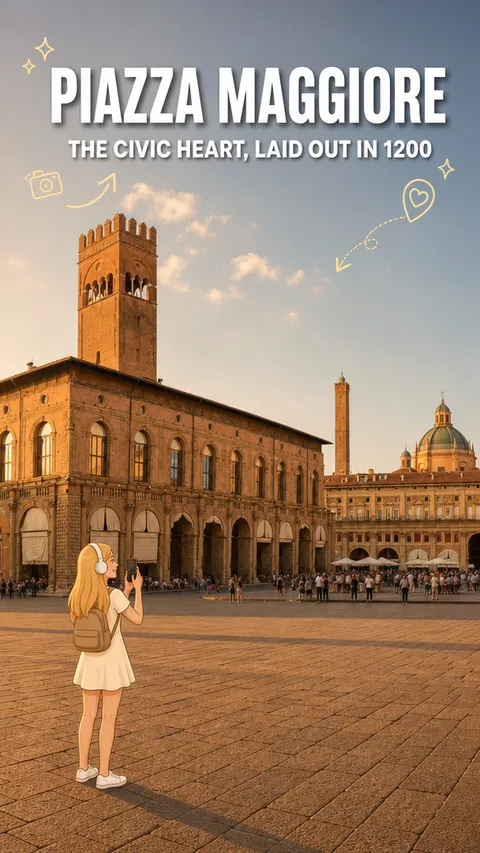
- Piazza Maggiore (free, open 24h): the civic heart since 1200, 115 by 60 meters, ringed by Gothic, Renaissance, and medieval palaces. In summer it becomes an open-air cinema with one of Europe's largest screens.
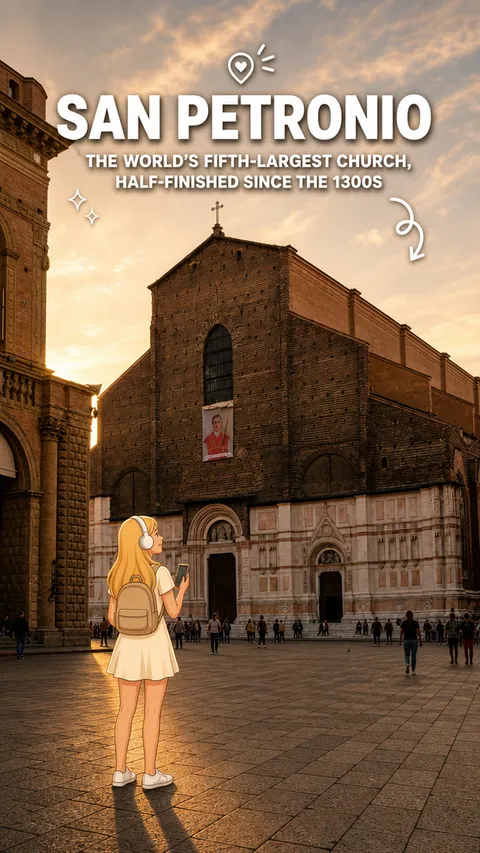
- Basilica of San Petronio (main church free; the terrace costs €3, daily 10:00 to 13:00 and 15:00 to 18:00): the world's fifth-largest church by volume, its facade left half marble and half raw brick since the 1300s. Inside runs the Cassini Meridian, a 66.8-meter sundial along the floor. Cover shoulders and knees.
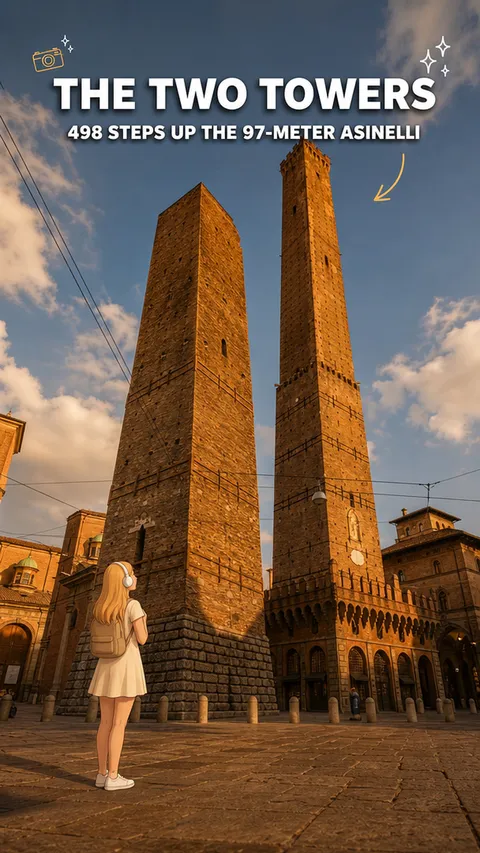
- Two Towers (Asinelli climb) (around €5, book a timed slot online; check the current status, the towers were under renovation in late 2025): 498 wooden steps up the 97.2-meter Asinelli, the tallest leaning tower open to the public in Italy, for the definitive view over the red rooftops. The leaning Garisenda is closed to visitors.
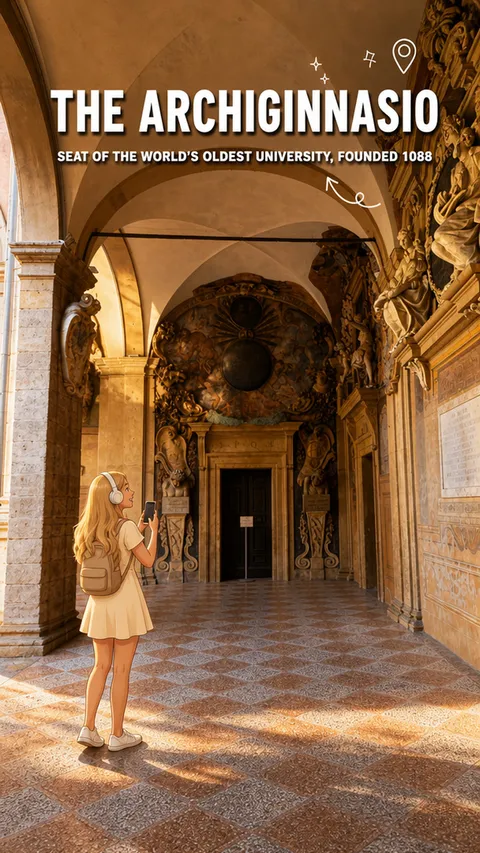
- Archiginnasio and Teatro Anatomico (courtyard and library free; anatomical theatre around €3): the 16th-century original seat of the university, with a 17th-century dissection theatre carved entirely from spruce wood and a marble slab at its center.
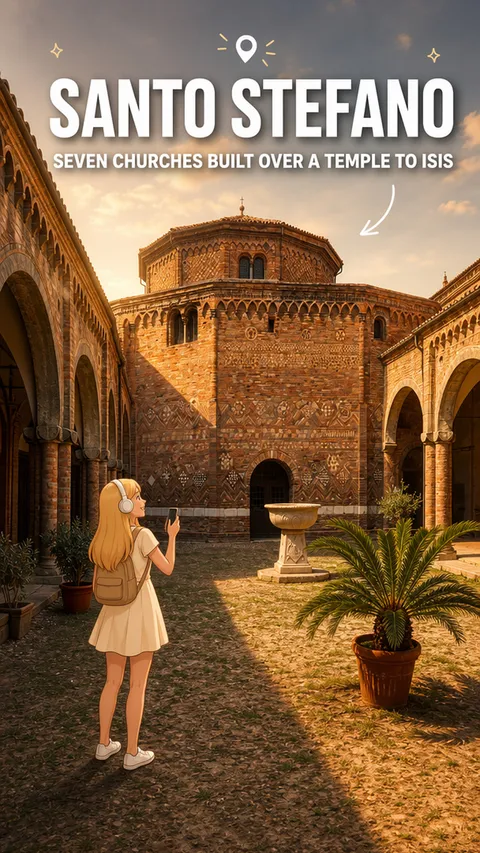
- Basilica di Santo Stefano (free): the "Seven Churches," a complex of interconnected chapels, some from the 5th century, built over a former temple to Isis. One of the quietest, most atmospheric corners in the city.
- The Quadrilatero food quarter (free to browse): the medieval market lanes east of Piazza Maggiore, Via Pescherie Vecchie, Via Clavature, Via Drapperie, packed with fresh-pasta windows, salumerie, and the covered Mercato di Mezzo. This is where you eat.
The route the tour walks with you
Instead of a scattered "find the towers, then somehow the churches" scramble, you walk one logical loop and the tour walks it with you. Our self-guided Bologna walking tour is 9 stops, 3.4 km, about two hours of pure walking, looping south from Piazza Maggiore through the university quarter to Santo Stefano, then back north past the towers and the hidden canal window. It starts from any stop, so you never backtrack to find an official beginning. This is the order that keeps you off the same streets twice:
- 1Piazza Maggiore Your entry point · Free
Begin in the 115-by-60-meter civic square laid out in 1200. The Crescentone platform in the center still carries a scar from a 1945 tank. Get your bearings, then face the giant brick facade to the south.
- 2Basilica of San Petronio Main church free
Step into the cavernous nave, 132 meters long, and find the Cassini Meridian traced across the floor. The unfinished facade tells the story of a church the Pope refused to let outgrow St. Peter's.
- 3Archiginnasio Courtyard free · theatre ~€3
Duck into the old university seat to see the spruce-wood anatomical theatre and the coats of arms lining the courtyard. Look for the peepholes students used when the room was full.
- 4Basilica of San Domenico Free · hours vary
Stand in front of three small marble figures the young Michelangelo carved for the Arca di San Domenico around 1494. Quieter than San Petronio, so you often get the tomb almost to yourself.
- 5Basilica di Santo Stefano Free
Wander the Sette Chiese, seven churches folded into one complex, and the Courtyard of Pilate with its 8th-century Lombard basin. The triangular piazza outside is one of the prettiest in the city.
- 6Two Towers Asinelli ~€5 · book ahead
Reach the leaning pair that define Bologna's skyline. Climb the 498 steps of the 97.2-meter Asinelli for the rooftop panorama; the shorter Garisenda leans off-center and stays closed.
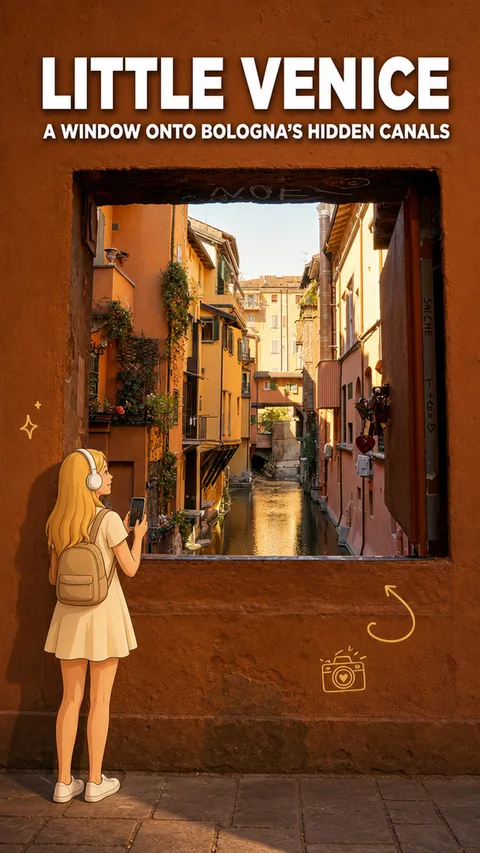
- 7Finestrella di via Piella Free
Open a small wooden shutter in an ordinary wall to reveal the Canale delle Moline, a surviving stretch of Bologna's hidden 60 km of canals. Locals call this corner Little Venice.
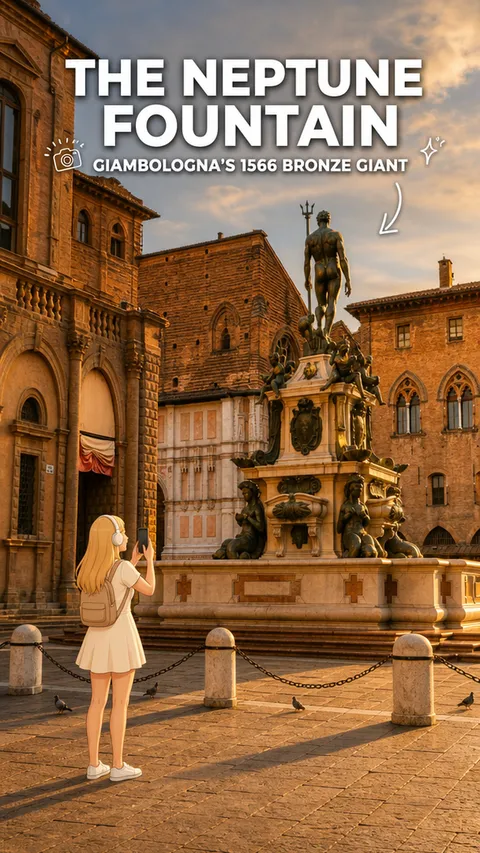
- 8Neptune Fountain Free
Circle Giambologna's 1566 bronze giant, ringed by cherubs for the four great rivers. Students walk around it twice for luck before an exam.
- 9Palazzo del Podestà Free
Finish under the vaulted portico with the whispering gallery: stand in one corner, whisper into the wall, and a companion in the diagonally opposite corner hears every word.


It runs in your browser, no app and no download. A voice guide walks the loop with you and leads a real conversation as you go: it greets you, tells the story between stops, asks what you actually want to see, and adapts. It is not a recording and not an audioguide. The map and step-by-step navigation get you from each stop to the next.
That entire loop is our free, self-guided Bologna walking tour, and because it can launch from any of its stops, you never backtrack to find an official start. You open it the moment you reach Piazza Maggiore and walk the loop at your own pace, ending right back where you began. It runs in your browser, with no app and no download. A voice guide walks the route with you and leads a real conversation as you go: it greets you, tells the story between stops, asks what you most want to see, and adapts the rest of the walk around your answer. It is not a recording and not an audioguide. The map and step-by-step navigation get you from each stop to the next, so you never stand on a corner squinting at Google Maps. See everything on the Bologna walking tour page, and you get 100 free credits to try it.
Insider Tips for the Bologna Day Trip
The most common mistake here is treating Bologna like a monument checklist when it is really an eating city. Build the day around one long lunch in the Quadrilatero or a trattoria on Via Santo Stefano, and slot the sights around it, not the other way round. And do not order "spaghetti bolognese." It does not exist in Bologna. The dish is tagliatelle al ragu, and the official recipe is deposited at the city's Chamber of Commerce.
Do
- Book the Asinelli Tower time slot online before you leave, and check it is open
- Carry cash for the Quadrilatero market stalls; many do not take cards
- Walk the 20 minutes from Bologna Centrale into the center; do not overpay for a taxi
- Order tagliatelle al ragu, tortellini in brodo, and a €3-5 mortadella sandwich
- Try the whispering gallery under Palazzo del Podestà early, before the crowds
- Book both train legs and note the departure board shows the final city, not Bologna
Don't
- Don't ask for "spaghetti bolognese"; it is tagliatelle al ragu
- Don't skip lunch to see one more church. The food is the point of Bologna
- Don't drive; the ZTL fines you and parking is expensive
- Don't turn up at San Petronio in shorts or a vest top; cover shoulders and knees
- Don't board a slow regional by mistake; check the ticket says 37 minutes, not 2 hours
- Don't forget to validate a paper regional ticket in the platform machine
Luggage
On a day trip you should travel light anyway, and full-size cases are fine on these trains, on the overhead racks and the larger shelves at the ends of each car. If you want to wander Florence before boarding, SMN has a left-luggage deposit inside the station.
Buffer
There is little to buffer on a route this short and frequent, but do not cut the very last direct fast train close, especially on summer Fridays and weekends when return trains fill up. Book your return leg before you leave Florence and aim to be on a train back by mid-evening, and the whole thing stays relaxed.
Book the Asinelli Tower slot online before you go, and check it is open, the towers were reported under renovation in late 2025. Watch the San Petronio dress code (shoulders and knees covered), and if you take the regional train, always validate the paper ticket in the platform machine to avoid a fine.
More day trips from Florence
Out in the morning, back in time for dinner. Every route here fits in one full day.
What the Florence to Bologna Journey Feels Like
This is the part no fare table can give you. The ride itself is almost comically easy. You settle into your seat at Firenze SMN, the train slides north into the long Apennine tunnels, and before you have finished a coffee you are pulling into Bologna Centrale. At 37 minutes it feels less like a journey than a commute, which is exactly why people from both cities do it without a second thought.
The arrival has its own small rhythm. You come up from the underground high-speed platforms into a modern concourse, then start walking, and the reward is the walk itself. As one traveler put it, simply start walking and the scenery gets more beautiful with every block. The porticoes close over your head, the smell of ragu drifts out of the trattorias, students cross on bikes, and the two leaning towers rise over the rooftops as a natural compass. By the time you reach Piazza Maggiore the city has already introduced itself.
Then there is the feeling that keeps people coming back: Bologna is lived-in. It is a working university city that happens to be beautiful, less polished than Florence and all the better for it. The uncrowdedness is a pleasant side effect, but the food is the main event. A gelateria crawl alone could fill a day, and wandering the streets between the university and the churches with a mortadella sandwich in hand is the whole trip in miniature. The one thing the speed costs you is the mountains: the fast train spends much of the run in tunnels, so if you want the Apennine ridgelines, take the slower regional one way. On a tight day trip, though, the 37-minute run is the right call, and Bologna rewards the hours you save.
Florence to Bologna: Your Questions Answered
Can you do Bologna as a day trip from Florence?
Yes, and it is one of the easiest day trips in Italy. The fast train is about 37 minutes each way, one leaves every 15 to 20 minutes, and Bologna's compact, flat historic center is made for a self-guided walk. Most sources recommend six to twelve hours on the ground, and a single day genuinely does the city justice.
How long is the train from Florence to Bologna?
About 35 to 37 minutes direct on a Frecciarossa, Frecciargento, or Italo high-speed train. Regional trains take anywhere from 1h15 to 2h30 with more stops through the mountains.
How much does the train cost?
Advance high-speed fares commonly run €9 to €25 one way in second class when you book a week or more ahead, and a same-day return for two often lands under €80 total. Regional trains are a fixed €8 to €12 and need no booking. Last-minute peak high-speed fares can be 3 to 4 times higher, so book ahead.
Is the fast train worth it over the regional?
For a day trip, usually yes. The high-speed train saves you well over an hour each way for a modest premium. Take the regional only if the budget is tight or the fast fares on your date look expensive. The extra stops add up quickly over such a short route.
What time should I leave and come back?
Aim for an 8:30 to 9:00 a.m. train out, which puts you in Bologna as the sights open, and a return in the 7:00 to 8:00 p.m. window, which is popular and still gets you home for a late dinner. Book both legs, because evening trains fill fast in summer and on weekends.
Do I need to book in advance?
Not weeks ahead, because the corridor is busy and seats rarely sell out. But the cheap advance fares do fill, so booking a week or so early keeps you in the €9 to €25 range instead of the pricier walk-up fares. Regional tickets never need booking.
What is Bologna known for?
Food above all. It is the home of tagliatelle al ragu, tortellini in brodo, mortadella, and lasagne verdi, with Parma ham, Parmigiano Reggiano, and Modena balsamic nearby. It is also famous for 38-plus kilometers of UNESCO porticoes, the two leaning towers, and the oldest university in the Western world, founded in 1088.
Is Bologna walkable in a day?
Completely. The historic center is flat and pedestrianized, the main walking loop is only 3.4 km, and dozens of kilometers of porticoes keep you covered in rain or sun. Everything on the route sits within a short walk of Piazza Maggiore.
Should I drive instead?
No. The A1 climbs and winds over the Apennines, Bologna's center is a restricted traffic zone (ZTL) that fines drivers automatically, and city parking is expensive. The train is faster, cheaper, and drops you a 20-minute walk from the old town.
Plan Your Bologna Day Trip
You have the train sorted, and that is the part most people overthink. Now make the hours on the ground count. The 9-stop loop above is our free, self-guided Bologna walking tour: open it the moment you reach Piazza Maggiore, walk the loop at your own pace, and finish back at the square one flat walk from your train home. See everything on the Bologna walking tour page, with 100 free credits to start.
