
Rome to Assisi Day Trip: The Honest Plan by Train
The direct train covers it in about two hours, but the catch nobody warns you about is that Assisi's station sits well below the hilltop town, so you finish with a short bus ride up. Here is the honest day plan, plus a free, self-guided walking tour for the hours on the ridge.
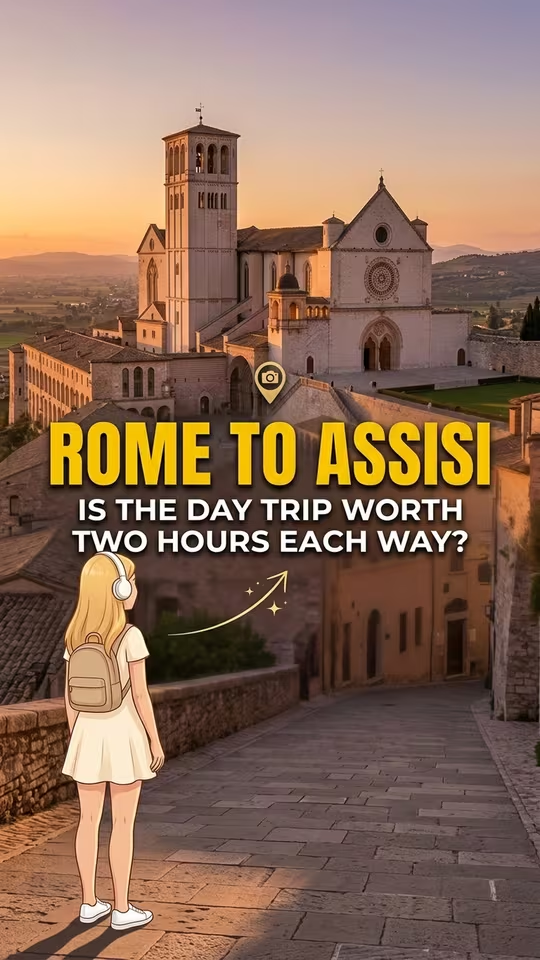
The Quick Answer: Rome to Assisi
The clean way from Rome to Assisi is the direct train, and the thing to understand before you book is that "direct" matters here twice over. A direct Regionale Veloce or Intercity from Roma Termini reaches Assisi station in about 2 hours to 2h10, while the alternatives make you change at Foligno and stretch the trip to 2h30 to 3 hours. The honest catch on this route is geography: Assisi's station is not in the hilltop town. It sits about 4 to 5 km below, down in Santa Maria degli Angeli, so once you arrive you take the local bus C (every 20 to 30 minutes, €1.30 at the station newsstand) or a taxi (€15 to €18) up to the medieval center. None of that kills the day trip. With an early start the town is small, the great sights line up along one ridge, and almost all of them are free.
| Question | Answer |
|---|---|
| Fastest journey time | ~2h to 2h10 on a direct Regionale Veloce or Intercity from Roma Termini |
| Frequency | Around 19 trains a day, but only a handful are direct. The rest change at Foligno |
| Price from | €12 to €13.50 one way on the regional train (Intercity higher), plus €1.30 for bus C up the hill |
| Operators / how | Trenitalia direct to Assisi station, then local bus C (or a taxi) up to the old town |
| First / last | Check the direct departures both ways. The last useful direct train back is early evening |
| Worth it as a day trip? | Yes, with an early start. One focused day covers the basilicas, the temple and the fortress |
Is the Rome to Assisi Day Trip Worth It?
Here is the honest verdict first: yes, Assisi is one of the best day trips you can make from Rome, and the only real argument against it is the distance, not the place. Two hours each way is a genuine commitment, and whether that reads as "easy" or "a stretch" depends on how you travel. What is not in doubt is that Assisi rewards the effort. The entire historic center is a UNESCO World Heritage Site, and unlike most of the famous Rome day trips, it stays remarkably calm once the bus crowds thin out.
The best of Assisi, stop by stop


The case for going is overwhelming. Assisi is one of Italy's most special towns, a serene, unhurried medieval hill town that hands you a completely different side of the country from the crush of Rome. Even if you are not religious, the scale of the Basilica di San Francesco and the Giotto frescoes inside land hard, and the views over the Umbrian plain are worth the ride on their own.
Worth the two hours each way, as long as you take an early direct train.
The honest counterweight is the distance. Assisi sits far enough north that the journey is a real part of the day, not an afterthought, and if you only want a short, low-effort outing there are closer options like Orvieto.
Skip it if you cannot commit to an early start, because the direct trains are limited.
Our call: if you have a spare day in Rome and you commit to an early train, go. You will spend roughly four hours of the day on trains, but the town itself is compact and downhill end to end, so the hours on the ridge are easy and unhurried. The catch worth planning around is not the walk in Assisi, it is the timetable: direct trains are limited, so the whole day hinges on picking the right departure out and the right one back. Pin those two trains first, and everything else falls into place.
Good fit if you...
- Have a free day in Rome and can take an early direct train
- Want a calm medieval hill town after the crush of Rome
- Care about Giotto, St Francis and St Clare, or just a beautiful walk
- Are happy with a 10-minute bus up the hill from the station
Skip it (save Assisi) if you...
- Want a short, low-effort trip (try Orvieto, ~1h15 by train)
- Cannot get an early start, so the direct times do not work
- Need a fast train all the way to the door, downtown to downtown
- Are building an Umbria road trip and would rather drive it
How to Get from Rome to Assisi by Train
You can reach Assisi from Rome a handful of realistic ways, and the train is the clear winner. The wrinkle is the one most guides skate over: the train wins the journey, but it does not deliver you into the old town. It sets you down at the foot of the hill, and you finish with a short bus ride or taxi up.

| Mode | Time | Price | Verdict |
|---|---|---|---|
| Direct train (Regionale Veloce / Intercity) | ~2h to 2h10 | €12 to €13.50 one way (IC higher) | WINNER. Then bus C, ~10 min up the hill |
| Train with a change at Foligno | ~2h30 to 3h | from €11 | Only if the direct times do not fit your day |
| Organized coach tour (often paired with Orvieto) | full day | ~€90 to €130+ | Zero logistics, but group-paced and rushed |
| Car (A1 then the SS75 / E45) | ~2h, ~175 km | fuel + tolls + parking | Only worth it for an Umbria road trip. ZTL and parking are a headache |
| Direct intercity bus | infrequent | varies | The train is faster and far more frequent |
The reason the train wins is simple: it is frequent, cheap, and the direct service is genuinely about two hours, faster and far less fuss than driving 175 km and then fighting Assisi's ZTL and parking. The fine print is that only a handful run direct; the rest change at Foligno and add 30 to 60 minutes, so look for the word "diretto" and the Regionale Veloce or Intercity service when you book. And be clear-eyed about the last leg: the train wins the journey, but it sets you down at the foot of the hill, not in the old town, so you still finish with a short ride up.

Plan your timing
The Train in Detail
The workhorses are Trenitalia's Regionale Veloce and Intercity trains out of Roma Termini. A direct service runs the route in roughly 2 hours to 2h10; the slower journeys change at Foligno, the regional hub 20 minutes short of Assisi, and come in around 2h30 to 3 hours once you add the connection. There are about 19 departures a day in total, but only a handful are direct, so the whole day really does turn on the timetable. Get a direct one and you are looking at a little over two hours; settle for a connection at Foligno and you can be closer to three once the wait is factored in.
Pricing is friendly. The regional train is roughly €12 to €13.50 one way (some advance and off-peak fares dip lower), and Intercity costs a few euros more for a faster, reserved seat. Regional tickets are not tied to a specific train, which suits a day trip, but you must validate a paper regional ticket before boarding, or you risk a fine. Intercity tickets are for a specific departure.
The station, and the bus up the hill
Assisi's station is at the bottom of the valley in Santa Maria degli Angeli, about 4 to 5 km from and well below the hilltop center. Local bus C stops right in front of the station, runs every 20 to 30 minutes, takes about 10 minutes to the old town, and costs €1.30 bought at the station (€1.50 from the driver, exact change). A taxi from the rank outside is €15 to €18. One smart move: buy your return bus ticket the moment you arrive. Tickets are sold at the station newsstand and at nearby bars and tobacconists, and a little cash makes it painless, so grabbing the return now saves you hunting for one when you are tired at the end of the day.
| Compare | Bus C up the hill | Taxi up the hill |
|---|---|---|
| Time to old town | ~10 min | ~8 min |
| Price | €1.30 station / €1.50 driver | €15 to €18 |
| Frequency | Every 20 to 30 min | On demand at the rank |
| Verdict | Best value, the standard move | Worth it if you just missed a bus |
Booking Strategy
There is not a lot to overthink, but a few moves protect the whole day.
Pin the direct trains first, both ways. Only a handful run direct, so before you commit, find a direct departure that gets you in by mid-morning and a direct return that leaves Assisi in the early evening. Build the day between those two.
Decide regional or Intercity by your start time. Regional tickets are open and flexible but slightly slower and unreserved. Intercity is a touch faster with a guaranteed seat, for a few euros more. For a relaxed day, the regional is fine.
Validate paper regional tickets. Stamp a paper regional ticket in the green machines on the platform before boarding. Mobile tickets do not need it. Skipping this is the classic tourist fine.
Buy the return bus ticket on arrival. Grab your bus C return in the station cafe when you land, in cash, so you are not hunting for a machine when you are tired at the end of the day.
Booking checklist
- On Trenitalia, search Roma Termini to Assisi and filter for direct (diretto) trains.
- Book a direct morning departure and a direct early-evening return.
- Choose Regionale Veloce (cheap, flexible) or Intercity (faster, reserved).
- On the day, validate any paper regional ticket before boarding.
- At Assisi station, take bus C up the hill and buy your return bus ticket in the cafe.
Assisi in One Day
Here is the part most day-trip guides bury, and it is the whole point: you do not need to plan a route. You ride bus C up from the station, step off near the top of the old town, open our free self-guided Assisi tour, and start it from wherever you are standing. The voice guide takes the planning off your hands and walks the ridge with you, stop by stop, so the short ride up becomes the start of the day rather than a logistics problem. Assisi makes this easy: the town is essentially one long medieval street on the side of Monte Subasio, with a great basilica bookending each end, so you walk it in a line and never double back.

The time math
Catch an early direct train and you can be on the ridge by mid-morning, ahead of the tour buses that roll in from Rome and Florence and fill the Basilica di San Francesco fast. Subtract roughly two hours of travel each way and the short bus ride, and you are left with five to six genuinely useful hours in town. That is plenty, because the route is short, about 1.6 km of actual walking, almost all of it downhill from the fortress end. The one timing trap is Santa Chiara, which closes from noon to 2:00 p.m., so do not leave it for lunchtime.
What you'll see
This is what a day-tripper should not miss, with the practical reality attached:
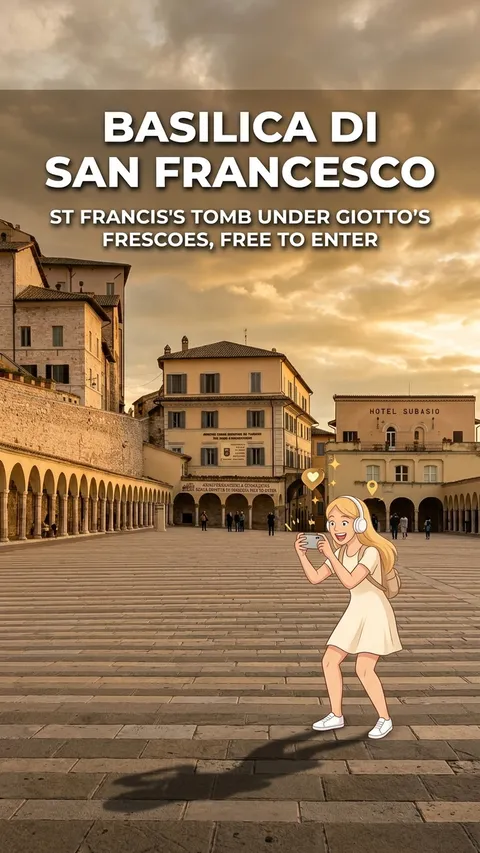
- Basilica di San Francesco (free; daily 6:00 a.m. to 7:00 p.m.): the reason most people come, two churches stacked one above the other over the tomb of St Francis, with the Giotto and Cimabue fresco cycles. Give it a full hour. Shoulders and knees must be covered, and no photos inside.
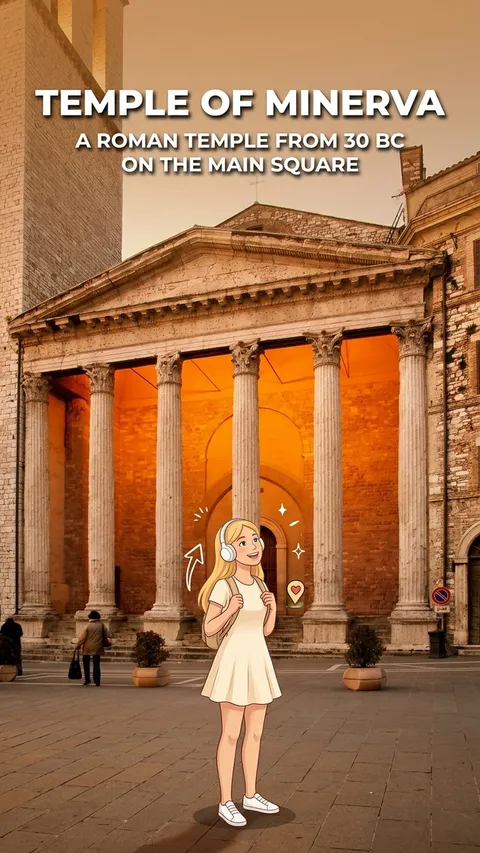
- Temple of Minerva (free; daily 8:00 a.m. to 8:00 p.m.): six Corinthian columns from around 30 BC on Piazza del Comune, one of the best-preserved Roman temples anywhere, with a Baroque church hollowed in behind the ancient facade.
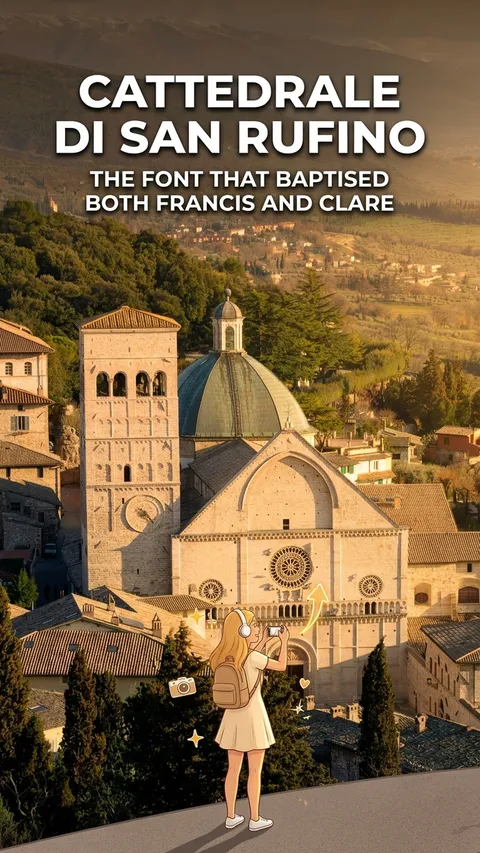
- Cattedrale di San Rufino (free; daily 7:00 a.m. to 7:30 p.m.): the Romanesque cathedral whose font baptised both Francis and Clare, on a wide terrace that was likely the Roman forum.
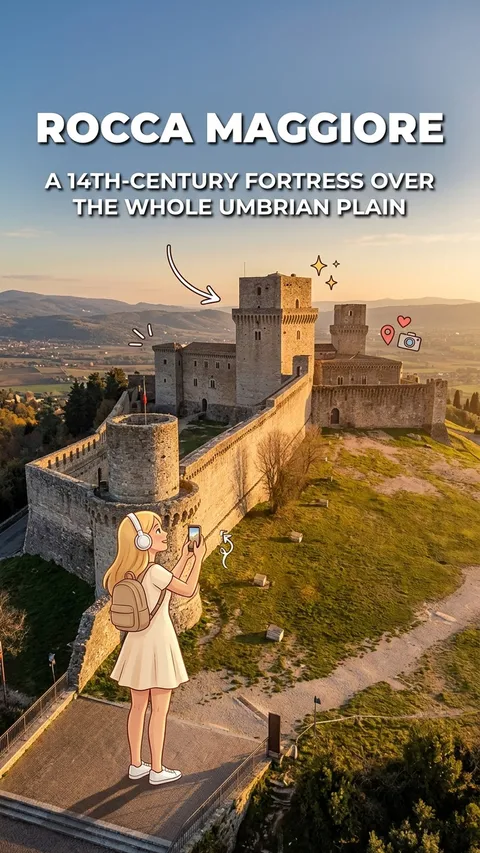
- Rocca Maggiore (€6; daily 10:00 a.m. to 7:15 p.m.): the 14th-century hilltop fortress and the best view in town. The walls are bare inside, so if you are tired the free panorama from just outside the gate is nearly as good.
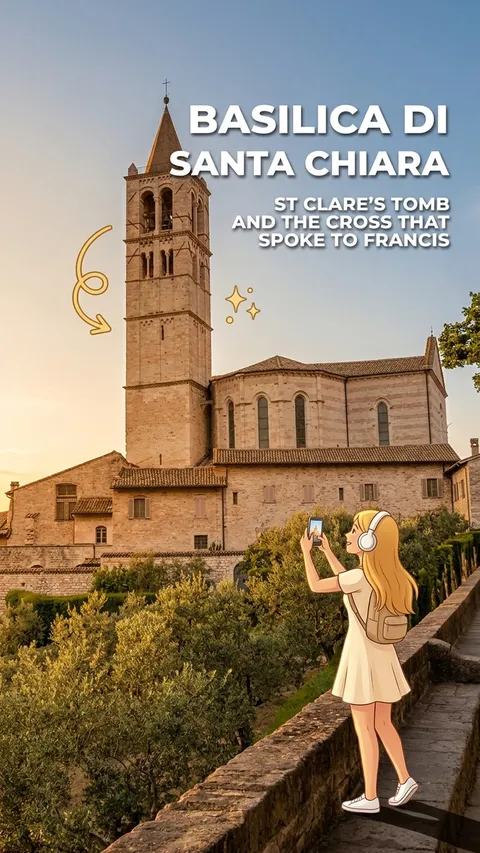
- Basilica di Santa Chiara (free; daily 6:30 a.m. to noon and 2:00 to 6:00 p.m.): the pink-and-white striped basilica with St Clare's tomb and the original San Damiano crucifix said to have spoken to Francis.
The route the tour walks with you
Instead of a generic "see the big basilica, then the rest" list, you walk one efficient line and the tour walks it with you. Because it can start from any stop, you do not backtrack to find an official beginning, you just begin where the bus drops you. This is the six-stop order, running west to east and downhill, from the great basilica to St Clare at the far end:
- 1Basilica di San Francesco Free · your start
The basilica rises out of the hillside on its own arched terrace, two churches stacked one above the other over the tomb of St Francis. Go down to the dim Lower Church for Giotto and Cimabue, then up to the bright Upper Church for the famous life-of-Francis cycle. Come early, before the buses unload mid-morning.
- 2Temple of Minerva Free
Walk up Via San Francesco, the town's spine, into Piazza del Comune. The Temple of Minerva, six Corinthian columns from around 30 BC, is one of the best-preserved Roman temples in the world. Step inside for the Baroque church built into the ancient shell. The square is the natural place to pause, with cafes on both sides.
- 3Casa Natale di San Francesco Free
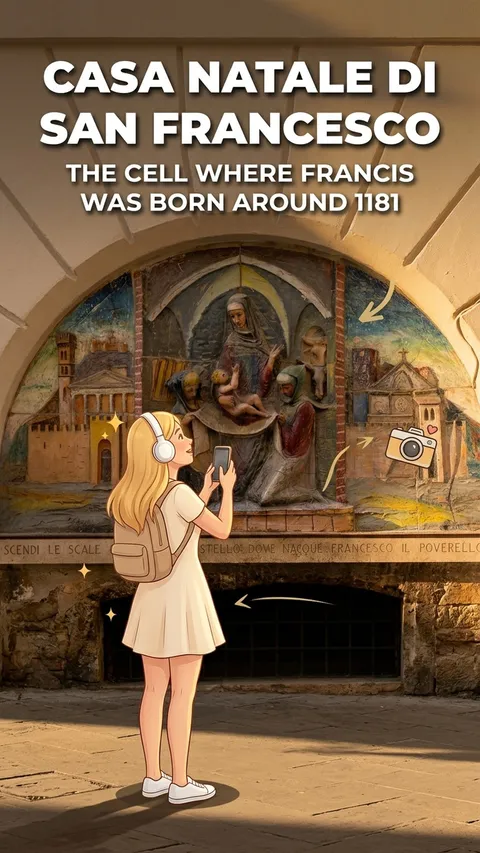
A minute east of the square, tucked into a narrow lane, the Chiesa Nuova was built in 1615 over the house where Francis was born around 1181, with the cramped San Francesco Piccolino cell beside it. Easy to walk straight past, which is exactly why it rewards a slow eye. Ten minutes, not more.
- 4Cattedrale di San Rufino Free
Climb the lane east and the ground opens onto a wide terrace facing the Romanesque cathedral, with its three rose windows and carved beasts. The font inside baptised both Francis and Clare. Stand back across the piazza for the facade, then look right: the lane rising sharply is your route up to the fortress.
- 5Rocca Maggiore Climb · €6
A short but genuinely steep cobbled climb to the 14th-century fortress that has guarded the ridge for over 800 years. The reward is the view: the whole town below, a basilica at each end, and the Umbrian plain running flat to the horizon. The panorama from outside the gate is free if you would rather save the ticket.
- 6Basilica di Santa Chiara Free
Come down off the fortress to the eastern end of town, where the pink-and-white striped basilica closes the route, bracing huge flying buttresses on its left flank. Inside lie St Clare's tomb and the original San Damiano crucifix. The terrace out front is the best valley viewpoint in town, and a fitting place to end the arc from Francis to Clare.

It runs in your browser, no app and no download. A voice guide walks the loop with you and leads a real conversation as you go: it greets you, tells the story between stops, asks what you actually want to see, and adapts. It is not a recording and not an audioguide. The map and step-by-step navigation get you from each stop to the next.
That whole line is our free, self-guided Assisi walking tour, and because it can be launched from any of its stops, you do not hunt for an official start, you just begin where bus C leaves you. You open it the moment you reach the old town and join the route at whichever end is closest. It runs in your browser, with no app and no download. A voice guide walks the ridge with you and leads a real conversation as you go: it greets you, tells the story between stops, asks what you actually want to see, and adapts to your answers. It is not a recording and not an audioguide. The map and step-by-step navigation get you from San Francesco to the temple to the fortress and down to Santa Chiara without squinting at Google Maps. See the full route on the Assisi walking tour page, and you get 100 free credits to try it.
Insider Tips for the Assisi Day Trip
The single biggest rookie error on this route is treating it like a casual, turn-up-and-go trip. It is not. The day lives or dies on catching a direct train out and a direct train back, because the connecting services at Foligno quietly eat an hour. After that, the mistakes are about timing and the church dress code.
Do
- Take a direct train both ways, and pin those times before anything else
- Reach the Basilica di San Francesco before 9:30 a.m., ahead of the buses
- Buy your return bus C ticket in the station cafe, in cash, on arrival
- Wear proper shoes with grip; Assisi is steep and entirely cobbled
- Dress modestly for the basilicas (shoulders and knees covered)
- Break on Piazza del Comune for lunch and the only reliable restrooms
Don't
- Don't gamble on a connecting train when a direct one fits your day
- Don't leave Santa Chiara for lunchtime; it closes noon to 2:00 p.m.
- Don't forget to validate a paper regional ticket before boarding
- Don't drive into the center; it is a ZTL with camera-enforced fines
- Don't photograph church interiors; it is not allowed
- Don't bank on the very last train back. Aim for the second-to-last
The whole day hinges on the timetable, not the town. Only a handful of trains run direct each way, so screenshot your chosen outbound and return departures before you leave Rome, and treat the second-to-last direct train as your real last train home. And remember the basilica dress code, shoulders and knees covered, or you will be turned away at the door.
More day trips from Rome
Out in the morning, back in time for dinner. Every route here fits in one full day.
What the Rome to Assisi Journey Feels Like
This is the part no timetable can give you. Assisi is the kind of town people come back from genuinely calmer than they left, and the texture of the day is half the point. After the noise and heat of Rome, the quiet lands almost physically. The streets are stone, the churches are old and cool, and there is a laid-back, unhurried air that the busier Rome day trips rarely manage. The town sits high on its hill, so corner after corner opens onto a long view over the green Umbrian countryside.
The basilica is the moment most people do not expect, even those who think they are tired of churches. You walk in for the architecture and stay for the frescoes, the whole life of Francis told across the walls in Giotto's hand.
The detail that surprises day-trippers is how easy the town is to do well on your own. The route is short, the sights line up in order, and nearly everything is free. The arc from Francis at one end to Clare at the other gives the day a shape, so it feels less like ticking off churches and more like following a single story along one ridge. You can walk the whole of it at a leisurely pace in well under a day, and then it is over almost too soon.
Rome to Assisi: Your Questions Answered
Can you do Assisi as a day trip from Rome?
Yes, comfortably, as long as you start early. A direct train is about 2 hours each way, then a 10-minute bus up the hill, which leaves roughly five to six useful hours in town. The historic center is compact and downhill end to end, so a focused day covers the basilicas, the Roman temple and the fortress. The thing to plan around is the limited direct-train timetable.
How long does it take to get from Rome to Assisi?
About 2 hours to 2h10 on a direct Regionale Veloce or Intercity from Roma Termini to Assisi station. Journeys that change at Foligno run roughly 2h30 to 3 hours. Add about 10 minutes for the bus C ride up to the old town.
Is the train or a tour better for Rome to Assisi?
The train, for most people. It is cheap (from about €12 one way), frequent, and lets you set your own pace on the ridge. An organized coach tour removes all the logistics and often pairs Assisi with Orvieto, but it costs €90 to €130 or more and runs to a group schedule. Take the tour only if you want zero planning and do not mind being rushed.
How do I get from Assisi station to the town?
The station is in Santa Maria degli Angeli, about 4 to 5 km below the hilltop center. Take local bus C from right outside the station, every 20 to 30 minutes, about 10 minutes, €1.30 bought at the station newsstand or €1.50 from the driver. A taxi from the rank is €15 to €18. Buy your return bus ticket in the station cafe when you arrive.
How much does the train cost?
The regional train is roughly €12 to €13.50 one way, with some advance and off-peak fares lower. Intercity costs a few euros more for a faster, reserved seat. Add €1.30 each way for bus C up the hill.
Do I need to book the train in advance?
Regional tickets are not tied to a specific train, so you can buy them on the day and stay flexible, but you must validate a paper ticket before boarding. Intercity tickets are for a specific departure and are worth booking ahead in summer. Either way, check the direct departure times first, since only a few run direct.
What should I not miss in one day?
The Basilica di San Francesco (give it a full hour for the frescoes), the Temple of Minerva on Piazza del Comune, the Cattedrale di San Rufino, the Rocca Maggiore for the view, and the Basilica di Santa Chiara. All are free except the fortress at €6. Just mind that Santa Chiara closes from noon to 2:00 p.m.
Should I drive instead?
Only if you are building an Umbria road trip and want to add Spello, Spoleto or Perugia. For a straight day trip from Rome, skip the car: it is about 175 km each way, Assisi's center is a ZTL with mailed fines, and parking near the old town is limited. The direct train is faster and far less stressful.
When is the best time to visit?
Spring (April to June) and early autumn (September to October) for mild weather and thinner crowds. Summer is hot and the basilica fills with tour groups by mid-morning, so start as early as you can. Assisi is also a major pilgrimage town, so expect bigger crowds around the feast of St Francis in early October.
Plan Your Assisi Day Trip
You have the trains sorted, which is the part most people get wrong. The hours on the ridge are the easy part: the six-stop line above is our free, self-guided Assisi walking tour, and it starts from any stop, so you launch it the second bus C drops you at the top of the old town and join the route at whichever end is closest. Open it and start walking with 100 free credits.
