
Rome to Capri Day Trip: Train + Ferry, Done Right
This one is a long day done as a round trip: a Frecciarossa to Naples, then a hydrofoil across the bay, with roughly three hours of travel each way. Here is the honest plan to make it work, plus a free, self-guided walking tour for the hours you actually get on the island.
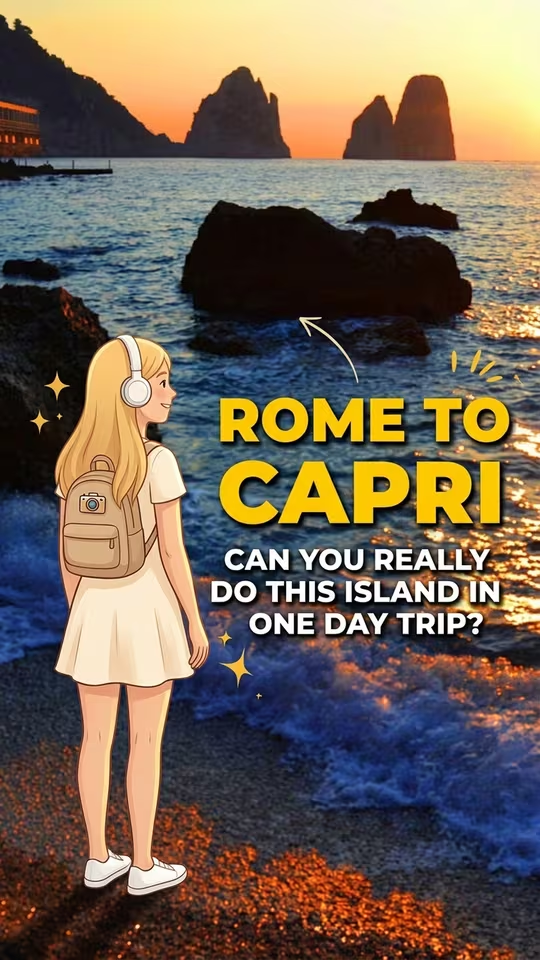
The Quick Answer: Rome to Capri
There is no direct line from Rome to Capri, so the honest answer is a two-leg chain: take a high-speed train to Naples, then a ferry across the bay. The fast version is a Frecciarossa from Roma Termini to Napoli Centrale in about 1 hour 10 minutes, a short hop across Naples to the Molo Beverello port, then a hydrofoil to Capri in roughly 50 minutes. Add the transfer and the inevitable waiting and you are looking at close to three hours each way, door to the island. It is absolutely doable as a day trip, and in summer with a dawn start it works well, but every honest source says the same thing: the travel eats the day, and Capri rewards anyone who can spare a night.
| Question | Answer |
|---|---|
| Fastest journey time | ~3h each way: Frecciarossa Rome to Naples (~1h10), hydrofoil Naples to Capri (~50 min), plus the port transfer |
| How / operators | Trenitalia or Italo to Napoli Centrale, then a SNAV or NLG hydrofoil from Molo Beverello |
| Price from | Train €15 to €40 + ferry from €25 one way. Book the train early for the cheap fares |
| Frequency | 20+ fast trains a day. About 17 ferries a day April to October, roughly 8 in winter |
| First / last | First ferry ~7:00 a.m. Last boat back ~7 to 8 p.m. in summer, earlier off-season. Never gamble on it |
| Worth it as a day trip? | Yes in summer with an early start, but it is a long day. An overnight in Naples or Sorrento is the calmer move |
Is the Rome to Capri Day Trip Worth It?
Here is the honest verdict first: Capri is worth the effort, and the people who love it most are also the ones telling you not to cram it into a single day from Rome. Both are true. The island is small, gorgeous, and genuinely doable in a few focused hours. The catch is geography. Rome sits a long way north of the Bay of Naples, so a "day trip" is really six hours of trains, transfers, and boats wrapped around five or six hours on the ground.
The best of Capri, stop by stop


The "just go" case is strong if you have one free day in Rome and you are willing to start early. The journey is long but it is reliable, and a dawn departure buys you a genuine afternoon on the island.
A Rome to Capri day trip is absolutely feasible with an early start.
You still get five or six unhurried hours on the cliff paths.
The "give it a night" case is not an argument against Capri, only against the round trip squeezed into a day. The honest math is the problem: with three-plus hours of travel each direction, even a perfect run leaves you watching the clock by mid-afternoon.
Three-plus hours each way eats most of the daylight.
An overnight in Naples or Sorrento makes the same island far calmer.
Our call: if Rome is your base and Capri is the dream, go, but treat it as a logistics exercise and book the early train. If you have any flexibility at all, sleep one night in Naples or Sorrento and make Capri a relaxed morning crossing instead. The single biggest mistake on this route is a lazy late start that turns a beautiful island into a panicked dash for the last ferry.
Good fit if you...
- Have a full free day and can leave Rome before 7:00 a.m.
- Are travelling April to October when ferries run late and often
- Want one iconic island and will skip the deep-dive museums
- Are happy to book the train ahead and move fast on transfers
Skip it (or stay overnight) if you...
- Want a relaxed, unhurried day with no clock-watching
- Are travelling in winter, when the last ferry is early and the sea is rough
- Would rather base in Naples or Sorrento and cross in the morning
- Get seasick easily and dread an open-water hydrofoil in chop
How to Get from Rome to Capri by Ferry or Train
You can reach Capri from Rome five realistic ways, and the surprise for first-timers is that there is no shortcut: every route ends with a boat, because Capri is an island with no airport and no bridge. The winner is the obvious DIY chain, the fast train to Naples plus a hydrofoil, because it is the quickest and by far the most flexible.

| Mode | Time | Price | Verdict |
|---|---|---|---|
| Train + hydrofoil (Frecciarossa + Molo Beverello aliscafo) | ~3h each way | train €15 to €40 + ferry from €25 | WINNER. Fastest and most flexible. The only sane DIY route |
| Train + slow ferry (Frecciarossa + Caremar traghetto) | ~3h15 | train + ferry from ~€20 | Boat a touch cheaper and steadier in swell, but slower and less frequent |
| Organised day-trip tour from Rome (train/coach + ferry package) | 13 to 15 hour day | €130 to €200+ | Zero planning, but a long fixed-group day and someone else's pace |
| Drive + ferry (car to Naples, park, then ferry) | ~2h30 drive + ferry | fuel + parking + ferry | Pointless. Non-residents cannot drive on Capri, and you still pay to park and ferry across |
| Overnight in Naples or Sorrento, then ferry | n/a | room + ferry from €20 to €25 | The honest upgrade. Turns a frantic round trip into a calm morning crossing |
The reason the train-plus-hydrofoil chain wins is flexibility, not just speed. Fast trains leave Roma Termini for Napoli Centrale 20-plus times a day, and from Molo Beverello there are up to 17 hydrofoils a day in season, so you are never locked to a single departure. The one real fork is the boat: the hydrofoil (aliscafo) is faster and runs more often, while the traditional ferry (traghetto) is a little cheaper and noticeably steadier if the sea is choppy. Skip the car entirely. Capri bans non-resident cars for most of the year, so a vehicle only gets you as far as a Naples car park before you board the same boat as everyone else.
Make an early start and this chain gets you the most island time.
The Ferry in Detail
The crossing is the part that makes this a day on Capri rather than a day near it, so it pays to understand both legs. First the train: a Frecciarossa or Italo from Roma Termini reaches Napoli Centrale in about 1 hour 10 minutes, with the fastest services closer to 1h07. Then you have to cross Naples from the station to the water. Molo Beverello is the hydrofoil pier, and from Napoli Centrale you have three options: the Alibus shuttle (about 20 minutes, ~€4, roughly every 20 minutes), Tram 1 (about 15 minutes, ~€1, frequent), or a taxi (about 10 to 15 minutes on a fixed city-fare). Build in a buffer here, because a missed connection cascades through the whole day.
From Molo Beverello the hydrofoil to Capri takes roughly 50 to 55 minutes, run by SNAV and NLG (Navigazione Libera del Golfo), with Caremar and others also on the route. Fares start around €25 one way, and the boat lands you at Marina Grande, the island's main port and the natural start of any walk. In high season (April to October) there are up to 17 sailings a day; in winter expect about 8, with a much earlier last boat back.
A useful benchmark: a 7:00 a.m. train out of Roma Termini puts you in Naples around 8:15, in time for a mid-morning crossing and a full island day.
Hydrofoil or slow ferry, which to book?
Take the hydrofoil unless the forecast is rough. It is faster, runs far more often, and on a tight day that frequency is everything. The slow car ferry is a euro or two cheaper and rides the swell better, which only matters if you are seasick-prone or the bay is whipped up, in which case the steadier boat is worth the extra fifteen minutes.
| Compare | Hydrofoil (aliscafo) | Ferry (traghetto) |
|---|---|---|
| Operators | SNAV, NLG | Caremar |
| Time | ~50 min | ~50 to 80 min |
| Frequency | Up to 17 a day in season | Fewer sailings |
| Price from | ~€25 | ~€20 |
| Best for | Speed and a flexible day | Choppy seas, seasick travellers, a tighter budget |
Booking the trip
- Book the Frecciarossa ahead. Advance fares run €15 to €40, but walk-up flexible tickets jump to €40 to €55, so reserve the outbound a week or two early.
- Take the first practical train. Aim to leave Roma Termini by 6:30 to 7:00 a.m. so you make a mid-morning ferry.
- Keep the ferry flexible. You can book the crossing online ahead (Ferryhopper and the operators sell tickets in advance) or buy at the port. Either way, leave the return open until you know your pace on the island.
- Cross Naples efficiently. Alibus, Tram 1, or a quick taxi from Napoli Centrale to Molo Beverello. Leave a 30-minute buffer.
- Plan your return boat first. Note the last sensible ferry the moment you land on Capri, and aim for the second-to-last, not the very last.
Capri in One Day
Here is the part most day-trip guides bury, and it is the whole point: once you are on the island, you do not need a plan at all. You step off the hydrofoil onto the quay at Marina Grande, in the thick of the harbour noise, open our free self-guided Capri tour, and start it right there at the port. The voice guide takes the planning off your hands and walks the island with you, stop by stop, so the climb up from the harbour becomes the first beat of the day rather than a navigation puzzle. No itinerary to memorise, no doubling back, no squinting at a map while the clock runs down toward your ferry.

The time math
Catch a 6:30 to 7:00 a.m. Frecciarossa and you can be standing on Capri soil by 10:00 to 10:30 a.m. The last comfortable ferry back is the lever the whole day turns on: in high summer the latest boats run into the evening, but in shoulder season and winter the last sensible departure can be 6:00 to 7:00 p.m. or earlier, so always check it on arrival and plan around the second-to-last. That leaves roughly six to seven usable hours on the island in summer, fewer off-season, of which the walking loop genuinely needs only four to five. The trick is to start moving the moment you land, hit the southern viewpoints before the midday glare, and keep one eye on the return boat.
What you'll see
This is the shortlist of what a day-tripper should not miss, with the practical reality attached:
- Piazzetta (Piazza Umberto I) (free, always open): the tiny clock-tower square locals call the "drawing room of the world." Worth seeing once for the theatre of it, best early before the late-morning crowds.
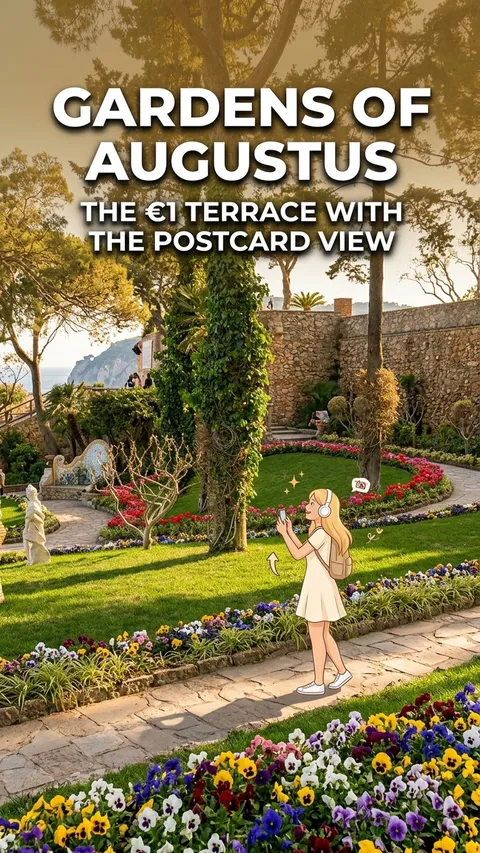
- Gardens of Augustus (€1; daily 9:00 a.m. to 8:00 p.m.): the best-value view on the island, with the postcard angle on the Faraglioni and Via Krupp. Walk to the lowest terrace.
- Via Krupp (free; April to October 9:00 a.m. to 7:30 p.m.): the switchback path carved into the cliff. The lower section often closes for rockfall, so check at the gardens.
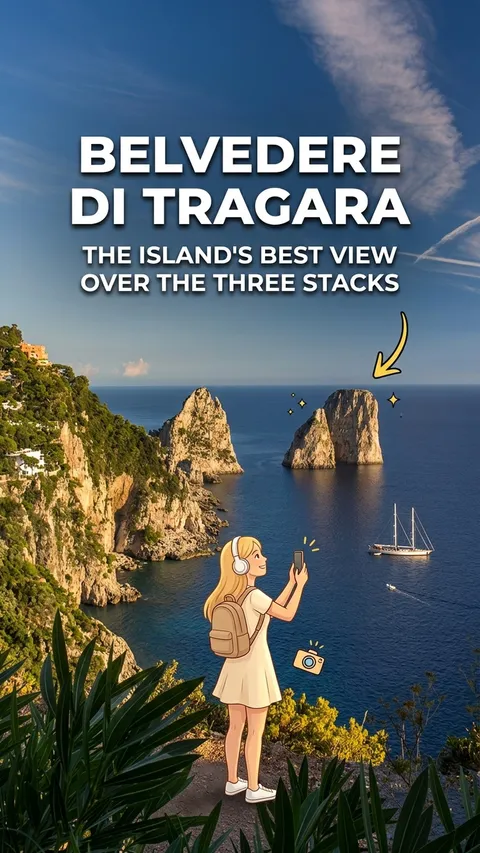
- Belvedere di Tragara (free, always open): for many the single best photo spot on Capri, almost level with the three stacks.
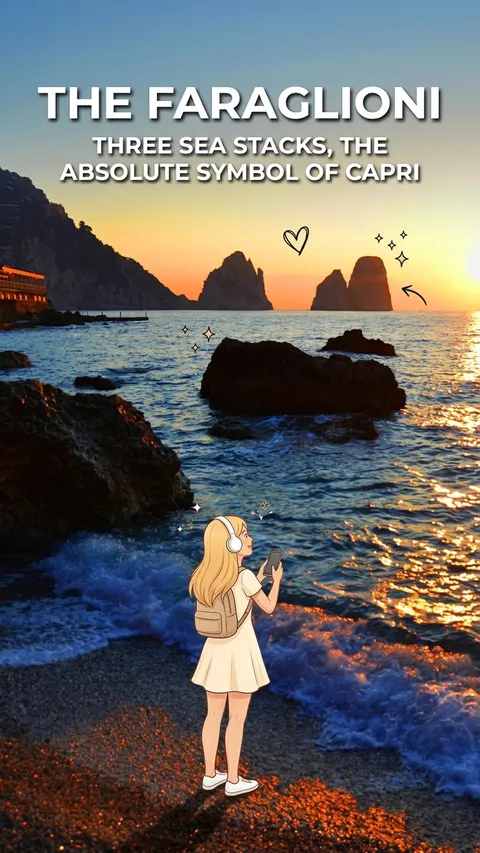
- Faraglioni (free to view; boat-under-the-arch and beach clubs cost extra): the three limestone sea stacks, the absolute symbol of the island.
- Natural Arch (free, always open): an 18-metre limestone span on the quiet eastern trail, the least crowded stop of the day.
- Charterhouse of San Giacomo (€10; Tue to Sun 10:00 a.m. to 5:30 p.m., closed Mon): the 14th-century monastery, the one indoor refuge if it rains. Optional on a tight day.
The route the tour walks with you
Instead of a generic "see the Piazzetta, then the gardens" list, you walk one efficient loop and the tour walks it with you. This is the nine-stop order, starting at the port where your ferry docks and ending on the quiet eastern trail at the Natural Arch, before the lanes lead you back toward your boat. Because the tour starts from any stop, you never backtrack to find an official beginning, you just open it where you stand:
- 1Marina Grande Your arrival point
You step off the ferry into the harbour noise, a row of pastel houses below Monte Solaro. Do not linger over an inflated harbour-front lunch. Your one choice is the funicular up to the Piazzetta or the fifteen-minute walking path beside it. Buy your return ferry time before you leave the port.
- 2Piazzetta Free
The island compresses into one tiny square, Piazza Umberto I, the "salotto del mondo." A coffee at the bar is a fraction of the price of a clock-tower table. See it once for the spectacle, then slip down the whitewashed alleys toward the gardens.

- 3Gardens of Augustus €1
Terraced flowerbeds step down the cliff to the postcard shot: the Faraglioni rising to your left, the white zigzag of Via Krupp dropping to your right. The best-value view on Capri, open daily 9:00 a.m. to 8:00 p.m.
- 4Via Krupp Free
The hairpin walkway switchbacking down toward Marina Piccola, an early-1900s feat of engineering and one of the island's most photographed sights. The lower section often closes for rockfall, so walk the first few bends for the view back up.

- 5Belvedere Cannone Free
A small terrace most day-trippers never find, up a steep stepped alley off Via Madre Serafina. It gives the southern view the famous Tragara lookout does not: straight down onto Marina Piccola and across the curve of Via Krupp. Catch your breath here.
- 6Charterhouse of San Giacomo €10
The oldest monastery on Capri, built in 1371, now a museum of cloisters, a church, and Diefenbach's landscape paintings. Open Tuesday to Sunday, closed Mondays. The cloister gardens have their own free sea view if your budget is tight.
- 7Belvedere di Tragara Free
Via Tragara is the walk's prettiest stretch, a flat promenade of villas and bougainvillea, delivering you to the premier viewpoint over the Faraglioni. Nobody charges you to stand here, so take your time. A steep staircase, the Pizzolungo trail, drops toward the stacks.
- 8Faraglioni Free
At the foot of the three rocks they are far bigger than the postcards suggest, the middle one pierced by a tunnel small boats pass through. The path runs alongside the water with a couple of beach clubs. This is the payoff of the whole loop, so sit a while.
- 9Natural Arch Free
The quietest stretch of the day, a panoramic trail east through holm oak and pine to an 18-metre limestone arch left standing over the drop to the sea. From here the lanes climb gently back toward the Piazzetta and down to Marina Grande, so check your ferry before the return.


It runs in your browser, no app and no download. A voice guide walks the loop with you and leads a real conversation as you go: it greets you, tells the story between stops, asks what you actually want to see, and adapts. It is not a recording and not an audioguide. The map and step-by-step navigation get you from each stop to the next.
That whole loop is our free, self-guided Capri walking tour, and because it can be launched from any of its stops, you do not hunt for a starting line, you just begin at the port and walk. You open it the moment you step off the ferry at Marina Grande. It runs in your browser, with no app and no download. A voice guide walks the route with you and leads a real conversation as you go: it greets you, tells the story between stops, asks what you actually want to see, and adapts to your answers. It is not a recording and not an audioguide. The map and step-by-step navigation get you from the harbour up to the Piazzetta, along the cliff paths, and out to the Faraglioni without losing the thread. See the full route on the Capri walking tour page, and you get 100 free credits to try it.
Insider Tips for the Capri Day Trip
The single biggest rookie error on this route is the lazy start. Leave Rome late, dawdle over the transfer in Naples, and you arrive with the midday crowds and spend the afternoon anxious about the last ferry. Beat that one mistake and the rest is easy. After timing, the tips are about money and footwear.
Do
- Leave Rome on the first practical Frecciarossa, before 7:00 a.m.
- Buy your return ferry the moment you land at Marina Grande
- Take the hydrofoil for speed unless the sea is rough
- Wear proper walking shoes for the stepped cliff paths
- Eat in the back lanes off Via Vittorio Emanuele, not the harbour
- Pay the €1 for the Gardens of Augustus, the cheapest great view anywhere
Don't
- Don't book the Frecciarossa at the station; advance fares are far cheaper
- Don't rely on the very last ferry. Weather and demand can upend it, so leave a cushion
- Don't bother with a car. Non-residents cannot drive on Capri
- Don't eat at the harbour-front or a Piazzetta terrace at full price
- Don't wear smooth-soled sandals. They slip on the polished paving
- Don't try to "do everything." One day is for the highlights, not the museums
Capri town is tiny, so the crowds concentrate fast around the Piazzetta and the main shopping lanes. The further you walk toward Tragara and the eastern trail, the more the island opens up and quietens down.
Luggage
If your Capri trip is a stop on a bigger Italy route, do not haul a suitcase across the bay. Leave the bulk in left luggage at Roma Termini or Napoli Centrale (Napoli Centrale has a staffed KiPoint deposit) and cross with a day pack. The funicular, the stepped alleys, and the cliff paths are no place for wheels.
The whole day hinges on the last ferry, and in shoulder season and winter it leaves early. Check the exact last departure from Capri the moment you arrive and aim for the second-to-last boat. Missing it means an expensive, unplanned night on the island. The Blue Grotto also closes entirely in rough seas, so do not build the day around it if the forecast is bad.
More day trips from Rome
Out in the morning, back in time for dinner. Every route here fits in one full day.







What the Rome to Capri Journey Feels Like
This is the part no timetable can give you. Capri is the kind of island people come back from genuinely moved, and the texture of the day, once you are off the boat and onto the cliff paths, is half the point. The crush is real around the Piazzetta and the boutiques, but it thins fast the further you walk. By the time you reach the Tragara promenade and the trail east toward the Natural Arch, you are often sharing the path with almost no one, walking under maritime pines with the sea wheeling below.
The Gardens of Augustus are the moment most people picture when they think of Capri, the terraced beds framing the Faraglioni and the white ribbon of Via Krupp, and for once the reality lives up to the postcard. From there the walk down toward the stacks is the stretch that stays with you: the path drops gently under the pines toward sea level, the three rocks growing from postcard-distant to genuinely towering as you approach. It is steady, well-graded walking, manageable for anyone reasonably mobile, and the payoff at the bottom is the closest you will get to the symbol of the island without renting a boat. Time it for the late afternoon, after the bulk of the day-trippers have started drifting back toward the port, and the light off the water turns the whole loop golden.
Rome to Capri: Your Questions Answered
Can you do Capri as a day trip from Rome?
Yes, but it is a long day. The fastest chain is a Frecciarossa to Naples (about 1h10), a short transfer to the Molo Beverello port, then a hydrofoil to Capri (about 50 minutes), so close to three hours each way. With a dawn start in summer you get a solid five or six hours on the island. If you can spare a night in Naples or Sorrento, that is the calmer and more rewarding way to do it.
How do you get from Rome to Capri?
There is no direct route. Take a high-speed train from Roma Termini to Napoli Centrale, cross Naples to the Molo Beverello port (Alibus, Tram 1, or a taxi), then board a hydrofoil or ferry to Capri's Marina Grande.
How long does the journey take?
About three hours each way, door to island: roughly 1h10 on the train, 15 to 30 minutes for the Naples transfer plus waiting, and about 50 minutes on the hydrofoil. Allow buffers, because a missed connection knocks the whole day off.
How much does it cost?
The train runs €15 to €40 one way if you book ahead (more at the station), and the hydrofoil starts around €25 one way. Budget roughly €80 to €130 round trip per person for transport alone, before food and any boat tour on the island.
What is the last ferry back from Capri to Naples?
It varies by season. In high summer the latest boats run into the evening, but in shoulder season and winter the last sensible departure can be around 6:00 to 7:00 p.m. or earlier. Always confirm the exact time when you arrive, and aim for the second-to-last boat, not the very last.
Should I drive from Rome instead?
No. Capri bans non-resident cars for most of the year, so a car only gets you to a Naples car park before you board the same boat. It adds cost and parking stress with no upside. Take the train.
Is it better to stay overnight or base in Naples or Sorrento?
If you have any flexibility, yes. A night in Naples or Sorrento turns the frantic round trip into a relaxed morning crossing, and you get Capri in the early light before the day-trippers arrive. An overnight is simply the more rewarding way to see the island.
What should I not miss in one day?
The Piazzetta, the Gardens of Augustus (just €1), Via Krupp, the Belvedere di Tragara for the best Faraglioni view, the Faraglioni themselves, and the Natural Arch on the quiet eastern trail. The whole loop is free or near-free and walkable in four to five hours.
When is the best time of year for this trip?
April to October, when the ferries run frequently and late into the evening. Avoid July and August if you can, when Capri is packed and the heat on the stone steps is punishing. Spring and early autumn give you the best balance of weather, sailings, and breathing room.
Plan Your Capri Day Trip
You have the chain sorted: the early train, the Naples transfer, the hydrofoil. Now make the hours on the ground count. The nine-stop loop above is our free, self-guided Capri walking tour, and it starts from any stop, so you launch it the second you step off the ferry at Marina Grande and walk straight into the day. Open it and start walking with 100 free credits.
