
Rome to Pisa Day Trip: The Honest Train Verdict
The direct train wins this one, about 2 hours 50 minutes each way for roughly €20, no change and no traffic. It is a long travel day, so here is the honest verdict, plus a free, self-guided walking tour for the hours on the ground in Pisa.
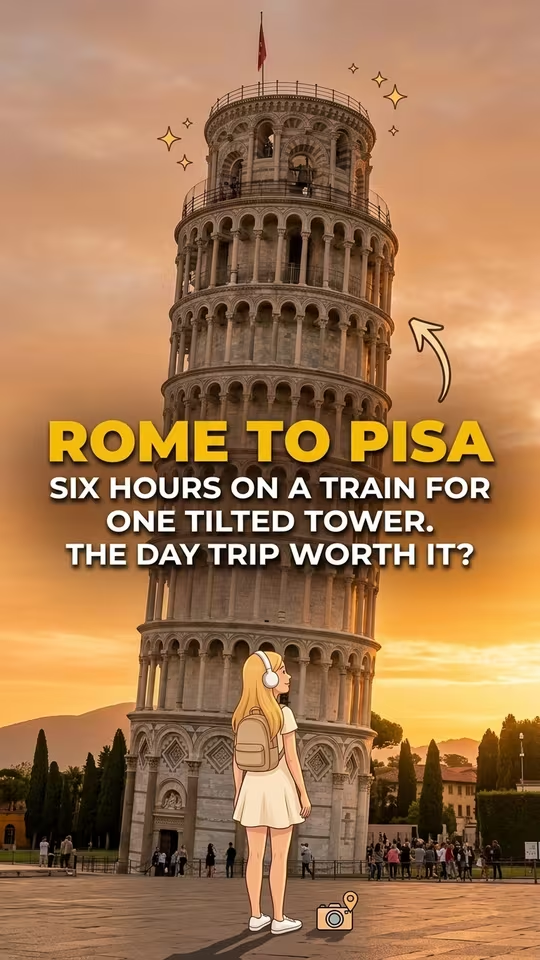
The Quick Answer: Rome to Pisa
The smart way from Rome to Pisa is the direct train, and the trick is to take the one that runs straight through without a change. A direct Frecciabianca or Intercity runs from Roma Termini to Pisa Centrale in about 2 hours 50 minutes, with roughly 9 direct departures a day, from around €20 one way. There are faster combinations that change in Florence, and slower regional trains that crawl up the coast for under €16, but the sweet spot for a day trip is the through train: no change, a guaranteed seat if you reserve, and the Tuscan coast rolling past the window. Be honest with yourself before you book, because this is a long travel day, close to six hours on rails round trip, and the people who come home flat are the ones who treated Pisa as a ninety-minute photo stop after a three-hour ride.
| Question | Answer |
|---|---|
| Fastest journey time | ~2h47 to 3h on a direct Frecciabianca/Intercity. Combos via Florence can match it but add a change |
| Frequency | ~9 direct trains a day, plus many more with one change in Florence (up to ~40 total) |
| Price from | ~€20 one way on a direct Intercity/Frecciabianca. Regional is cheapest (~€16) but ~4h |
| Operators / how | Trenitalia. Direct Frecciabianca/Intercity, or Frecciarossa to Florence then a regional connection |
| First / last | First from Rome ~6:15 a.m., last useful ~8:12 p.m. Leave early, this is a long day |
| Worth it as a day trip? | Yes, with an early start and a tight focus. Or pair it with Florence, since the line runs through |
Is the Rome to Pisa Day Trip Worth It?
Here is the honest verdict first: yes, but only if you respect the distance. Pisa from Rome is not the easy hop that Florence-to-Pisa is. You are giving up close to six hours to travel, which means an early alarm and a disciplined plan, or you arrive tired, see the tower, and ride home wondering what the fuss was about. Decide which trip you are taking before you board, because the single biggest mistake on this route is underestimating how much of the day the train eats.
The best of Pisa, stop by stop


The travelers who come home happy are the ones who set the right expectation and caught an early train. Pisa is unapologetically touristy, and that is worth saying out loud: the base of the tower is a circus of forced-perspective poses and souvenir stalls. But step two streets back and it turns into a genuine Tuscan university town with an Arno waterfront, and a focused day gives you both sides.
Worth it with a 7 a.m. train and a tight, full-day plan.
The case against the trip is just as real, and it is not an argument against going. It is a warning that a half-hearted, mid-morning departure leaves you too few hours on the ground to make the long ride pay off. You cannot see everything in Pisa in one day, but you can see the things that matter if you start early.
Skip it if you can only spare a rushed afternoon for one square.
Our call: if you have a spare day in Rome, catch a train by 7 a.m., and you genuinely want the leaning-tower experience, go, and give Pisa a focused full day rather than the photo stop. The square, the tower climb, the Baptistery acoustics and a slow walk along the Arno fill the hours well. But the smartest move on this route is often to pair Pisa with Florence, because the train runs through Florence anyway. If your real goal is just the selfie, ask yourself whether six hours on a train is the right way to get it.
Good fit if you...
- Have a full free day in Rome and can leave by 7 a.m.
- Genuinely want the leaning-tower experience, not just the photo
- Are happy on a train and like Tuscan coastal scenery
- Want to pair Pisa with a few hours in Florence on the way
Skip it (or restructure) if you...
- Only have a half day or want a relaxed pace
- Expect a grand monument (the tower is smaller in person)
- Resent spending six hours in transit for one square
- Would rather base in Florence, a far shorter hop to Pisa
How to Get from Rome to Pisa by Train
You can reach Pisa from Rome several ways, and unusually the obvious one is also the right one. The train wins, decisively, and the only real decision is which train: the direct through service, or a faster-feeling combination that changes in Florence.

| Mode | Time | Price | Verdict |
|---|---|---|---|
| Direct Frecciabianca / Intercity (Trenitalia) | ~2h47 to 3h | from ~€20 | WINNER. One train, no change, a seat you can reserve |
| Frecciarossa to Florence + regional to Pisa | ~2h45 to 3h15 | ~€30 to €50+ | Often the fastest on paper, but you change trains in Florence |
| Regional / Intercity all the way | ~3h45 to 4h+ | from ~€16 | Cheapest, but it eats most of the day. Skip for a day trip |
| FlixBus | ~6h | from ~€15 | Far too slow for a day trip. Traffic risk on top |
| Car (A12 / coastal route) | ~3h45 to 4h | ~€45 fuel + tolls | Discouraged. ZTL and parking in Pisa are a headache |
| Flight + transfers | ~55 min air | €30 to €100 | Pointless once you add airports and transfers |
The train wins for the simple reason that it runs city center to city center with no driving, no parking and no airport. Pisa Centrale drops you a flat 20-to-25-minute walk from the Leaning Tower. The choice between the direct train and the change-in-Florence combination comes down to temperament: the direct Frecciabianca or Intercity is the low-stress pick, one train you settle into and do not think about again, while the Frecciarossa-plus-regional route can shave a few minutes but asks you to make a connection in a busy station with a day-trip clock running. For most people the direct train is the better day, and the rule is simple: book the through service on purpose and you only have one train to think about all day, no connection to chase with a day-trip clock running.

The Train in Detail
The route is Roma Termini to Pisa Centrale, all on Trenitalia. The direct trains are Frecciabianca and Intercity services that run up the Tyrrhenian coast through Grosseto and Livorno, no change required. There are also frequent Frecciarossa departures that go via Firenze Santa Maria Novella, where you change onto a regional train for the final 50-to-60-minute leg into Pisa.
A few practical realities. The direct services are reserved-seat trains, so unlike the regional commuter runs you board with a specific seat and do not risk standing. The fastest direct timings sit around 2h47 to 3 hours; the slower all-regional option crawls in at 3h45 to 4 hours and is only worth it if money matters more than your day. Roma Termini is the main hub with every facility, and Pisa Centrale sits south of the Arno, a flat walk or a short bus ride from the monuments.
On price, the spread is wider than the Florence-to-Pisa hop because high-speed fares move with demand. The most commonly cited starting point for a direct Intercity or Frecciabianca is around €20, climbing toward €40 closer to departure. A Frecciarossa via Florence typically runs €30 to €50 or more. The all-regional route can be had from about €16 at a fixed fare. Book the high-speed and Intercity tickets a week or two ahead for the cheaper buckets, because unlike the regional trains these do rise and can sell out on busy days. Even the change-in-Florence combination beats every road option, so the only real question is direct versus one connection, not train versus car or bus.
Direct train or change in Florence, which to book?
Book the direct Frecciabianca or Intercity if it lines up with your timings, because one train with a reserved seat is the calmest version of a long day. Take the Frecciarossa-via-Florence combination only if the direct departures do not suit your schedule, or if you actually want to break the journey and spend a few hours in Florence on the way. Avoid the all-regional route for a day trip: the €4 you save is not worth the hour you lose.
| Compare | Direct Frecciabianca / Intercity | Frecciarossa + regional via Florence |
|---|---|---|
| Time | ~2h47 to 3h | ~2h45 to 3h15 |
| Changes | None | One, at Firenze SMN |
| Price from | ~€20 | ~€30 to €50+ |
| Best for | A calm, single-train day | Tightest timing, or pairing with Florence |
| Verdict | Best for most day-trippers | Only if the direct times do not fit |
Booking Strategy
Unlike the regional trains on shorter Tuscan hops, the trains you will actually take from Rome do move with demand and can sell out, so this route rewards a little planning. The strategy is about catching the cheap fare bucket and reserving a seat, not about hunting for a deal that does not exist.
Book the direct train one to two weeks ahead. Frecciabianca, Intercity and Frecciarossa fares rise as seats fill, so the €20 direct ticket becomes €40 if you wait for the morning of. Buy early for the cheaper "Economy" or "Super Economy" bucket.
Reserve a seat, then stop worrying. These are reserved-seat services, so once you have a ticket you have a place. That is the whole appeal of paying more than the regional fare.
Decide direct versus via-Florence before you book. A direct Frecciabianca is one purchase. The via-Florence route is usually two tickets, the Frecciarossa to Florence and a separate regional to Pisa, so factor in the connection time.
Buy the return at the same time. Since these trains sell out on busy days, lock your evening train home when you book the outbound, picking a sensible early-evening departure rather than the very last one.
Booking checklist
- Pick a direct Frecciabianca or Intercity that leaves Roma Termini by around 7 a.m.
- Book it one to two weeks ahead on the Trenitalia app for the cheap fare bucket.
- Lock your return at the same time, an early-evening train, not the last one.
- If no direct train fits, book the Frecciarossa to Florence plus a separate regional to Pisa.
- Keep your reservation handy; on the high-speed and Intercity trains your seat is assigned.
Pisa in One Day
Here is the part most day-trip guides bury, and it is the whole point: you do not need to plan a route. You step off the train at Pisa Centrale, open our free self-guided Pisa tour, and start it from wherever you are standing. The voice guide takes the planning off your hands and walks the city with you, stop by stop, so the 20-minute stroll up to the Piazza dei Miracoli becomes the first beat of the day rather than a logistics problem. After three hours on a train, the last thing you want is a guidebook in your hand and a map you keep losing. That short walk in, past the Arno and into the square, is exactly what turns a rushed photo stop into a real, if compact, day in Pisa.

The time math
This is where the distance bites, so plan around it. Catch a direct train around 6:15 to 7:00 a.m. and you are standing at the tower around 10 a.m. Take an early-evening train back, ideally one leaving Pisa around 6 to 7 p.m., and you have a comfortable six-plus hours on the ground, which is genuinely enough for a focused day. Cut it tighter than that, leave Rome mid-morning, and you are down to three or four hurried hours that will not feel worth the ride. The non-negotiable on this route is the early start. Everything good about the day depends on it.
What you'll see
This is what a day-tripper should not miss, with the practical reality attached:
- Piazza dei Miracoli (free, open 24/7): the UNESCO-listed green where the four marvels stand together, the Cathedral, the Baptistery, the Camposanto and the tower. The lawn itself is free to walk.
- Leaning Tower (around €20 to €25, timed entry): 294 steps up the famous tilt, a 30-to-45-minute experience that books out online via opapisa.it. No bags inside (free storage at the museum entrance), and children must be at least 8.
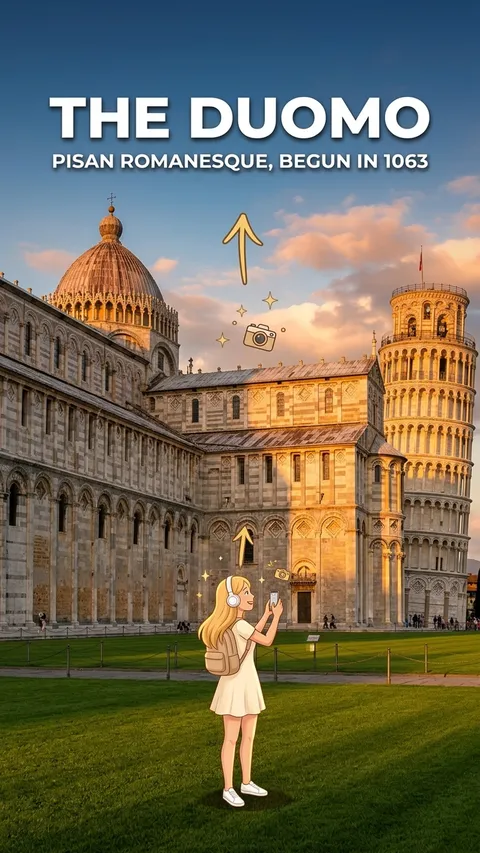
- Pisa Cathedral (Duomo) (free, but you still need a time-slot ticket): the Pisan Romanesque masterpiece at the heart of the square, begun in 1063. Open 10:00 a.m. to 6:00 p.m.
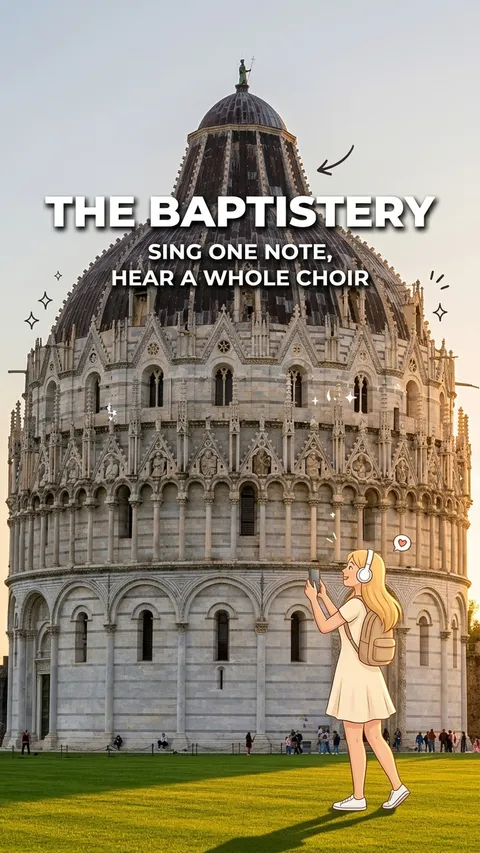
- Baptistery of Pisa (€5, or in a combo): the largest baptistery in the world. Do not miss the acoustic demonstration, where one sung note blooms into a chord. Open 9:00 a.m. to 6:00 p.m.
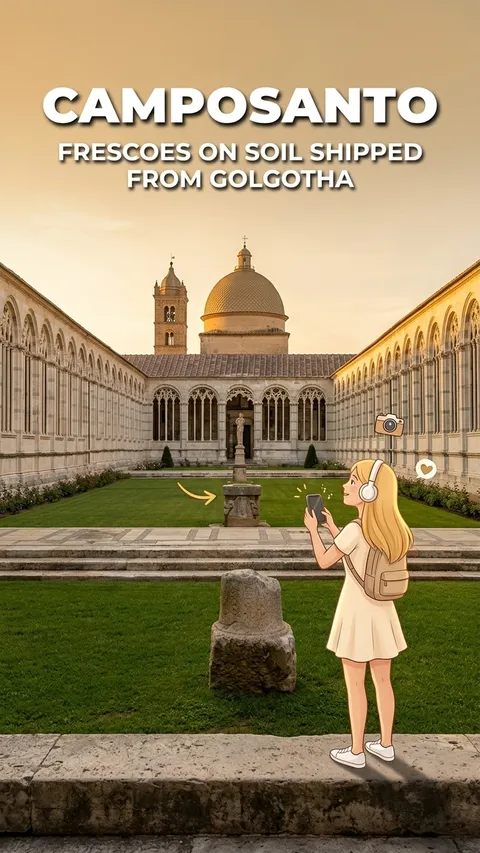
- Camposanto Monumentale (€7): the frescoed cloister-cemetery on the north edge of the square, built on soil said to come from Golgotha. Open 9:00 a.m. to 8:00 p.m.
- Combo tickets (€7 to €27): bundle the monuments at the ticket office. Buy the tower slot online ahead, sort the rest on the day.
The route the tour walks with you
Instead of a generic "see the tower, take the photo" list, you walk one efficient line and the tour walks it with you. This is the seven-stop order, starting in the Piazza dei Miracoli where the marvels cluster and ending down on the Arno at Santa Maria della Spina, which points you back toward Pisa Centrale and your train home:
- 1Baptistery of Pisa Your start · €5
Begin at the largest baptistery in the world, a marble drum begun in 1152 and topped over two centuries, Romanesque arches below and Gothic pinnacles above. Wait for a custodian to demonstrate the acoustics: a single sung note resonates for about eight seconds into what sounds like a full chord.
- 2Camposanto Monumentale €7
The long cloistered cemetery closing the north side of the square, founded in 1277 on soil legend says was shipped from Golgotha in 53 boatloads. The galleries hold Roman sarcophagi and the battered, partly restored "Triumph of Death" fresco. Most of the tower crowd walks straight past it, which is their loss.
- 3Pisa Cathedral Free · timed ticket
The Pisan Romanesque cathedral begun in 1063 with the spoils of a naval victory over Palermo, its bronze Porta di San Ranieri the only original portal to survive the 1595 fire. Inside, Giovanni Pisano's carved marble pulpit alone justifies the stop. Free to enter, but you still need a time-slot ticket.
- 4Leaning Tower of Pisa Climb · €20 to €25
The 56-meter campanile that took 199 years to build and leans 3.97 degrees off vertical. Climb the 294 steps and feel the floor tilt under you, genuinely disorienting if you are prone to motion sickness. Book the timed slot online ahead, because the online climber slots go first on busy summer days.
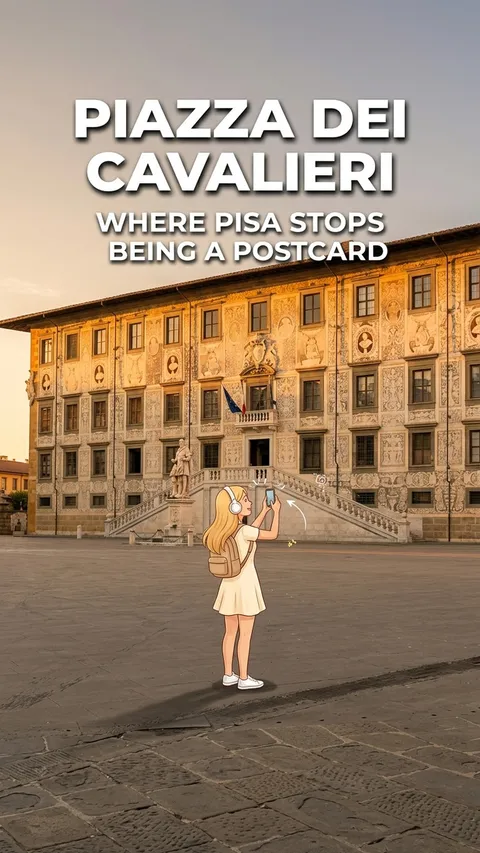
- 5Piazza dei Cavalieri Free
A short walk south into the real city, the medieval seat of civic power redesigned by Vasari in 1562, its Palazzo della Carovana covered in sgraffito and now home to the elite Scuola Normale Superiore. This is where Pisa stops being a postcard and becomes a town.
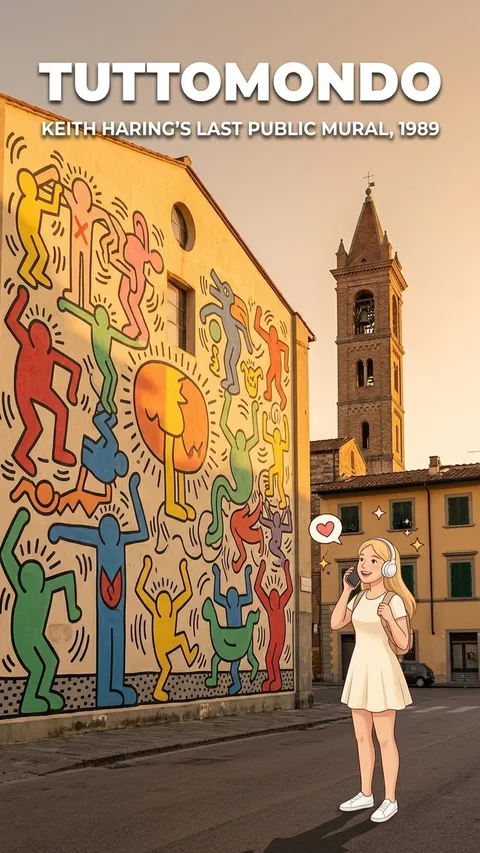
- 6Tuttomondo Free
Keith Haring's last great public mural, 180 square meters of thirty interlocking figures painted in June 1989 on the flank of Sant'Antonio Abate. Painted in durable acrylics, so the colors still blaze. It faces a quiet side street, so come down Via Zandonai to find it.
- 7Santa Maria della Spina Free · on the Arno
The tiny Gothic jewel-box church on the riverbank, dismantled and rebuilt a meter higher in 1871 to escape the floods, its exterior bristling with gables, pinnacles and saints. It sits right on your way back to the station, the perfect last stop before the train.
It runs in your browser, no app and no download. A voice guide walks the loop with you and leads a real conversation as you go: it greets you, tells the story between stops, asks what you actually want to see, and adapts. It is not a recording and not an audioguide. The map and step-by-step navigation get you from each stop to the next.
That whole line is our free, self-guided Pisa walking tour, and because it can be launched from any of its stops, you do not backtrack to find an official start, you just begin where you are. You open it the moment you step off at Pisa Centrale and it walks you up to the Piazza dei Miracoli to begin. It runs in your phone browser, with no app and no download. A voice guide walks the route with you and leads a real conversation as you go: it greets you, tells the story between stops, asks what you actually want to see, and adapts to your answers. It is not a recording and not an audioguide. The map and step-by-step navigation get you from the square to Knights' Square to the Arno without squinting at Google Maps. See the full route on the Pisa walking tour page, and you get 100 free credits to try it.
Insider Tips for the Pisa Day Trip
The single biggest rookie error on this route is leaving Rome too late, then losing the day to the three-hour ride and giving Pisa a rushed ninety minutes. Leave early or do not go. After that, the mistakes are about tickets and the tower.
Do
- Book a direct train that leaves Rome by 7 a.m.
- Buy the high-speed ticket a week or two ahead for the cheap fare
- Reserve your evening return at the same time
- Book the tower climb online in advance (the online slots go first)
- Use the free bag storage at the museum before the tower
- Stay past the tower into the old town and the Arno
Don't
- Don't leave Rome mid-morning and expect a real day in Pisa
- Don't take the all-regional train for a day trip (it eats ~4 hours)
- Don't drive into Pisa (ZTL and a parking nightmare)
- Don't take the wrong-side bus at the station (that one heads to the airport)
- Don't carry bags up the tower (no bags allowed inside)
- Don't judge Pisa on ninety rushed minutes
Plan the day before you board so you know which monument needs a timed slot and where the queues form. On this route the early train is the whole game, and a loose plan on top of it is what separates a great day from a rushed one.
This is a long-distance, reserved-seat journey, not a turn-up-and-go regional hop. If you book a direct Frecciabianca or Intercity, your seat is assigned, so check your carriage and seat number before the train fills. And if you take the bus from Pisa Centrale up to the tower instead of walking, take the LAM Rossa (red line, under €2, get off at "Torre"), not the bus on the exit side, which heads the opposite way toward Pisa Airport.
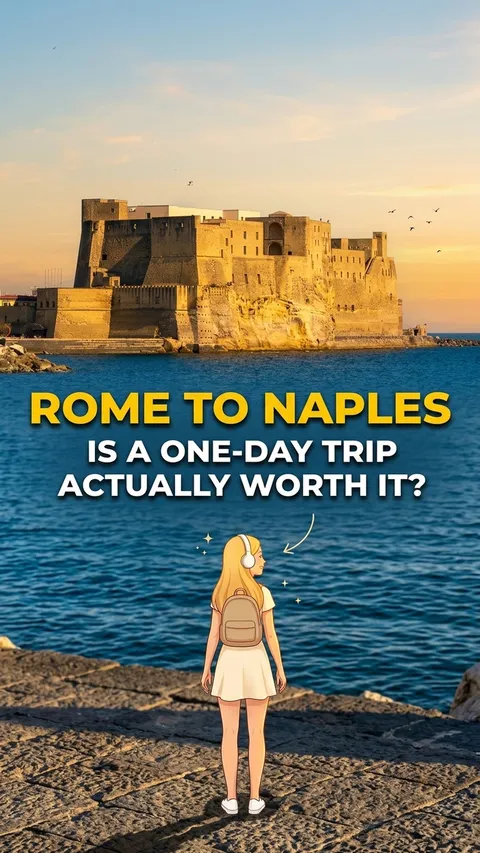
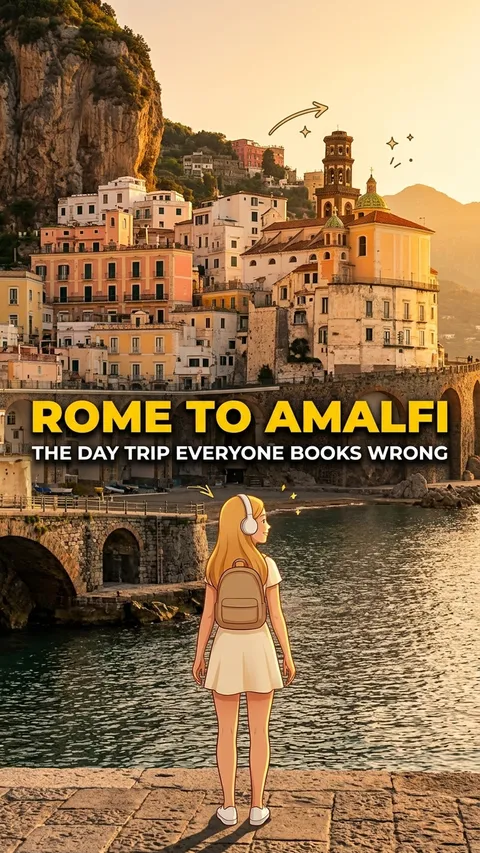
More day trips from Rome
Out in the morning, back in time for dinner. Every route here fits in one full day.
What the Rome to Pisa Journey Feels Like
This is the part no timetable can give you. After three hours of coast and countryside, the tower lands smaller than you expect. In photos it looms; in person it is a 56-meter campanile, and the base is a circus of forced-perspective poses and souvenir stalls. None of that is the real memory.
The real memory is the climb, and it is genuinely strange. The 294 steps spiral up a floor that tilts under you, so you lean from one side to the other the whole way up. It is disorienting enough that anyone prone to motion sickness should think twice before committing. It is the most physically odd monument experience in Tuscany, and that is exactly why people remember it long after the photo fades.
And then there is the other Pisa, the one the day-trippers miss, which is the whole reason to give it the full day you traveled so far for. Step away from the tower scene and the city changes character completely. The Cathedral is beautiful, filled with the spoils of ancient naval wars. The Baptistery acoustics are close to perfect, where one sung note blooms into a chord. The Camposanto holds a vast spread of fresco on soil legend says came from Golgotha. Walk into Piazza dei Cavalieri and down to the Arno and Pisa finally stops being a postcard.
Rome to Pisa: Your Questions Answered
Can you do Pisa as a day trip from Rome?
Yes, but it is a long day. The direct train is about 2 hours 50 minutes each way, so you spend close to six hours in transit. With an early start, around a 6:15 to 7 a.m. departure, you get the highlights comfortably. Many travelers prefer to pair Pisa with Florence, since the train runs through Florence anyway.
How long does the train from Rome to Pisa take?
About 2 hours 47 minutes to 3 hours on a direct Frecciabianca or Intercity. A Frecciarossa changing in Florence can be similar or a touch faster but adds a connection. The all-regional option crawls in at 3 hours 45 minutes to over 4 hours.
How much is the train from Rome to Pisa?
From around €20 one way on a direct Intercity or Frecciabianca if you book ahead, rising toward €40 closer to departure. A Frecciarossa via Florence is typically €30 to €50 or more. The cheapest is the all-regional route from about €16, but it takes around four hours.
Do I need to book the train in advance?
For this route, yes. Unlike the short regional Tuscan hops, the Frecciabianca, Intercity and Frecciarossa trains move with demand and can sell out, so book a week or two ahead for the cheaper fare and a guaranteed seat. Only the slow all-regional option is fixed-price and turn-up-and-go.
Should I take the direct train or change in Florence?
Take the direct Frecciabianca or Intercity if the timing fits, because one reserved-seat train is the calmest way to spend a long day. Use the Frecciarossa-via-Florence combination only if the direct departures do not suit you, or if you want to spend a few hours in Florence on the way.
Which station should I get off at in Pisa?
Pisa Centrale. It is the main station with full service and a flat 20-to-25-minute walk to the tower, or a short LAM Rossa bus ride. Pisa S. Rossore is closer to the monuments but usually needs a transfer, so only use it if a train lines up perfectly.
Can I combine Pisa with Florence in one day from Rome?
Yes, and it is a popular plan precisely because the Rome-to-Pisa line runs through Florence. A common approach is a few hours in Florence in the morning, then a short regional train on to Pisa in the afternoon, before the long ride home. It makes the travel time feel far better spent than visiting Pisa alone.
How much time do I need in Pisa?
A focused day, roughly five to six hours on the ground, lets you climb the tower, see the Baptistery and Camposanto, walk into the university quarter and reach the Arno. Half that and you are doing the photo stop, which is hard to justify after a three-hour train ride.
Is the train or a guided coach tour better?
The independent train, for almost everyone. Organized coach day trips from Rome exist, but they cost more, herd you between photo ops, and give you even less free time. The train is cheaper and leaves you in control of your own day.
Plan Your Pisa Day Trip
You have the train sorted: book a direct service ahead and leave Rome early. What you do once you step off at Pisa Centrale is what decides whether the long ride was worth it, and that part is already handled. The seven-stop line above is our free, self-guided Pisa walking tour, and it starts from any stop the moment you step off the train. Open it and start walking with 100 free credits.
