
Rome to Orvieto Day Trip: The Train Done Right
The direct regional train runs you up the Rome to Florence line in about 1h15, and a €1.30 funicular lifts you from the valley station onto the cliff-top town. Here is the honest day plan, plus a free, self-guided walking tour for the hours on the rock.
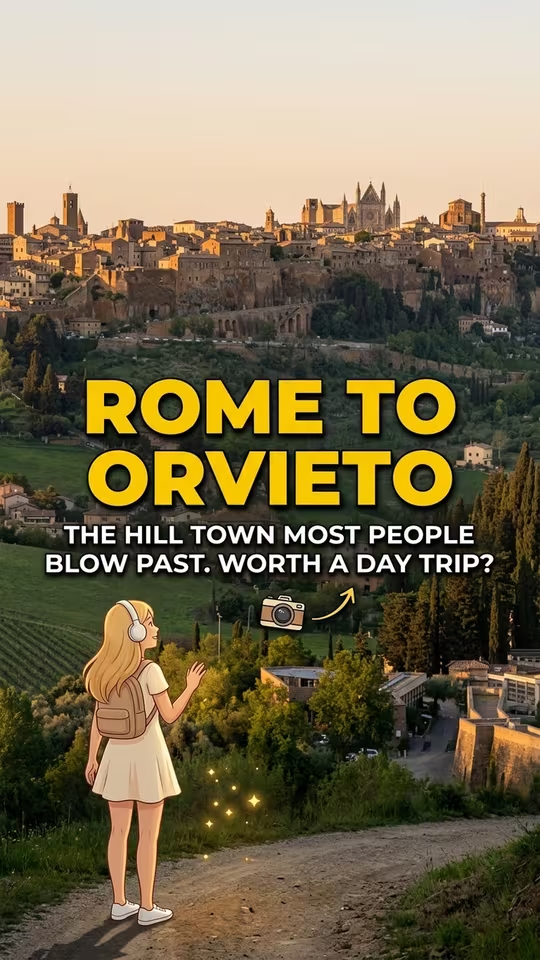
The Quick Answer: Rome to Orvieto
The simplest way from Rome to Orvieto is the direct regional train, and it is one of the easiest day trips in central Italy. Trenitalia Regionale services run up the Rome to Florence main line from Roma Termini (and Tiburtina and Ostiense) to Orvieto in about 1 hour 15 minutes, leave roughly hourly through the day, and cost a fixed €10 or so one way with no need to book ahead. Orvieto's station, Orvieto Scalo, sits in the valley at the foot of the cliff, so you finish the trip on the funicular: a €1.30 cable car that climbs to Piazza Cahen in the old town in about two minutes, and the ticket even covers the shuttle bus on to the cathedral square. As a day trip it works beautifully, though the people who love Orvieto most are also the ones quietly telling you to stay the night.
| Question | Answer |
|---|---|
| Fastest journey time | ~1h05 to 1h15 by direct regional train. A few Intercity trains shave a little off |
| Frequency | Roughly hourly regional trains, many of them direct. Around 17 to 30 a day total |
| Price from | €10 fixed on the Regionale (one way). Intercity advance fares from ~€6 to 15 |
| Operators / how | Trenitalia Regionale (the workhorse) and some Intercity. Then the Orvieto funicular |
| Funicular up | €1.30 single, €2.60 return, every ~10 min, includes the shuttle to Piazza del Duomo |
| Worth it as a day trip? | Yes. Direct train, a tiny walkable town, and the Duomo alone earns the trip |
Is the Rome to Orvieto Day Trip Worth It?
The honest verdict first: yes, Orvieto is one of the best train day trips you can do from Rome, and yes, almost everyone who goes wishes they had given it a night. Both are true. It is close, it is direct, and the whole town fits on a slab of volcanic tufa barely a kilometer across, so a single focused day genuinely delivers the place rather than skimming it.
The best of Orvieto, stop by stop


The "absolutely go" case is strong. The ride is short and scenic, the funicular up the cliff face is half the fun, and Orvieto is a real exhale after the crush of Rome. From the foot of the funicular the walled town reads as one of the most striking hill towns in central Italy, distinctive and faintly improbable, floating on its rock above the Paglia valley.
Direct train, a two-minute cable car, and a town you cannot get lost in. This is the easy one.
The "give it more time" case is not an argument against going, only against rushing a town that rewards slowness. Orvieto fills with day-trippers from late morning, then empties out and turns quiet and golden after dark, which is the version overnight guests get to keep.
If you want the wine, the long dinner, and the town after the funicular stops, stay the night.
Our call: if you have a spare day in Rome and you get a morning train, go. The four things that matter most, the Duomo, the underground caves, St. Patrick's Well, and the view from Torre del Moro, sit within a ten-minute walk of each other on top of the rock, so a day is plenty for the highlights. If you can spare a night, do that instead and watch the day-trippers drain out on the evening funicular. But nobody should skip Orvieto waiting for a longer Umbrian trip that may never happen.
Good fit if you...
- Have a free day in Rome and can catch a morning train
- Want a tiny, walkable hill town after Rome's scale and crowds
- Love the core: the Duomo facade, the caves, the well, the views
- Want a cheap, direct, no-booking ride downtown to cliff-top
Skip it (stay overnight instead) if you...
- Want to linger over wine, dinner, and the town after dark
- Need to see every museum on Piazza del Duomo
- Have weak knees (the well and the towers are real climbs)
- Are building a wider Umbria trip with Civita and Lake Bolsena
How to Get from Rome to Orvieto by Train
You can reach Orvieto from Rome three realistic ways, and unlike most Italian routes the obvious answer is also the right one: take the train. It is direct, cheap, frequent, and lands you a two-minute funicular ride from the old town.

| Mode | Time | Price | Verdict |
|---|---|---|---|
| Regional train (Trenitalia Regionale) | ~1h05 to 1h15 | €10 fixed one way | WINNER. Direct, hourly, no booking. Then the funicular up |
| Intercity train | ~1h05 to 1h10 | from ~€6 to 15 advance | A few faster trains, but fewer, and you must reserve a seat |
| Car (A1 Autostrada) | ~1h20 to 1h30 | fuel + tolls + parking | Only for a wider road trip. The center is ZTL; park at Campo della Fiera |
| FlixBus / coach | ~1h40+ | from ~€8 | Slower and infrequent, and it strands you below the rock. Skip it |
The reason the train wins is not just speed, it is the door-to-cliff simplicity. You walk onto a Regionale at Termini, sit back for the run through the Tiber valley, and step off at Orvieto Scalo where the funicular is directly across from the station. The funicular hauls you up the tufa face to Piazza Cahen in about two minutes, and that same €1.30 ticket includes the little shuttle bus from Piazza Cahen to Piazza del Duomo if you would rather not walk the gentle slope in. The one thing to get right: take a Regionale (fixed price, turn up and go) unless a faster Intercity lines up with your plans, in which case book it ahead for the cheaper fare and the reserved seat.

Plan your timing
The Train in Detail
The workhorse is Trenitalia's Regionale service on the Roma to Firenze line. Trains leave from Roma Termini, and most also call at Roma Tiburtina and Roma Ostiense, so catch it at whichever station is closest to your hotel. The run to Orvieto is about 1 hour 15 minutes, with many departures direct (no change) and the rest involving at most one easy connection. Total daily departures across regional and Intercity land somewhere around 17 to 30, which in practice means you rarely wait long.
A few things make this painless. The Regionale fare is fixed at roughly €10 one way, identical whether you buy it a month ahead or five minutes before, so there is no advance-booking game to play. Just validate your ticket before boarding if it is a paper regional ticket (the green machines on the platform), or carry it on the app. Intercity trains cover the same line a touch faster, but there are fewer of them and they require a seat reservation, so they only make sense if you book ahead and the timing suits you.
The funicular, the last leg up
Orvieto Scalo station sits in the valley, and the historic town is 150 meters straight up on the cliff. The funicular solves it: the lower station is across the forecourt from the rail platforms, it departs every ~10 minutes on weekdays (every 15 on weekends and holidays), runs roughly 7:15 a.m. to 8:30 p.m., and costs €1.30 one way or €2.60 return. Crucially, that ticket also covers the shuttle bus from Piazza Cahen to Piazza del Duomo, so you can ride all the way to the cathedral square if you skip the short walk in.
Booking Strategy
There is genuinely little to overthink on this route, which is part of why it is such a good day trip, but a couple of moves save money and stress.
Don't bother booking the regional train ahead. The Regionale fare is fixed, so a ticket bought on the morning costs the same as one bought weeks out, and it ties you to no particular departure. Buy it at the machine, the Trenitalia app, or a tobacco shop, and go.
Only pre-book if you want an Intercity. Intercity trains are faster and reservation-based, and their advance fares can dip well below the regional price. If your schedule is fixed and you spot a cheap one, grab it. Otherwise stay flexible with the Regionale.
Buy a return funicular ticket. At €2.60 round trip it saves a queue at the end of a tired day, and the same ticket covers the shuttle to the cathedral square on arrival.
Booking checklist
- Pick your Rome station: Termini, Tiburtina, or Ostiense, whichever is nearest.
- Buy a Regionale ticket to Orvieto (about €10), or a cheaper Intercity if you booked ahead.
- Validate a paper regional ticket in the platform machine before boarding.
- At Orvieto Scalo, cross to the funicular and buy a €2.60 return.
- Ride up to Piazza Cahen; walk in, or take the included shuttle to Piazza del Duomo.
Orvieto in One Day
Here is the part most day-trip guides bury, and it is the whole point: you do not need to plan a route. You ride the funicular up to Piazza Cahen, on the eastern edge of the rock, open our free self-guided Orvieto tour, and start it from wherever you are standing. The voice guide takes the planning off your hands and walks the town with you, stop by stop, so the climb up from the station becomes the first beat of the day rather than a logistics problem. No map-squinting, no wondering which way the Duomo is. The town is barely a kilometer across and the edges all drop off into cliff, so you genuinely cannot get lost, and the tour just walks you cleanly west and back.

The time math
Catch a morning regional train, around 8:00 to 9:00 a.m. from Termini, and you are stepping off the funicular into the old town well before the lunch crowds. The last trains back to Rome run into the evening, so plan around a comfortably early-evening return and you get roughly five to six genuinely useful hours on the rock once you subtract the ride, the funicular, lunch, and ticket time. Lock in the two timed, slower things first, the underground caves (guided, fixed tour times) and the Duomo, then let yourself drift through the lanes.
What you'll see
Here is what a day-tripper should not miss, with the practical reality attached:
- Orvieto Cathedral (€8; daily 9:30 a.m. to 7:00 p.m.): the Gothic Duomo begun in 1290, with a gold-mosaic facade and Luca Signorelli's apocalyptic San Brizio chapel frescoes inside. Shoulders and knees covered, or you may be turned away.
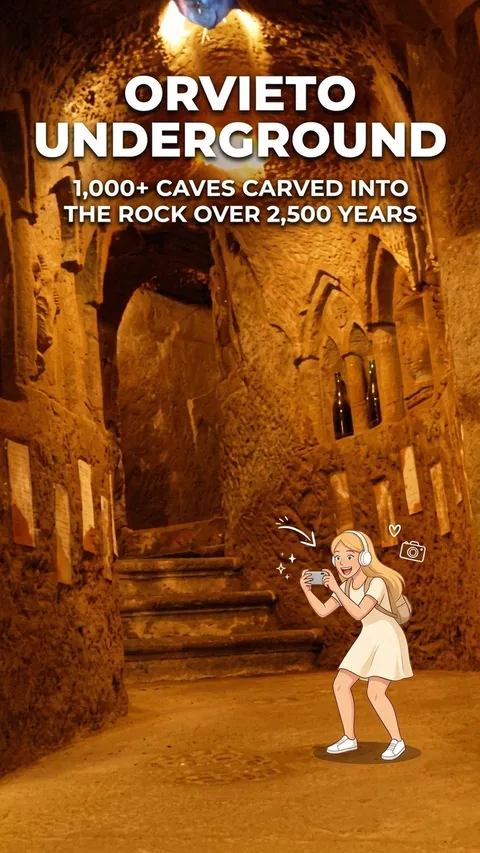
- Orvieto Underground (€8; guided tours daily ~10:30 a.m. to 12:30 p.m. and 3:30 to 5:30 p.m.): a honeycomb of 1,000+ caves, cisterns and dovecotes carved into the tufa over 2,500 years. Guided only, and worth it. Bring a layer, it is cool down there.
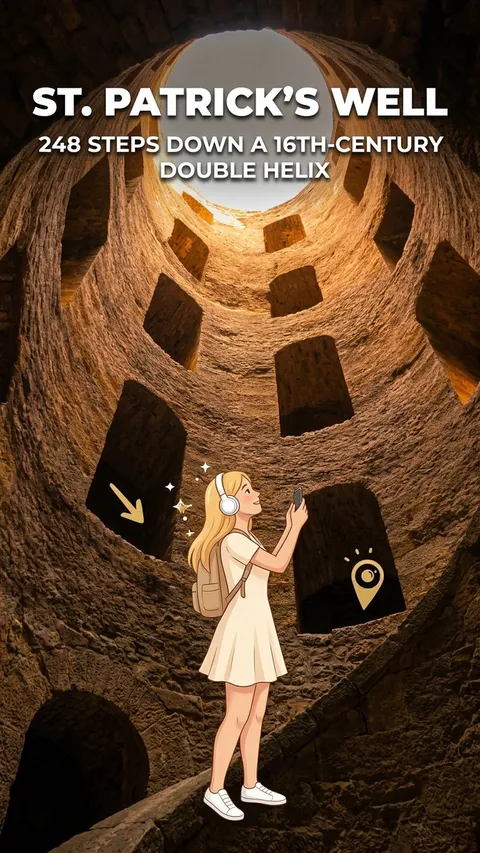
- St. Patrick's Well (€5; daily 9:00 a.m. to 7:30 p.m.): Sangallo's 1527 to 1537 double-helix well, 248 steps down and back up beside Piazza Cahen. A real climb, not a glance.
- Torre del Moro (€3.80; daily 10:00 a.m. to 6:00 p.m.): the central 12th-century civic tower with a lift partway and the best 360 panorama in town.
- Piazza del Duomo (free, open 24/7): the square that frames the cathedral facade, ringed by the Opera del Duomo, Faina and archaeological museums.
The route the tour walks with you
Instead of a generic "see the Duomo, then the caves" list, you walk one efficient line and the tour walks it with you. Because it can be launched from any of its stops, you never backtrack to find an official start, you just begin where you stand. This is the seven-stop order, starting at the fortress by the funicular and finishing in the quiet medieval quarter on the western lip of the rock:
- 1Rocca Albornoziana Free · your start
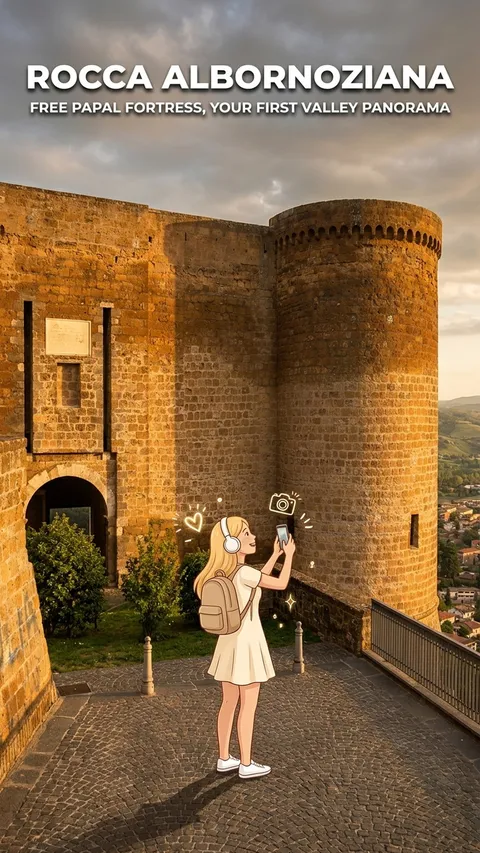
Step off the funicular at Piazza Cahen and the 14th-century papal fortress is right there. Most of the walls are gone, but the surviving tower and the gardens inside give you the first proper look at where you are: a town floating on a cliff above the Paglia valley. Free, open daily 8:00 a.m. to 4:30 p.m., maybe fifteen minutes. The warm-up, not the main event.
- 2Torre del Moro Climb · €3.80
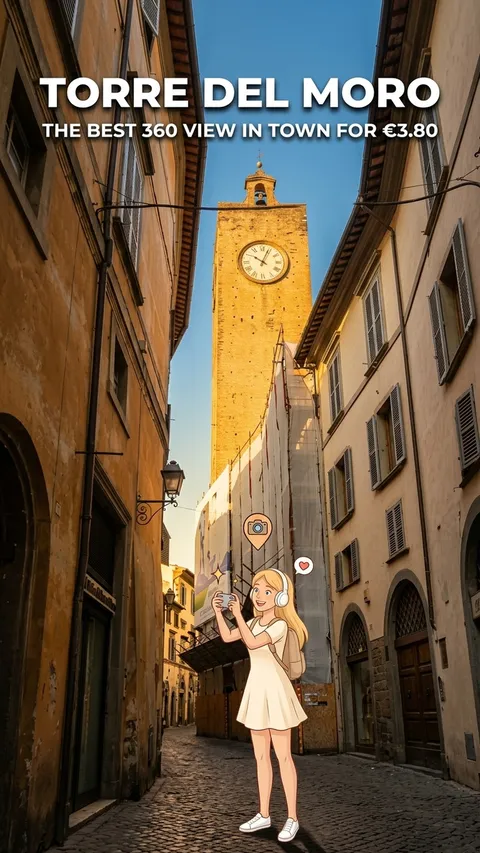
Corso Cavour runs straight and flat, lined with wine shops and ceramic windows, to the crossroads where this 12th-century civic tower marks the dead center of town. Climb it (a lift goes partway) for the best 360 view in Orvieto: the cathedral, the rooftops, and the valley falling away on every side.
- 3Piazza del Duomo Free
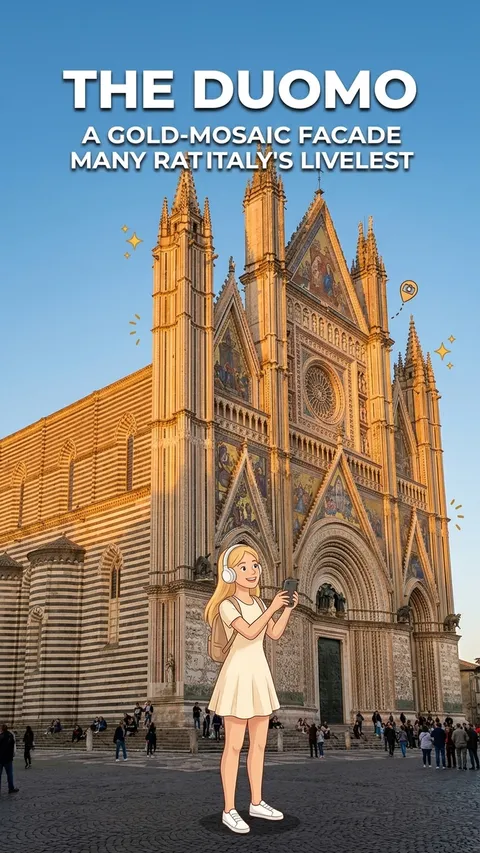
Turn the corner and the square hits you all at once, the cathedral facade filling the end of it in a wall of gold mosaic and carved marble. Free and never closed, ringed by museums. Stand here and take it in before you commit to any tickets.
- 4Orvieto Underground Guided · €8
A few steps from the square, an unassuming door leads down into the rock the whole town is built on. More than a thousand caves, cisterns, olive presses and dovecotes carved into the tufa over 2,500 years. You can only go down on a guided tour, and that is the point: the guide explains how Orvieto fed and watered itself through sieges.
- 5Orvieto Cathedral €8
Now go inside the building you have been staring at. Construction began in 1290; the Sienese architect Lorenzo Maitani shaped the facade. The prize is the San Brizio chapel, where Signorelli's end-of-the-world frescoes (1499 to 1504) are said to have been studied by Michelangelo. Give it a solid forty-five minutes.
- 6St. Patrick's Well €5
Back near Piazza Cahen is the strangest piece of engineering in town. Sangallo's double helix winds 53 meters down, two spiral staircases so that mules carrying water never crossed paths. You walk all 248 steps down to the water and back up. A workout, and genuinely memorable.
- 7Church of San Giovenale Free
The streets narrow and the crowds thin as you reach the western lip of the rock. Consecrated in 1004, this is the oldest church in Orvieto, plain Romanesque stone layered with faded medieval frescoes, often empty. The calm end of the route, with a cliff-edge view back over the valley you saw from the fortress.
It runs in your browser, no app and no download. A voice guide walks the loop with you and leads a real conversation as you go: it greets you, tells the story between stops, asks what you actually want to see, and adapts. It is not a recording and not an audioguide. The map and step-by-step navigation get you from each stop to the next.
That whole loop is our free, self-guided Orvieto walking tour, and because it can be launched from any of its stops, you do not backtrack to find a start, you just begin where you are. You open it the moment the funicular drops you at Piazza Cahen and enter the loop at the fortress. It runs in your browser, with no app and no download. A voice guide walks the route with you and leads a real conversation as you go: it greets you, tells the story between stops, asks what you actually want to see, and adapts to your answers. It is not a recording and not an audioguide. The map and step-by-step navigation get you from the Rocca to the Duomo to San Giovenale without staring at Google Maps. See the full route on the Orvieto walking tour page, and you get 100 free credits to try it.
Insider Tips for the Orvieto Day Trip
The single biggest rookie move on this route is overthinking the logistics. There is no booking puzzle and no transfer drama: a regional train and a €1.30 cable car, and you are on top of the rock. After that, the mistakes are about timing and footing.
Do
- Take a morning regional train; the fare is fixed, so no need to pre-book
- Buy a return funicular ticket (€2.60); it covers the shuttle to the Duomo
- Hit the underground caves and Duomo first; they are slower and time-bound
- Climb Torre del Moro for the best panorama on the rock
- Order a glass of Orvieto Classico, the crisp local white, with lunch
- Dress modestly for the Duomo (shoulders and knees covered)
Don't
- Don't drive in; the center is a ZTL with camera fines. Park at Campo della Fiera if you must
- Don't take the FlixBus; it is slower and leaves you below the cliff
- Don't arrive at 4 p.m. expecting to fit both the caves and the cathedral
- Don't skip the well over a few steps; the 248 are the point
- Don't eat on Piazza del Duomo without checking the view premium first
- Don't rely on the very last train; aim for an earlier evening departure
Wear shoes with grip. The streets are basalt cobbles, and the tufa underground plus the well's 248 steps and the tower stairs are all real climbs, not gentle ramps. Public restrooms are scarce on the rock, so use the facilities at the funicular station in Piazza Cahen before you start.
More day trips from Rome
Out in the morning, back in time for dinner. Every route here fits in one full day.

What the Rome to Orvieto Journey Feels Like
This is the part no timetable can give you. Orvieto is the kind of place people come back from genuinely moved, and the texture of the day is half the point: the slow climb up the cliff in the funicular, the gold facade ambushing you at the end of a narrow lane, the cool dark of the caves under your feet. Even from the valley floor, looking up at the walled town stacked on its tufa rock, the place is distinctive and a little breathtaking before you have climbed a single step.
The Duomo is the moment most people do not expect, even the ones who think they are tired of Italian churches. Its front is arguably the liveliest facade in Italy, a wall of gold mosaic and carved marble that has stood for nearly 800 years and still stops people mid-stride when the afternoon light catches it.
And the train itself is the quiet luxury of this trip. No planning, no traffic, no white-knuckle drive: just an hour up the Tiber valley, then a two-minute lift onto the rock. It is the easiest you will ever feel arriving somewhere this dramatic.
Rome to Orvieto: Your Questions Answered
Can you do Orvieto as a day trip from Rome?
Yes, easily. The direct regional train is about 1h15 each way, runs roughly hourly, and drops you a two-minute funicular ride from the old town. With a morning train you get the Duomo, the underground caves, St. Patrick's Well, and the tower comfortably in a day. Just know that many visitors wish they had stayed the night.
How long is the train from Rome to Orvieto?
About 1 hour 5 minutes to 1 hour 15 minutes on a direct regional train, a touch less on the occasional Intercity. It runs up the main Rome to Florence line, so the route is fast and straightforward.
How much does the train cost?
The Trenitalia Regionale fare is fixed at roughly €10 one way, the same whenever you buy it. Intercity advance fares can run from about €6 to €15 with a seat reservation. The funicular up to the old town is an extra €1.30 single, €2.60 return.
Is the train direct, and which Rome station?
Many regional trains are direct, with the rest needing at most one easy change. They leave from Roma Termini, and most also stop at Roma Tiburtina and Roma Ostiense, so use whichever station is closest to you.
Do I need to book the train in advance?
No, not for the regional train. The Regionale fare is fixed, so just turn up and go, and validate a paper ticket before boarding. Only book ahead if you specifically want a faster, reservation-based Intercity, which can also be cheaper if booked early.
What is the funicular and do I need it?
Orvieto's station sits in the valley, and the funicular is the cable car that climbs the cliff to the old town in about two minutes. It is right across from the rail platforms, runs every ~10 minutes, costs €1.30 single or €2.60 return, and the ticket includes the shuttle bus from Piazza Cahen to Piazza del Duomo.
What should I not miss in one day?
Orvieto Cathedral and its Signorelli frescoes, the guided Orvieto Underground caves, St. Patrick's Well, and the panorama from Torre del Moro. They sit within a ten-minute walk of each other, so a focused day covers them. Book nothing in advance; just start with the time-bound caves and cathedral.
Should I drive instead?
Only if Orvieto is one stop on a wider Umbria road trip. For a straight day trip from Rome, the train wins easily: the historic center is a ZTL with camera-enforced fines, and you would have to park below at Campo della Fiera and ride up anyway.
When is the best time to visit?
Spring (April to June) and fall (September to October) for mild weather and thinner crowds. Summer is hot but manageable because so much of the best of Orvieto, the caves, the cathedral, the museums, is cool and indoors.
Plan Your Orvieto Day Trip
The train is the whole logistics puzzle, and you have it sorted. Now make the hours on the rock count with our free, self-guided Orvieto walking tour: open it the moment the funicular drops you at Piazza Cahen and start the seven-stop loop right at the Rocca Albornoziana. It runs in your browser with 100 free credits, no app and no download. See the full route on the Orvieto walking tour page.
