
Rome to Siena Day Trip: The Bus Done Right
The direct intercity bus from Roma Tiburtina puts you in the centre of Siena in about 2h40, with fares from roughly €6 if you book early. Here is the honest day plan, plus a free, self-guided walking tour that takes the planning off your hands the moment you step off the coach.
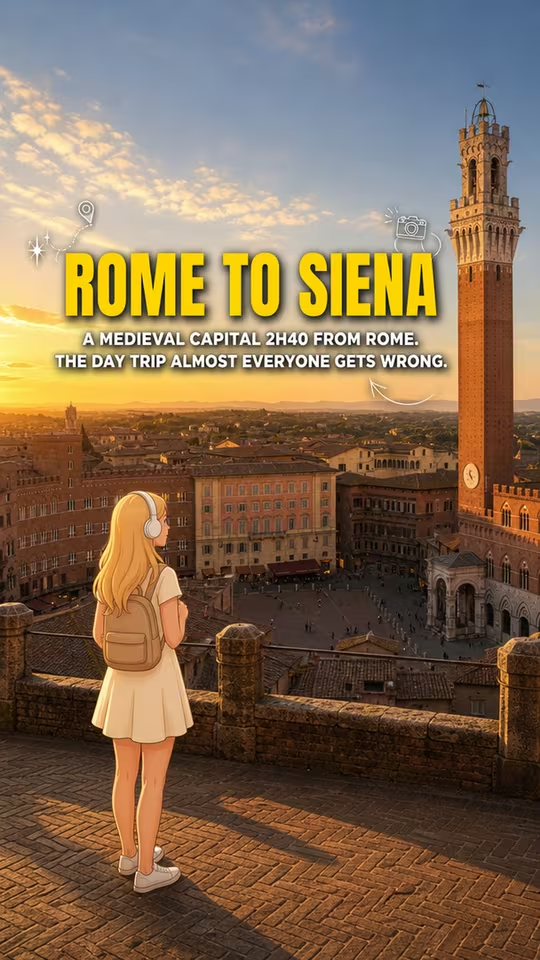
The Quick Answer: Rome to Siena
The best way from Rome to Siena for a day trip is the direct intercity bus from Roma Tiburtina, and it is not a close call. Coaches run by FlixBus, Itabus and Tiemme cover the ~230 km run north to Siena in about 2h40 direct, leave multiple times a day (FlixBus roughly every three hours), and start around €6 to €8 if you book early, rising to €20 to €32 on busy days. The decisive detail is the arrival: where the train strands you at Siena's hill-bottom station a 25- to 30-minute uphill walk from the centre, the bus drops you at Piazza Antonio Gramsci, inside the old town walls, five flat minutes from Piazza del Campo. You step off and you are already there.
| Question | Answer |
|---|---|
| Fastest journey time | ~2h39 direct (FlixBus). Some services up to 3h15 |
| Frequency | Multiple daily; FlixBus roughly every 3 hours, plus Itabus, Tiemme, MarinoBus |
| Price from | €5.99 (Itabus promo) to ~€8.50 early FlixBus; typically €13 to €32 walk-up |
| Operators / how | FlixBus, Itabus, Tiemme, MarinoBus from Roma Tiburtina (some FlixBus also from Termini) |
| Arrival point | Piazza Antonio Gramsci (or Siena FS station), inside the old town walls |
| Worth it as a day trip? | Yes, with realistic expectations. Compact medieval centre, real Tuscan atmosphere, ~8 useful hours on the ground |
Is the Rome to Siena Day Trip Worth It?
The honest verdict: yes, Siena is worth a day from Rome, and yes, you will wish you had stayed the night. Both are true at once.
The best of Siena, stop by stop


The "absolutely go" case is that Siena is the medieval counterweight to Rome's ancient chaos. Where Rome sprawls, Siena fits on three ridges of red brick you can cross on foot in twenty minutes. The whole historic centre is a UNESCO World Heritage Site, and on a quiet morning the brick lanes, contrada flags and the sudden drop into the shell-shaped Campo feel like stepping back four centuries without trying. The bus makes it genuinely affordable and the centre is small enough that one long day delivers the headline sights without rushing.
A walkable medieval capital, an iconic main square, and a bus that drops you flat in the centre. The effort-to-reward ratio is hard to beat from Rome.
The "give it more time" case is the transit. Three hours each way is real time on a coach, and Siena after dark, when the day-trip buses have gone and the contrada lanterns come on, is the version the day-tripper never sees. Siena also makes a superb base for southern Tuscany, the Val d'Orcia, Pienza, Montalcino, if you stayed over.
If you want the slow dinner, the empty lanes after the coaches leave, and the morning Campo before the crowds, stay the night instead.
Our call: if a day is what you have, take it. Siena's two great poles, the civic one (Campo, Palazzo Pubblico, Torre del Mangia) and the religious one (Duomo, Baptistery, Santa Maria della Scala), sit five minutes apart and the route between them is under 1.5 km of actual walking. One focused day delivers both. Just do not try to bolt on San Gimignano too, that is eight hours on a bus and the forum regulars are right to warn against it.
Good fit if you...
- Have a free day in Rome and can catch a morning coach
- Want a walkable, hill-town Tuscan counterpoint to Rome's scale
- Are happy with the highlights: Campo, Duomo, one climb, lunch
- Are travelling on a budget (this is one of the cheapest day trips from Rome)
Skip it (stay overnight, or pick a closer trip) if you...
- Only have two or three days in Rome total, spend them in Rome
- Want to combine Siena with San Gimignano or Chianti in a single day
- Are already doing Florence, Siena is much easier as a Florence day trip (~1h30)
- Hate long bus rides, pick Orvieto (~1h15 by direct train) instead
How to Get from Rome to Siena by Bus or Train
You can get from Rome to Siena four realistic ways. The bus wins for day-trippers without a car, and it wins for a single blunt reason: it drops you in the centre, where every other mode drops you at the edge.

| Mode | Time | Price | Verdict |
|---|---|---|---|
| Direct intercity bus (FlixBus / Itabus / Tiemme) | ~2h40 direct | from €6 to €8 advance, typically €13 to €32 | WINNER. Direct, cheap, drops you inside the walls at Piazza Gramsci |
| Train via Chiusi (Regionale + Regionale) | ~2h55 to 3h10 with transfer | €16 to €40 each way | Faster than it looks on paper, but a transfer and a 25 min uphill walk at the end |
| Train via Florence (Frecciarossa + Regionale) | ~3h20 to 4h with transfer | €21 to €41 each way | Geographically backtracking. Florence is north of Siena. Skip |
| Car (A1 + raccordo) | ~2h25 to 2h45 | fuel + ~€15 tolls + parking | Fastest on paper. Siena's ZTL and parking make it a headache for a day trip |
The reason the bus wins is the last kilometre. Siena's train station sits in the valley below the old town, and the walk up to the centre is 2 km, ~25 to 30 minutes uphill, or a €10 taxi. The bus rolls in on the autostrada, pulls into Piazza Antonio Gramsci (or in some cases the FS station forecourt), and you step out inside the walls, on the same level as the Campo. For a day-tripper counting hours, that single fact is worth more than any timetable difference.

The Bus in Detail
The workhorse operators on this route are FlixBus, Itabus, Tiemme, MarinoBus and Sena. They all serve the same Rome to Siena corridor, with slightly different stops and pricing, but the practical experience is similar: a modern intercity coach, air-conditioning, a dedicated luggage hold, and one straight run up the A1 autostrada and the Siena raccordo.
Where you board in Rome. The main hub is Roma Tiburtina bus station, at Largo Guido Mazzoni, right next to Roma Tiburtina train station (Metro line B). Some FlixBus departures also pick up at Roma Termini, on Via Marsala, handy if your hotel is near the main station. Check the boarding point on your ticket, because the two stops are a 10-minute Metro ride apart.
Where you arrive in Siena. Most coaches pull into Piazza Antonio Gramsci, a square inside the old town walls roughly 600 m, an easy flat walk, from Piazza del Campo. A few services call at the Siena FS railway station forecourt instead, which is just outside the walls on the valley side. From Gramsci you are already there; from FS, follow the escalators or the steep lane up to the centre (about 15 minutes on foot).
FlixBus or Itabus, which to book?
| Operator | Fares | Frequency | Luggage | Verdict |
|---|---|---|---|---|
| FlixBus | from ~€8.50 early, €15 to €32 walk-up | Up to 11 daily, roughly every 3h | 1 carry-on + 1 hold bag included | WINNER. Most departures, reliable, easy app |
| Itabus | from €5.99 promo, often €10 to €20 | Multiple daily | 1 carry-on + 1 hold bag included | Cheapest floor fare. Book early for the promo seats |
| Tiemme / MarinoBus | ~€13 to €20 | A few daily, incl. late-night | Varies | Local fallback. Useful if FlixBus is sold out |
The honest move is to compare on the day you travel. FlixBus publishes the timetable cleanly and has the most departures, so it is the default. Itabus occasionally drops to €5.99 promo, which is almost too cheap to believe, but those fares go early. Tiemme and MarinoBus are worth searching when the others are full on a summer Friday.
Booking Strategy
Bus pricing, like airlines, is dynamic: cheap early, expensive on the day. A few moves make a real difference.
Book one to three weeks ahead for the promo fares. Itabus's €5.99 seats and FlixBus's €8.50 seats exist, but they vanish first. If your travel date is fixed, lock the outbound and return together.
Avoid walk-up on Fridays and summer weekends. This is when fares jump to €25 to €32 and seats sell out. Sunday buses back to Rome also fill, especially the evening departures.
Mind the Sunday schedule. Service frequency drops on Sundays and Italian public holidays, sometimes sharply. If you can only travel on a Sunday, check the live timetables on the FlixBus and Itabus sites before committing to an itinerary.
Validate nothing, but keep the QR code handy. Long-distance coaches in Italy do not need a platform validation stamp the way regional trains do. Your ticket is the QR code in the app or printed. Have it out when you board.
Booking checklist
- Pick your operator on the travel date: FlixBus for frequency, Itabus for the promo floor, Tiemme/MarinoBus as fallback.
- Book outbound and return together to lock both fares (around 7:30 to 8:00 a.m. out, 19:00 to 21:00 back).
- Confirm the Rome boarding point: Tiburtina (most) or Termini (some FlixBus).
- Confirm the Siena arrival point: Piazza Gramsci (best) or FS station.
- Keep the QR code ready on your phone, screenshot it in case signal drops on the road.
Siena in One Day
Here is the part most day-trip guides bury, and it is the whole point: you do not need to plan a route. You step off the coach at Piazza Gramsci, walk five flat minutes to Piazza del Campo, and open our free self-guided Siena tour right there. It runs in your browser, no app, no download, and a voice guide walks the whole route with you, stop by stop, leading a real conversation as you go. No map-squinting, no wondering which way the Duomo is. The town is small, the route is logical, and the guide takes the planning off your hands so the climb from the Campo to the cathedral ridge becomes the day itself rather than a logistics puzzle.

The time math
Catch a coach around 7:00 to 8:00 a.m. from Tiburtina and you are stepping into Piazza del Campo by 10:00 a.m., before the day-trip coaches from Florence unload. The last FlixBus back to Rome typically leaves Siena between 19:00 and 21:45 depending on the season (the absolute last train via Chiusi rolls into Roma Termini around 23:00). That gives you roughly eight useful hours on the ground, or five to six once you subtract lunch, queues and a sit-down. Lock in the two time-bound things first, the Torre del Mangia ticket (in-person only, slots sell out) and the Duomo, then let yourself drift through the lanes.
What you'll see
Here is what a day-tripper should not miss, with the practical reality attached:
- Piazza del Campo (free, open 24/7): the shell-shaped, fan-paved main square and the heart of the Palio. Sit on the brick, get your bearings, watch the contrada flags. The whole space tilts toward the town hall.
- Palazzo Pubblico + Civic Museum (€9; daily 10:00 to 18:00): the Gothic town hall, with Ambrogio Lorenzetti's Allegory of Good and Bad Government frescoes, possibly the most important secular painting of the 14th century.
- Torre del Mangia (€10; daily 10:00 to 18:00, timed slots, in-person only): the 88 m civic tower, ~300 steps up a tight spiral. Best aerial view of the Campo's shell shape. Slots are capped, go straight there when you arrive.
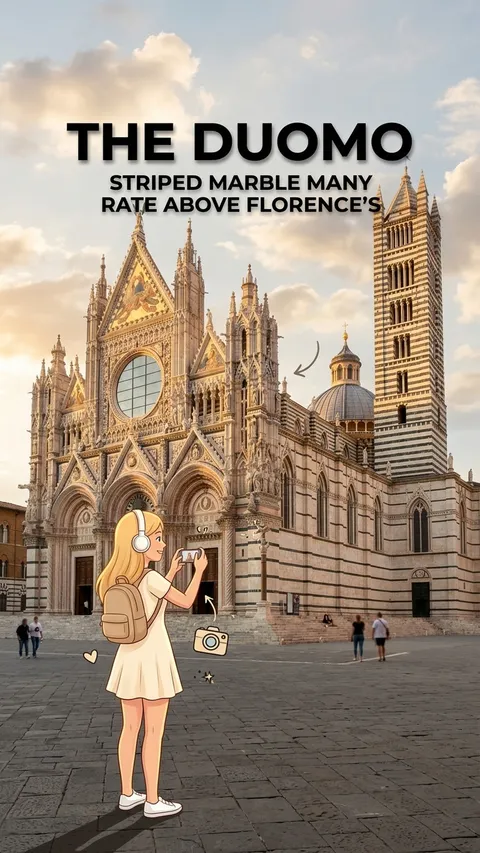
- Siena Cathedral (€5 floor-only, €21 full OPA Si Pass; daily 10:00 to 19:00): black-and-white striped marble, the inlaid marble floor, the Piccolomini Library. The full pass also covers the Facciatone, Baptistery and cathedral museum.
- Facciatone (€6 via OPA Si Pass; daily 10:00 to 17:30): the wall of the abandoned Duomo Nuovo. The best rooftop panorama in Siena, level with the cathedral itself.
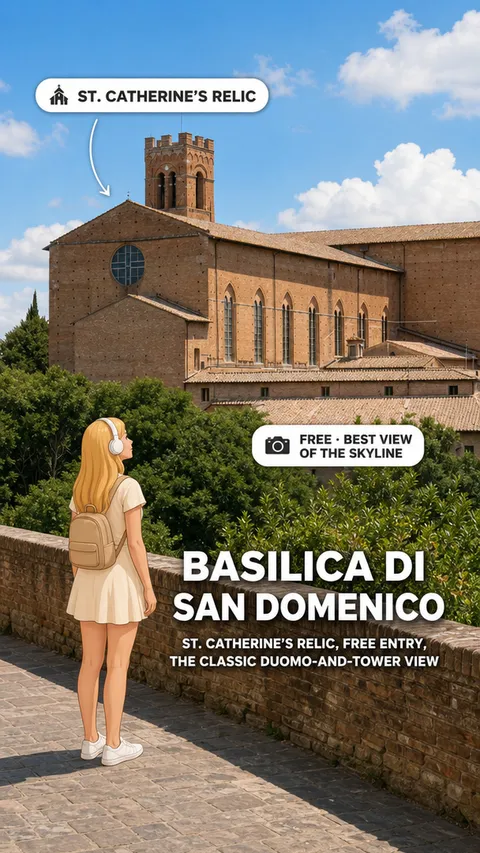
- Basilica of San Domenico (free; Mon to Sat 7:30 to 18:30, Sun from 8:45): vast 13th-century brick basilica holding the head-relic of St. Catherine, and the best long view back to the Duomo and the tower.
The route the tour walks with you
Instead of a generic "see the Campo, then the Duomo" list, you walk one efficient line from the lowest point of the town up to the cathedral ridge, and the tour walks it with you. Because it can be launched from any of its stops, you never backtrack to find an official start, you just begin where you stand. This is the nine-stop order, starting at the Campo and finishing on the quiet ridge at San Domenico:
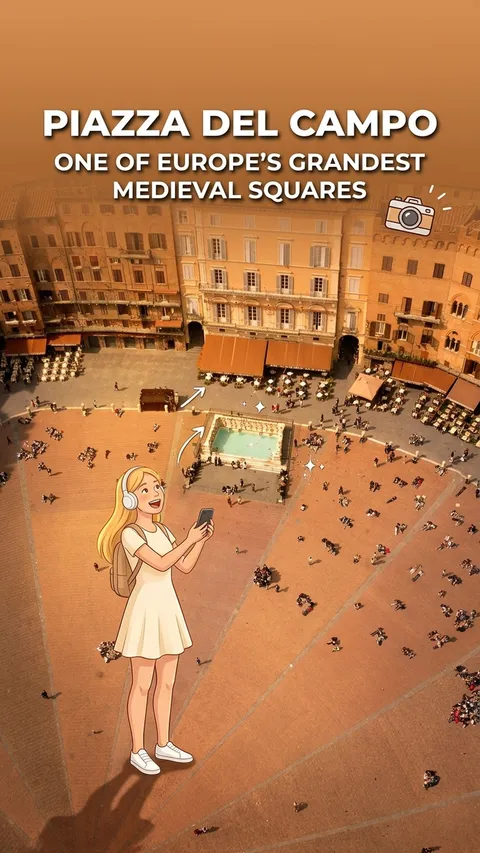
- 1Piazza del Campo Free · your start
The shell-shaped, fan-paved main square and the heart of the Palio. Nine paved segments slope toward the Palazzo Pubblico like the inside of a shell. Sit on the brick (it is allowed), get your bearings, note how the whole space tilts toward the town hall. Open 24/7, free.
- 2Palazzo Pubblico €9 Civic Museum
The Gothic town hall that closes off the bottom of the Campo, brick below and white stone above. The reason to go inside is the Civic Museum, specifically Ambrogio Lorenzetti's Allegory of Good and Bad Government, one of the most important secular frescoes of the 14th century. Budget 45 minutes.
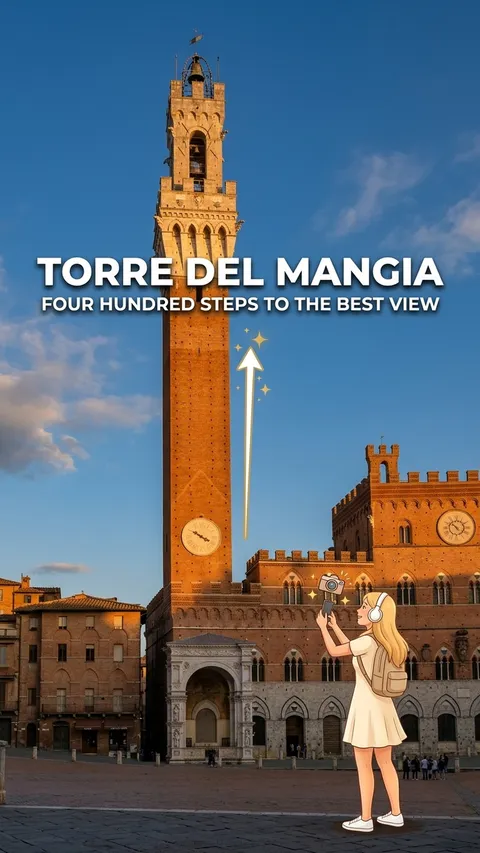
- 3Torre del Mangia €10 · timed
The slender 88 m civic tower rising out of the Palazzo Pubblico, deliberately built to match the cathedral campanile, the symbolism being that civic and church power should balance. ~300 steps up a tight spiral. Best aerial view of the Campo's shell. Slots are capped, in-person only, go first thing.
- 4Piazza del Mercato Free
Duck around the back of the Palazzo Pubblico and the crowds thin. A broad terrace opens onto the green valley below, with the old wash-houses down the slope. Your breather between the civic cluster and the cathedral cluster. Lean on the railing and look back up at the tower you just photographed from below.
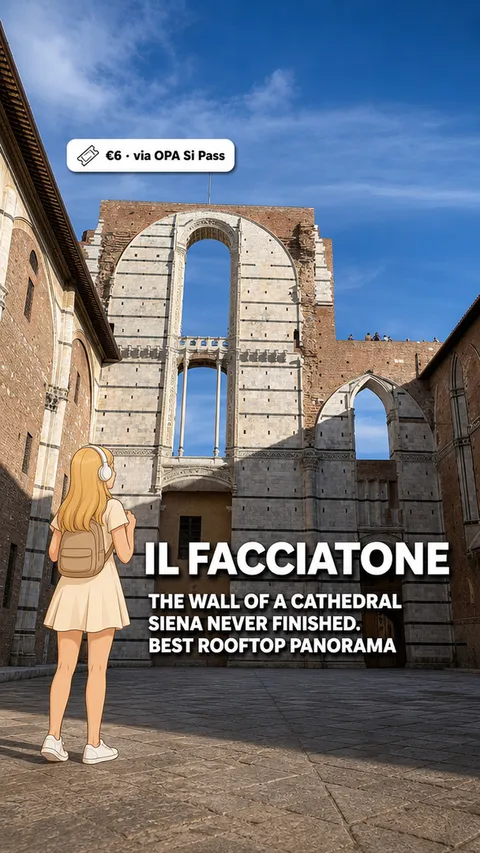
- 5Facciatone €6 via OPA Si Pass
The wall of the colossal Duomo Nuovo that Siena started in the 1300s and abandoned after the Black Death of 1348. Climb a narrow internal staircase to a terrace level with the cathedral, arguably the best rooftop panorama in town. The final stretch is a cramped spiral with a metal walkway at the top.
- 6Santa Maria della Scala €9
Directly facing the cathedral across Piazza del Duomo, a thousand-year-old hospital turned museum complex. The highlight is the Pellegrinaio, the old pilgrims' ward, covered in the most important 15th-century Sienese secular fresco cycle. Underrated, far less crowded than the Duomo opposite.
- 7Siena Cathedral €5 / €21 pass
Black and white striped marble, a facade crusted with sculpture, and underneath your feet the famous inlaid marble floor, dozens of panels worked over centuries. Do not miss the Piccolomini Library off the left aisle, with brilliantly preserved frescoes by Pinturicchio. The two interiors never to skip in Siena are this and the Civic Museum.
- 8Baptistery of San Giovanni €4
Wedged directly beneath the cathedral choir, a single richly painted Gothic room with a Renaissance baptismal font carrying bronze panels by Donatello and Ghiberti. The cheapest of the cathedral-complex sites, 15 to 20 minutes covers it. Already included if you bought the OPA Si Pass.
- 9Basilica of San Domenico Free
The walk ends at a great barn of red brick on the northwest ridge, the spiritual home of St. Catherine of Siena. Her preserved head is kept here as a relic in a Renaissance chapel frescoed by Sodoma. Vast, austere, usually quiet. The real bonus is the terrace outside: the best long view back across the valley to the striped Duomo and the Torre del Mangia lined up against the sky.
It runs in your browser, no app and no download. A voice guide walks the loop with you and leads a real conversation as you go: it greets you, tells the story between stops, asks what you actually want to see, and adapts. It is not a recording and not an audioguide. The map and step-by-step navigation get you from each stop to the next.
That whole loop is our free, self-guided Siena walking tour, and because it can be launched from any of its stops, you do not backtrack to find a start, you just begin where you are. You open it the moment you step off the coach at Piazza Gramsci and enter the loop at the Campo. It runs in your browser, with no app and no download. A voice guide walks the route with you and leads a real conversation as you go: it greets you, tells the story between stops, asks what you actually want to see, and adapts to your answers. It is not a recording and not an audioguide. The map and step-by-step navigation get you from the Campo to the Duomo to San Domenico without staring at Google Maps. See the full route on the Siena walking tour page, and you get 100 free credits to try it.
Insider Tips for the Siena Day Trip
The single biggest rookie move on this route is taking the train. The station is downhill, the walk up is long and steep, and you have burned an hour of your day before you have seen anything. The second biggest move is over-planning the centre, which is small and which the tour above already walks for you.
Do
- Take the direct bus from Tiburtina, not the train. The arrival point decides it
- Go straight to the Torre del Mangia ticket office on arrival. Slots sell out, in-person only
- Buy Duomo tickets online ahead of the day. The OPA Si Pass bundles the Facciatone and Baptistery
- Wear shoes with grip. The whole town is medieval brick on a slope, slick when wet
- Eat on the side streets, not on the Campo. One block away, better food, better prices
- Order pici al ragù di cinghiale (wild boar) and a glass of local Sangiovese with lunch
Don't
- Don't try to combine Siena with San Gimignano in one day from Rome. That is eight hours on buses
- Don't take the train via Florence. Florence is north of Siena, you are backtracking
- Don't drive into the historic centre. Siena's ZTL is camera-enforced, the fines arrive months later
- Don't eat on Piazza del Campo if you care about the bill. The view premium is real
- Don't plan the last bus to the minute. Service thins on Sundays and public holidays
Avoid the Palio dates, July 2 and August 16, unless you are specifically there for the race. Accommodation prices in the region skyrocket, the city is packed, and a day-trip bus ticket becomes much harder to score at the last minute.
More day trips from Rome
Out in the morning, back in time for dinner. Every route here fits in one full day.
What the Rome to Siena Journey Feels Like
This is the part no timetable can give you. Siena hits most people harder than they expect. Three hours out of Rome on a coach and you are standing on a tilted brick square that has barely changed in seven centuries, contrada flags overhead, the slim tower of the Palazzo Pubblico climbing out of the lower edge of the Campo, and the whole space sloping toward the town hall as if the square itself were leaning in to listen.
The medieval time-capsule thing is real. Siena was Florence's great rival until the Black Death of 1348 broke the republic, and after that the city essentially stopped growing, which is why the centre still reads as a complete 13th- and 14th-century place. The streets are narrow, the brick is weathered, the contrada insignia (Eagle, Unicorn, Caterpillar, Seashell) are painted on the walls, and there is barely a flat street in town. You are always climbing or dropping, always on cobblestones. Comfortable shoes are not optional.
And the bus itself is the quiet luxury of this trip. No transfers, no white-knuckle drive through Tuscany, no ZTL fines. You sit on a coach for two hours forty, the autostrada runs north, the countryside slowly turns into the Sienese hills, and then the bus pulls into Piazza Gramsci and you step out already inside the walls. It is the easiest arrival you will ever have in a town this dramatic.
Rome to Siena: Your Questions Answered
Can you do Siena as a day trip from Rome?
Yes. The direct intercity bus from Roma Tiburtina takes about 2h40, runs multiple times a day, and drops you at Piazza Gramsci inside the old town walls. With a 7:00 or 8:00 a.m. departure you get roughly eight useful hours in the centre, which is enough for the Campo, one climb (Torre del Mangia or Facciatone), the Duomo and a proper lunch.
How long is the bus from Rome to Siena?
About 2h39 to 3h15 direct, depending on the operator and traffic. FlixBus is the most frequent, with up to 11 daily departures roughly every three hours. Itabus, Tiemme and MarinoBus run alongside.
How much does the bus cost?
Fares start around €5.99 (Itabus promo, book early), with FlixBus from about €8.50 in advance. Walk-up and last-minute fares on busy days run €20 to €32. Book one to three weeks ahead for the cheap seats.
Where does the bus leave from in Rome?
Most operators leave from Roma Tiburtina bus station, Largo Guido Mazzoni, next to Tiburtina train station (Metro line B). Some FlixBus services also pick up at Roma Termini, on Via Marsala. Check your ticket for the exact boarding point.
Where does the bus drop me in Siena?
Most services arrive at Piazza Antonio Gramsci, a square inside the old town walls roughly a five-minute flat walk to Piazza del Campo. A few call at the Siena FS railway station forecourt instead, just outside the walls on the valley side.
Bus or train from Rome to Siena?
For a day trip, the bus. Siena's train station sits in the valley below the centre, a 2 km, 25 to 30 minute uphill walk or a €10 taxi. The bus drops you inside the walls, on the level. The train via Chiusi (about 2h55 with a transfer) is a real option if you specifically prefer rail, but it adds a connection and the climb at the end.
Do I need to book the bus in advance?
Yes, for the best fares. Itabus and FlixBus both use dynamic pricing, the cheapest seats go first, and Fridays, summer weekends and Sunday returns sell out. Book outbound and return together, one to three weeks out.
Should I drive from Rome to Siena?
Only if Siena is one stop on a wider Tuscan road trip. For a straight day trip, the bus wins. The historic centre of Siena is a ZTL, a camera-enforced restricted traffic zone, and the wrong turn into it produces a fine that arrives months later. Parking is also a headache. Take the coach and skip the stress.
What should I not miss in one day?
Piazza del Campo, the Civic Museum's Lorenzetti frescoes in the Palazzo Pubblico, the Torre del Mangia climb, the Siena Cathedral floor and Piccolomini Library, and the Facciatone panorama. They sit within a ten-minute walk of each other. One focused day covers all five.
When is the best time to visit?
Spring (April to June) and early autumn (September to October) for mild weather and thinner crowds. Summer is hot and the unshaded Campo bakes at midday. Avoid the Palio dates, July 2 and August 16, unless you are there for the race itself.
Plan Your Siena Day Trip
The bus is the whole logistics puzzle, and you have it sorted. Now make the hours in the medieval capital count with our free, self-guided Siena walking tour: open it the moment you step off the coach at Piazza Gramsci and start the nine-stop loop right at the Campo. It runs in your browser with 100 free credits, no app and no download. See the full route on the Siena walking tour page.
